


 Apple Podcasts

 Spotify

 Castro

 RSS Feed
Why Rewards Backfire: How to Motivate Teens Without Bribes
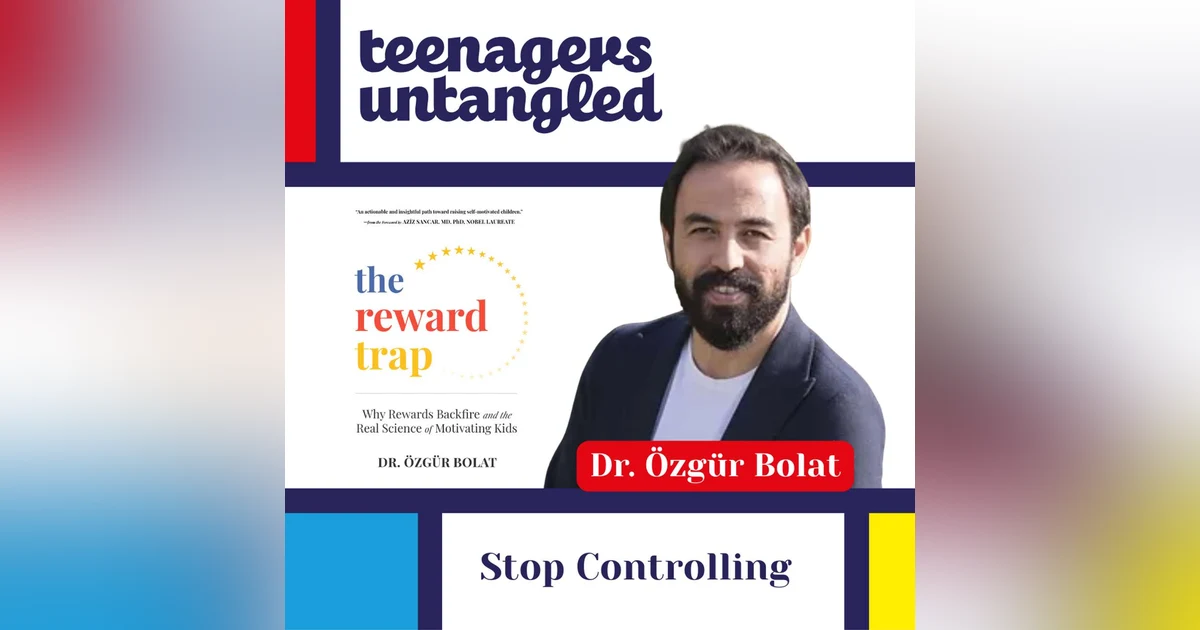

Ask Rachel anything What if the things we do to motivate our teenagers are doing the opposite? Most of us have done it. A tenner for a good exam result. An hour on the Xbox once the homework is done. A new phone if the grades come back right. It works, in the moment. But Dr Özgür Bolat thinks we are paying a much higher price than we realise. Özgür is an educational scientist with a master's from Harvard, a PhD from Cambridge and a visiting research post at MIT Sloan. He has advised Google, Y...
What if the things we do to motivate our teenagers are doing the opposite?
Most of us have done it. A tenner for a good exam result. An hour on the Xbox once the homework is done. A new phone if the grades come back right.
It works, in the moment. But Dr Özgür Bolat thinks we are paying a much higher price than we realise.
Özgür is an educational scientist with a master's from Harvard, a PhD from Cambridge and a visiting research post at MIT Sloan. He has advised Google, YouTube Kids and Unilever on child development. His book, The Reward Trap, draws on seven decades of research to show why gold stars, treats, praise and privileges so often backfire, and what to do instead.
His interest is personal. He was the textbook high achiever: 56th out of a million students in Turkey's national exam, a perfect GPA at Harvard, a Cambridge doctorate. Then he came home, with everything going right, and felt anxious. He realised his happiness depended on outside approval. He had to keep succeeding to feel OK. And when he asked himself why, the answer led back to how he was parented.
For a full explanation of the points made in the podcast click here
Dr Özgür Bolat -The Reward Trap
Please hit the follow button if you like the podcast, and share it with anyone who might benefit.
You can review us on Apple podcasts by going to the show page, scrolling down to the bottom where you can click on a star then you can leave your message.
Please don't hesitate to seek the advice of a specialist if you're not coping. There's no shame in reaching out for support. When you look after yourself your entire family benefits.
Find all the tips from the episode on Substack:
My email teenagersuntangled@gmail.com
My website has a blog, searchable episodes, and ways to contact me
00:00 - Do rewards backfire? Why parents’ motivation tactics fail
01:05 - Dr Özgür Bolat’s story: success, anxiety and external validation
03:15 - What is the reward trap? Compliance vs intrinsic motivation
04:51 - Why routines work for teens, and why connection makes them stick
06:00 - What counts as a reward? Conditional rewards and conditional love
07:34 - Rewards and punishments: two sides of the same coin
08:39 - How fear and rewards narrow focus and kill creativity
10:01 - Is praise harmful? The problem with “I’m proud of you”
12:42 - Seeing your child as an extension of yourself
14:04 - How to let go and let your teen walk their own path
15:40 - Status and respect vs praise for teenagers
16:28 - What to say instead of “well done”
18:30 - Parenting across cultures: UK, US and Turkey
20:03 - How to stop using rewards: homework and bedtime examples
22:45 - Connection over compliance with a strong-willed teen
23:26 - When rewards can work: trying something new
25:10 - Key takeaway: move from control to connection
Do rewards backfire? Why parents’ motivation tactics fail
SPEAKER_02What would you think if you were told the things we parents do to motivate our children are actually doing the opposite of what we intend, undermining their intrinsic motivation, damaging their self-esteem, and weakening our parent-child bond. Today we're going to be talking about rewards. And you're listening to Teenagers Untangle, the audio hug for parents going through the tween and teen years. I'm Rachel Richards, journalist, mother of one teenager now, three older girls, two of whom are bonus daughters. Our guest today is Dr. Uzgar Ballat. He's an educational scientist, a Fulbright scholar with a master's from Harvard, a PhD from Cambridge, and a visiting research position at MIT Sloan. Uzgar has also worked with Google, YouTube Kids and Unilever on child development, and he's written The Reward Trap, which draws on seven decades of research to show why Gold Stars treats, praise, and privileges can actually backfire. And the most important thing, what should we do instead?
unknownDr.
SPEAKER_02Bollard, thank you so much for joining us.
SPEAKER_01Thank you. Thank you for inviting me to be able to do that.
Dr Özgür Bolat’s story: success, anxiety and external validation
SPEAKER_02Now I'm always dated by the personal stories that led people to where they have ended up. Why did you decide that this was such an important topic that you wanted to write a book about it?
SPEAKER_01I was always successful in my academic life. I ranked 56th among one million students. I got in the best college in Turkey. Then I got the Fulbright Scholarship, studied at Harvard. I I had a perfect GPA, four out of four. Then I spent one year at MIT Salon as a visiting PhD student. Then I had my PhD from the University of Cambridge. I was very successful. Then I finished my PhD, came back to Turkey, and then all of a sudden I felt a little bit anxious. I said, like, why am I anxious now? Everything is perfect. I have the best work. Why am I anxious? Then I realized my happiness is externally validated. I had to be successful all the time to be happy. Then I realized I am an externally validated person. Then I ask myself, why am I like this? Then it goes back to parenting. Like if you keep rewarding your child, if you keep praising your child, in fact, you raise a child who's dependent on external motivation, external approval, uh, external validation. What we want is uh a child who is internally validated. Okay, who who does the right thing, not because he or she will be liked, but because it's the right thing to do. Uh they will work hard, not because to impress parents or others or to get validation. They will work hard to learn, to improve, and to contribute to the society. I did my own research and I have this book now to teach parents. Tell parents that you need to raise a child who is internally validated. So let's go to your book. What is the reward trap? Okay, you want your child to do something, and when you offer a reward, you see that things get done. You buy compliance. Okay? So it looks good, things get done. But what we want is not compliance, what we want is ownership,
What is the reward trap? Compliance vs intrinsic motivation
SPEAKER_01commitment, and engagement. So when you offer a reward, the child will do it, but at the same time, they will lose the real motivation to do it when the word is withdrawn. Because if a child is already motivated, if you offer a reward, uh the child thinks, okay, I like this. Now it's a means to something else, the value of the activity will decrease. So you have to keep offering reward all the time to make things get done. So you are in a trap now. What you need is get out of the cycle and not worry about result, not worry about consequence, not worry about compliance. We ask ourselves this question: why doesn't my child want to do homework, for instance? Why doesn't my child have interesting motivation to do homework? Why doesn't my child uh have the habit of tidying group? Why hasn't he always pleasant? Yeah. We do a lot of things which are unpleasant because it's part of our identity, it's part of our habit, part of our routine. So um we do a lot of things like this. We should have taught our kids to create this routine and to develop this habit. So yeah. In a trap, uh you get things done, but uh the motivation will get lost. You have to offer more rewards so that the child can do the same thing. You're in a trap.
Why routines work for teens, and why connection makes them stick
SPEAKER_02I love that. I love that you mentioned routine because we have actually talked about this quite recently and how incredibly powerful routines are for getting things done. And because when everybody knows what's going to happen and there's there's no discussion about it, it becomes just part of who we are. So that's fascinating. I'd like to just talk about rewards and say what do you mean by reward?
SPEAKER_01Uh let me talk about the routine first a little bit. Yes, please.
SPEAKER_02Yes.
SPEAKER_01Uh routines, like when you have a routine uh with your child, okay, things are predictable, this is perfect, but routine routines can be boring as well. So routines should be fun. So what is fun for a child? If the child does it uh with their mom or dad, if they connect with their parents while doing the routine, the fun is that connection.
SPEAKER_02So I love that.
SPEAKER_01So if you keep telling your child, like uh we have the routine, we have to do this, then there's no fun. You always say, let's do it now, and you connect. Relationship is the glue of the routine. So it's a very important uh aspect. So what
What counts as a reward? Conditional rewards and conditional love
SPEAKER_01is a reward? A reward is something offered to a child in return for something. It's conditional. So for instance, if I if I buy you a present and if I give it to you, it's not a reward. Okay, if you work and you get you get paid, it's not a reward. And you say, okay, I want I want a telephone and say, okay, I will buy it for you, or you pay 20%, I will pay the rest, it's not a word reward. But if I say if you get an A, I will buy you a telephone, it's a reward. So reward is always conditional. So I think my book is unique in terms of this. In the literature, almost always rewards are discussed in terms of motivation. I discuss it in terms of self-esteem and personality structure. For instance, let's say you say, hey mom, I need an iPad. And I say, okay, if you get all A's, I will buy you an iPad. And the child thinks, why doesn't she buy it for me just because she loves me? Why does she want something in return? So maybe she doesn't love me. So it's conditional love as well. And the child may lose self-esteem, and then the child may be approval seeking all the time. So for instance, you call your child and you say, Hey, I'm gonna be late a little bit. Can you warm up the food dinner? And the child says, Okay, I will do it for you, but what will you give me back instead? Like, and you say, Hey, come on, you are part of the family. And you say, No, it's not about being a part of the family, it's about transaction. You taught
Rewards and punishments: two sides of the same coin
SPEAKER_01me this. Yeah.
SPEAKER_02Yes, and we only have ourselves to blame when that happens. I absolutely can relate to that. Um, and I suppose you you've actually said that reward and punishment are pretty much two sides of the same coin. Yeah. Can you explain that thinking?
SPEAKER_01Yeah, it's the same thing. Okay, your child says, Okay, I want to play uh computer games. And I say, Okay, if you do your homework, you can play. Instead of word. And I will give you one hour of screen time instead of word. But it's the same thing. The implicit message: if you don't do it, you won't get it. So a reward is also a threat. You're threatening the child. So we don't want to use fear at home at all. Because when you use fear, the child will be scared to face the challenges in their lives. Okay, we want their mind to be limitless. We want them to think they can do anything if they want to. Okay, if you use fear, they will be scared uh to face challenges.
How fear and rewards narrow focus and kill creativity
SPEAKER_02Yes, it's interesting. When I've been reading about positive psychology and the four different negative emotions, that when you experience those, your ideas of how to fix things narrows down because you're just focused on that thing that you're experiencing. So if you're experiencing fear, you're only going to be focused on that and not looking around you for ways that you can grow and change. So it really narrows your focus, doesn't it?
SPEAKER_01Yes, there's great research I cited in my book. They are showing children numbers. And if you get some of them correct, like they say, okay, if you get 10 correct, we will give you a word. Okay, so what happens? You try to memorize, right? Those who were offered reward, of course, memorize more. Makes sense. You know, you focus, you memorize. And then the researcher asks these questions. Hey, you remember the numbers? They say, Yes. Did you notice that they were different colors? And tell me the colors of the letters now. And the rewarded group couldn't remember. But the other group remembered more. Why? Because they were learning and their awareness is expanded. With a reward, you're too focused and you lose everything. And also, there is research in my book. If you're too focused, you produce more, but you are less creative. Because creativity requires expanding your mind.
Is praise harmful? The problem with “I’m proud of you”
SPEAKER_02It's interesting, isn't it? Because my youngest said we didn't do enough to reward or praise one of my daughters when she got perfect grades. And because we we'd never use that as an incentive. Because part of it is that we've got very different children who are very differently capable academically. And I always looked at it and thought, how on earth would you even pass this? This is not something that is an easy thing to reward. But even praise, how do you view praise? Just saying, Oh, I'm so proud of you, this is so great.
SPEAKER_01So um it's in my it is in my next book. When you say I am proud of you, and the child might be happy. But and then what if he fails? And he will think, if my mom is proud of me when I am successful, what will my mom feel or think when I fail? So most of the kids think that their parents will feel shame. So it's it and it um puts extra pressure and they avoid challenges most of the time. I'm not saying it it it happens, but there's research done by Carol Dweck as well, and uh you know, uh growth mindset, uh, she found the same thing. And then so uh being proud of a child and saying it uh is made uh might make the child feel they have to succeed all the time. And I have a personal story. I tell this in my uh workshop, and he notes I was a successful student, and everybody was proud of me and everything. So I went to dinner, there was a guy, and he said, Hey, do you remember me? We are from the same town. I said, sorry, I couldn't remember you. And then he turned to other people, he said, uh Uzger is from our town. We grew up in the same town, uh, we are all proud of him. Okay, and then he said, Oh, his brother. We love him, but we are proud of Uzgar. He was like, I said, okay, why does he love him? Why doesn't he love me? Why is because he sees my success as part of their own identity as well, you know? They see me as an extension of their own identity. So they're using my name in a way to make feel good about themselves. And so, and it's about we we love uh his brother, you know, because they they connect. So it's more important to be loved, I think, uh to make uh parents proud.
Seeing your child as an extension of yourself
SPEAKER_02It sounds like you're implying that we see our kids as an extension of our own abilities and our the our pride in our children is is almost a kind of justification for ourselves. Do you see this much?
SPEAKER_01There's research uh as well. Um some parents do that, some parents don't do that, and they there's a way to there's a way to measure this. There's a scale, they put two circles, okay? So circle one, they're together, circle seven, they're separate, and they ask which one reflects your relationship with your child. If you choose one, it means you're totally seeing your child as the extension of yourself. If you choose seven, it means you see your child as an individual person. So like parents differ in their views, yeah. And the more you see your child as an extension of yourself, you will be more controlling. I did this research myself in Turkey, it's in the book. I use you are more likely to see your child as uh sorry, if you see your child as an extension of yourself, you are more likely to control, you're more likely to praise, yeah, you are more likely to offer rewards, and you are more likely to punish. And this has proved my argument that praising and rewarding as a form of control supports some parents. Yeah.
How to let go and let your teen walk their own path
SPEAKER_02That is so interesting, isn't it? And what it implies is that for us parents, that's the first portal call. How closely do we identify ourselves with our child? But how do we shift from that? Because of course, the most important thing is unconditional love. How do we shift from the fact that we we fully identify with our child to that differentiation that has to happen at some point during these teenage years?
SPEAKER_01Okay. So for instance, you have your own issues. Maybe you have trauma. Yeah. For instance, you say, man shouldn't be trusted, or woman shouldn't be trusted. Then you say, Okay, I have to teach this to my kid so that she feels safe so she doesn't trust men. Why are you doing this? Because you want to protect your child. So in that case, you are believing your your mindset, your thought is absolute true, absolute truth. Okay, but you you should say, okay, this is my thought, this is what I believe. But the life of my child might be different. So uh he or she will walk their own path. I have walked my own path rather than imposing my path, let me help my child choose their own path. So you separate and you look at your child and say, like, okay, what is my child's story? What does he want to do? What is her strength? What's her fear? And let me help her. And yeah, you detach yourself.
Status and respect vs praise for teenagers
SPEAKER_02That's exactly what I use as my mantra on the podcast is fearless parenting. So fearing less, which is what you're talking about, is this fear that we experience that comes from our own life and our own experience and wondering more. And the wonder is about wondering about our child and how they're growing up and who they are, and that's that that separation that's so important that you're referring to. David Yeager, when I interviewed him, he talked about how from the age of 10 kids are absolutely hardwired to seek status and respect. And giving them status and respect is not the same as giving them praise, isn't it? How do we give our kids this sense that they're important, that they have a role and they they are respected, and we don't use all of this praise. Like what are your tools that you
What to say instead of “well done”
SPEAKER_02would offer?
SPEAKER_01There are many tools. Let's say the child drew a very good picture.
SPEAKER_00Okay? Okay. So he brings it to me and I say, Wow, well done. Okay. This is not respect. This is a judgment.
SPEAKER_01If I say it's a very good picture, it's a judgment. How do I make my child feel important and respected? And I say, tell me about it. What made you draw this? The child will tell you, you will ask follow-up questions, and the child will be listened to. And why my mom really listens to me and I'm real important. And the other thing is that judgment and no connection, no conversation, the child will not feel important. It's very easy.
SPEAKER_02I think it just takes practice, doesn't it, though?
SPEAKER_01Yeah, it takes practice, but if you change one mindset, you don't need to practice. And this mindset, you see every child as a person who is in your life is as rich as adults in their life. You will just look at the child and he he has his own ideas, he has his own issues. Like let me understand this. If you see that child in that lens, then you don't feel like judging. And I I I so agree. And in in some cultures, uh praising is more common, is because I think they have this habit of trying to make people feel good about themselves. And so they feel like they have to say nice things so that they feel about their themselves and they feel responsible for others' emotions. Truth is is more important. It's better to tell the truth and make people um uh cry than to tell the lies and to make them feel happy. It always truth uh sets you free.
Parenting across cultures: UK, US and Turkey
SPEAKER_01Yeah.
SPEAKER_02I agree. Absolutely agree. I'm glad you brought up the the issue of cultures. I'm fascinated to know, given that you've got this very interesting background, you know, you're in Turkey, which is straddling the Middle East, um, you spent a lot of time in sort of what they call weird countries, Western um educated, industrial, rich, democratic countries. What are your thoughts about, say, the English or American cultures of bringing up kids? Are we worse at this or better? Or do you have any opinion?
SPEAKER_01We need to mix and match. There are two things that make people happy. One of them is about feeling happy, the other one is about being happy. Okay? So countries like America and UK, they are happy because they trust their institutions, they trust the system, they feel safer, and the the way they judge their life is good, and they are happy. In our countries, we have a rich social connection, we spend more time with each other, and this makes us feel happy. Okay, so we have to mix and match. I think these countries need to invest more in connection and in social relationships, helping others and being helped. They need to be more community-oriented, and uh in Turkey, we have to have more trust and feel secure in our life. So if you mix and match, it's gonna be perfect.
How to stop using rewards: homework and bedtime examples
SPEAKER_02I love this. It's so brilliant. And let's say we've got a parent who's listening at the moment, and they think, wow, I've been using rewards all the way through. I'm always praising my kids, I pay them for their exam results. What could they do now to start changing the way that they have been working?
SPEAKER_01Okay, the child doesn't want to do something. The first thing you do is, how can I get my child to do it? I can use threats or rewards. Yes, the first thing you catch yourself. You say, Okay, I was gonna offer a reward so that the child will do what I want them to do. Okay, I stop. And secondly, I will say, What I'm about to ask, does it make sense for my child as well? Let's say the answer is yes. And then I I will just say to the child, okay, do you want to do this? The child says, No. It starts now. You explore with your child, you try to understand why the child doesn't want to do it. What is the real issue? Let's talk about homework. So the child doesn't want to do homework. The first question I will ask, why doesn't my child uh want to do homework? Then I say, Okay, can you tell me why you don't feel like doing it? What are the possible answers? It's just too difficult. Then what the child needs is not a reward, but support. Okay, let's say homework is too difficult. You know what happens? If the child tries to do it, and if the child fails, maybe he will feel or she will feel shame. The child is protecting themselves by not doing to homework, you know? The issue is bigger. Let's say uh the child says it's too easy. So what that child needs is challenge, not rewards. Let's say it's too boring. What the child needs is to make it interesting. So, how do you make it interesting? You ask open ended questions. Uh like if it is about blood type, you say, Hey, why do you think blood type have evolved differently? In the past there was only one. Why is there four now? Like you explore. And the child may say anything. Or if the child doesn't want to go to bed, you say, Okay, if you go to bed, I will give you a treat. And why doesn't he want to go to bed? Maybe he's too scared. Maybe he didn't spend enough time with you. You know, you have to explore the reason and try to help your child. So stop and explore uh the reason why he or she doesn't want to do it. And then help your child. Then you connect.
Connection over compliance with a strong-willed teen
SPEAKER_02Oh, and the word connection, that's the key, isn't it? It's this building a relationship where it's all based on connection. And I found that was a massive change for me and my youngest who always push back at every single thing that anybody expected of her. And I realized eventually that the most important thing was for her to feel connected and that she was being respected and understood. And once she we had that relationship that's very, very solid, she does things because she wants to protect our relationship, not because for she wants rewards or anything, it's because we want to we we'll work together. And she will have conversations with me about why she thinks something's unreasonable, and I'm okay with that.
SPEAKER_00Yeah.
When rewards can work: trying something new
SPEAKER_02But it takes time to get there. So are there any situations that you think rewards are possibly the right response?
SPEAKER_01Yeah. Let's say you want to introduce your child to an activity for the first time. Okay. Um I have this story in my book. There was a um horse riding instructor in a school. Okay. And the uh the instructor says, Okay, today we're gonna ride horses. And and he told me like half the kids don't want to try because they are scared. And in our generation, they are even more scared because they are too much protected. Anyway, he said, Okay, if you come and try riding horse with me, I will give you chocolate. And children say, Oh, okay, great. So he brings them with a reward, he puts them in an experience, but he designs that experience so well that extrinsic motivation, which is chocolate, turns into intrinsic motivation, which is fun. So to start an activity for the first time you can offer a reward. Yeah.
SPEAKER_02I love that. Yes. Just to get it started. And and then what do you what do you say? So by the way, this is just for this time. It's not gonna keep happening.
SPEAKER_01No, you don't have to say this. Let's say next week there's a class again. If 30% of them had said no, now it will be 10%. And then you offer the word this 10% again, and then let's say it didn't change, and then horse riding is not okay for this child. So then you stop. You can try two or three
Key takeaway: move from control to connection
SPEAKER_01times.
SPEAKER_02So parents have listened to this entire interview and they're thinking, oh, this is a this is great, I'm gonna buy his book. Um, what one line from your book would you like parents to take away that would really help?
SPEAKER_01Oh, stop controlling your child using the word, start connecting with them using the peace model that I mentioned in my book. Move from control to connection. I think I would say this. And also, I am honored that uh Aziz Sanjar, Nobel Prize winner, for the four awards for my book, and he said, as a scientist, I admire clarity and evidence. It is both research-based and it is story-driven. You know, there are there are solutions and everything. I think they will move from controlling to connection, and they will raise children with intrinsic motivation and with an inner compass. Yeah.
SPEAKER_02If people want to get in contact with you, what's the best way to do that?
SPEAKER_01I have my website, my first name and last name.com, osgurbolat.com or osgurbolat.couk. I have my uh Instagram, I have Twitter, LinkedIn, I am everywhere.
SPEAKER_02Fantastic. Thank you so much for coming on the programme. I I can't begin to express how much this aligns with everything else that we talk about on this podcast. It's so definitely running on a rich theme of all the research and your own research now bringing to this um this whole point to the conversation. So I'm very, very grateful for you coming on the podcast. Um, if you're listening to this and you think, oh, that's really interesting, please right now send it to somebody that might find it useful. If you know somebody who's using rewards all the time to say, oh, you might want to listen to this, um, if you'd like to contact me or give us some feedback, it's teenagersuntangled at gmail.com. My website is teenagersuntangled.com and I do have a sub stack. I'm on all social media too. So come and say hi, give some feedback, um, like and follow. And um, yeah, that thank you once again, uh, Dr. Bollard. That's it for this week. Bye bye for now.