


 Apple Podcasts
 Spotify
 Castro
 RSS Feed
 The Pressure Teen Girls Aren’t Talking About — and How Parents Can Help
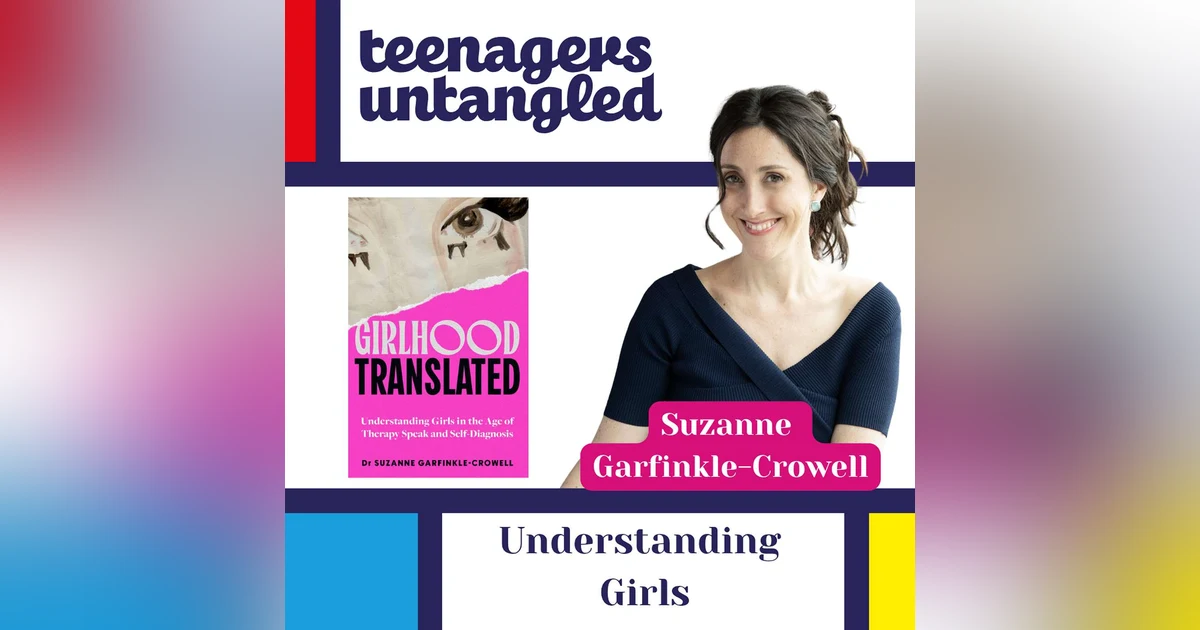

Ask Rachel anything If your teenage daughter says, “I have anxiety,” “my ADHD was out of control today,” or calls a friend “toxic,” it can feel both strangely sophisticated and oddly shallow at the same time. She has language. She has labels. But somehow, you’re still not sure what’s really going on inside her. In this episode with psychiatrist Dr Suzanne Garfinkel-Crowell, author of Girlhood Translated: Understanding Girls in the Age of Therapy Speak and Self-Diagnosis, we pulled back the cu...
If your teenage daughter says, “I have anxiety,” “my ADHD was out of control today,” or calls a friend “toxic,” it can feel both strangely sophisticated and oddly shallow at the same time. She has language. She has labels. But somehow, you’re still not sure what’s really going on inside her.
In this episode with psychiatrist Dr Suzanne Garfinkel-Crowell, author of Girlhood Translated: Understanding Girls in the Age of Therapy Speak and Self-Diagnosis, we pulled back the curtain on what this language is doing for girls — and what it’s doing to them.
I particularly loved Suzanne’s tip for us parents:
‘The biggest problem with therapy speak is when it’s a conversation stopper, because really, these words should be conversation starters.’
In the discussion she gives us parents ideas on how to move beyond the language our kids are using, and help them understand what’s really going on.
This isn’t an “anti-diagnosis” conversation. It’s about understanding how the language of mental health, the DSM, and social media are shaping girlhood, and how we as parents can respond in a way that brings us closer instead of shutting our daughters down.
If you'd like written notes to remind you about the points in this episode, or you'd like to think more about it, come to my Substack
Please hit the follow button if you like the podcast, and share it with anyone who might benefit.
You can review us on Apple podcasts by going to the show page, scrolling down to the bottom where you can click on a star then you can leave your message.
Please don't hesitate to seek the advice of a specialist if you're not coping. There's no shame in reaching out for support. When you look after yourself your entire family benefits.
Find all the tips from the episdoe on Substack:
My email teenagersuntangled@gmail.com
My website has a blog, searchable episodes, and ways to contact me
01:35 - How Therapy Language Changed the Way Girls Talk About Feelings
04:46 - Identity, the Teen Brain, and Why Feelings Are So Intense
08:38 - “Exploding with Pressure”: Girls, Mixed Messages, and Perfectionism
13:00 - “I Have Anxiety” vs Feeling Anxious: What’s the Difference?
17:01 - “You’re Perfect as You Are” vs Reality: The Perfectionism Trap
18:20 - The Girl Self-Defense System: Apologising, Minimising, Smiling Through Pain 0:18:20
20:33 - “She’s Toxic”: How Labels Split the World into Good and Bad
21:01 - Why Girls Seek Diagnoses: Identity, Belonging, and Validation Online
25:47 - How Psychiatry, DSM, and Pharma Shaped Today’s Therapy-Speak
29:54 - Checklists, Meds, and 10-Minute Appointments: The New Mental Health Model
30:37 - Girl Culture Vocabulary: Goths, Baddies, Labradors and Black Cats
31:38 - The “Wrong Colour Tank Top”: Why Clothing Choices Feel So High-Stakes
33:21 - Social Media, Sad-Girl Aesthetics, and the Blurring of Illness and Suffering
36:20 - “I’m Depressed” After a Bad Week: What’s the Real Risk?
38:40 - How Parents Can Respond: Small Acts of Translation, Not Panic or Dismissal
43:09 - Mother-Blaming, Parenting Labels, and the Pressure on Today’s Mums
45:37 - The “Good Enough Mother” and Why 30% Is Actually Great
If your teenage daughter has been using language you don't remember from your youth calling people toxic or telling you, I think I have anxiety or ADHD or OCD and you're not sure whether to take it seriously, push back gently, or just feel relieved that she has words for what's going on, this episode is for you. My guest today has spent her career in the room with teenage girls. She says about 10 years ago she noticed young women were speaking in a new way about their feelings and almost everything was evidence of a mental disease. So what's going on? You're listening to Teenagers Untangle, the audio hug that helps parents going through the tween and teen years turn their fear into wonder. I'm Rachel Richards, journalist, mother of two teenagers and two bonus daughters, and here to help us today is psychiatrist Dr. Suzanne Garfinkel-Krowell, who has written the absolutely brilliant book, Girls Hood Translated: Understanding Girls in the Age of Therapy Speak and Self-Diagnosis. Now, Suzanne has spent her career in the room with teenage girls, and she's noticed a change in the last 10 years, which is why she felt compelled to write this book. Now we're going to talk about why a diagnosis can feel like relief, even when it isn't necessarily accurate, why girls specifically have been psychiatry's go-to patient for over a century, and what that history has to do with your own daughter today. And that all important advice on how to raise a girl who feels like she's enough without needing a label. So before we go on, don't forget to share, like, review, or comment on this episode. Now, Dr. Garfinkel Krell, thank you so much for joining us.
SPEAKER_01Thank you, Rachel. I'm so excited to
How Therapy Language Changed the Way Girls Talk About Feelings
SPEAKER_01be here.
SPEAKER_00I absolutely love this book. I say that about quite a few books, but I'm really, really passionate about this one. I've gone through it twice because most books I read feel quite familiar and they're just written in interesting new ways. Your book explained things I hadn't fully understood up until now. I think being a teenage girl has always been hard, but you're saying something has shifted in how girls are narrating that difficulty to themselves, and that's this sort of mental health language explosion. Can you explain how girls are using this language to express who they are? Sure.
SPEAKER_01I noticed that girls were starting to speak in a very different way in this language of therapy speak. So, for example, 15 years ago when I started my practice, people would come in and talk about their problems, right? A teenage girl would say, you know, I'm really not getting along with my mom, or school has become really challenging, or I've been feeling bad about myself. And now it's I have attachment issues and ADHD and depression. So I can give you an example of when I first started to observe this trend. So I have a patient in the book who I call Violet, and she came in for her first appointment. She was this incredibly engaging, smart, articulate young woman who could speak, you know, very eloquently about any number of topics. But when it came to her own feelings and experiences, she would return to this very narrow set of clinical jargon, clinical terminology. So, for example, she would say, Oh, Saturday, I was just having this OCD meltdown. And, you know, yesterday my ADHD was just out of control. And today I really feel my depression setting in. And I would go back and say, Okay, Violet, so tell tell me about that. Let's go back to Saturday. You know, what were you feeling and experiencing on Saturday? And she would say, Well, I was just so OCD. And, you know, I'm a psychiatrist. I've treated lots of patients with OCD. I think I kind of know what that is, but I don't know this person. And I didn't know what that meant for her. So I figured if I don't really understand what she's saying about herself, and it was very hard to ever feel like I was getting to know her, getting closer to her, then this is a teenager. She probably doesn't understand what is going on inside either. And that seemed like a really big problem. And then gradually I started seeing more and more patients who were doing the same thing and comparing notes with colleagues, and turns out everybody was having the same experience. And, you know, you take one look on TikTok and you can see how pervasive all of this language is in the culture. But I thought this is concerning, and that's why I decided to do a deep dive, trying to understand the forces that are causing girls to reach
Identity, the Teen Brain, and Why Feelings Are So Intense
SPEAKER_01for this language.
SPEAKER_00Fascinating. I've seen the same thing. I've got four girls, and particularly one of them has often come to me and given me therapy speak to describe what's happening, but not necessarily being in touch with who she is and how she feels. So I'm I imagine a lot of parents listening to this will find this really, really hits home. So let's refresh our thinking on the job of being a teenager. And I love Sarah Jane Blakemore's book, you mentioned on this, and she talks about the most important thing is figuring out your identity, isn't it? And they are going out looking in the world, and their world now is online with a lot of information, a lot of therapy speak. Can you talk a bit more about that before we go on and talk a bit more about the therapy speak?
SPEAKER_01Sure. So as you mentioned, the developmental task of adolescence is really twofold. It's separating from your family of origin, becoming your own person, and figuring out who you are and where you fit in in the outside world. Right. There are different aspects of this, you know, that that pertain to the therapy speak issue. You know, on the identity side, girls have always been fascinated by any activity that helps them define themselves, right? So, like when I was younger, it was looking in magazines in 17 and Cosmo, and there would be these quizzes, right? Of like, you know, what's your color scheme? Right. Who's your celebrity crush? What's your, what's your spirit animal? Which TV character do you most resemble? Et cetera. And it's like teenage girls can't get enough of this stuff because, first of all, it's fun and it helps them feel like, okay, there's a way for me to be myself, but also be like in a category that's accepted in the world. And it also connects you to other people because, right? I mean, it's it's it's a way of um finding one's place in a group, not just as an individual, but especially for early adolescence, being in a group is the most important thing. Um, and finding a group that you feel represents you, that you also, you know, would be willing to be a part of and that you think reflects your good qualities, right? And then there's the other piece of what you said, which is brain development and how the feeling brain develops much faster than the thinking brain, and especially in that in an accelerated way in the beginning at puberty. And there is a real advantage of this developmentally, because you know, if you think about how important friends are and how important the social world is for teenagers, especially young teenagers, there is a motivation to really invest in these relationships. And that comes with all of the challenges and struggles because you're dealing with a peer group who are also immature and are also heavily driven by their emotions. So it is like a propeller that gets you out of your home and out of your comfort zone, whatever that may be, not always so comfortable, but you know, out of what you're used to and into the social world. And it provides all this motivation to figure it out. Like, how do I deal with when there's someone I really like, but they're doing a thing that I don't like? Or, right, or my group of friends is, you know, terrific, but there's one person in it who's behaving in a way that bothers me, right? There's so every day of being a high school student, there are these kinds of challenges. And without that motivation and that adrenaline and excitement about forming the connections and making a meaningful and safe space for yourself outside your home, um, you know, it wouldn't be worth it. Like, why would why would anyone go through all the trouble? So I, you know, it it does serve a developmental advantage to feel things so strongly.
“Exploding with Pressure”: Girls, Mixed Messages, and Perfectionism
SPEAKER_00To what extent are girls struggling because there are so many mixed messages? Because I do think that there is an awful lot of be like this and then you're an acceptable girl, but like body positivity, and yet everyone's using weight loss drugs. Oh my God.
SPEAKER_01Well, you know, there's this really troubling statistic that I keep coming back to in the book that 83% of girls feel that they are going to explode with pressure. Wow. And that is a strong statement from 83% of girls. And another interesting thing about that is that it's not just pressure from one source. It's not like, oh, they're so stressed about school or getting into college or university, or they're just so stressed about their body image, right? It's what they say is it's about having to fulfill certain kinds of roles or stereotypes. In other words, be a certain kind of girl that they feel they've got to be. And so, of course, that comes from many different areas of society, right? I mean, there is tons of academic pressure. And, you know, girls are doing well academically. They're doing better than boys. That's, you know, that's been in the news a lot. Um, but that doesn't mean that they aren't feeling, you know, an incredible amount of pressure to keep it up. Um, and then there's all of the physical stuff and body image. And, you know, that's that's really gotten worse in in recent years. Um, there was, I think, like a little bit of a golden age, you know, in the early 2010s when body positivity was more popular than it is now. Um, but I think even more than that, there are age-old expectations of girls that are are not anything new, but I mean, things like being nice, being likable, um, not being too much of a burden on people, you know, playing a certain role in families, you know, the kind of eldest daughter, like being, you know, being the one who's responsible or the peacemaker, the problem solver, um, the role model, right? And what happens is that these are these are age-old problems. Social media has poured gasoline on this fire. And the trouble that I see girls having in my office is that when they're feeling the need to be this certain kind of girl and to fulfill all of these social roles, they really don't let themselves have a full range of human feelings. So, like, for example, in the book, I talk about Eliza who comes in and she believes at first that her problem is test anxiety. And of course, she does feel anxious on tests, right? But she believes that it's like she has this medical condition, you know, this diagnosis that is her problem. But as I get to know Eliza, it's really the tip of the iceberg of this generalized perfectionism. And when we get even deeper, it comes down to, you know, she doesn't let herself feel basic human things. Like, you know, she feels some jealousy of a friend of hers who had a better day in cheerleading practice. But she thinks that it's bad to feel jealous and that she shouldn't, and that that's not the kind of person she is. And so she punishes herself. And, you know, she you can read all about it, she has other problems too. But but it is so common for girls not to accept a whole range of human feelings as they're trying to fit these social roles.
SPEAKER_00And as you say in the book, because of this ramped up emotional development, the experience of jealousy is much bigger for a teenager than it would be necessarily for an adult. So it's a normal human feeling on steroids, and they're trying to suppress it, which is really hard. I've done two episodes on anxiety, some of my most downloaded. Um, this is a real problem for a lot of parents. So, how do I support my child who has anxiety? And you say this is a case study in how the medical model distorts a normal human process. Can you talk a bit more about the difference between feeling anxious and anxiety itself?
SPEAKER_01Absolutely.
“I Have Anxiety” vs Feeling Anxious: What’s the Difference?
SPEAKER_01This is one of my favorite topics because so many girls use this phrase, right? I have anxiety. And the truth is everybody has anxiety. It's like having blood pressure. Anxiety is a normal signal that our bodies and brains use to show us that there's danger, that something could go wrong. And look, there are people who have clinically significant anxiety disorders for sure. And I mean, just to be very clear, you know, psychiatric diagnoses are real, psychiatric treatment is often necessary. This is not an argument against the validity of those things. But I do think that there's a great deal of normal anxiety, you know, anxiety that is just alerting you to, you know what, the stakes of this test are actually really high. You know, if you get an 80 instead of a 90, that might change the entire list of colleges you can apply to. That might make your parents look at you differently for a day. You know, that might separate you from your friends in a way that, you know, feels really hard and shameful. It actually is something to feel anxious about. So look, I mean, anxiety is something that people who are, you know, sort of hypothetically healthy, normal person can regulate their anxiety, right? So when anxiety gets really, really intense, there are things that we can do to help our bodies be calmer, right? Things like breathing, exercise, taking active breaks, you know, thinking thoughts that are calming or that can be like a frame shift or per add perspective. Because that's another thing about teenagers is that they don't have perspective. They haven't lived long enough to see that even if something really bad happens, like there's time and room for recovery. And, you know, life is long and things that feel incredibly high stakes today in two months from now, you know, may be distant memories. So teenagers have an especially intense experience of anxiety. Like I think the movie Inside Out 2 does a really great job of showing, you know, showing that how anxiety is such an active player. But that is different from having anxiety as an illness in a in a lot of cases. And, you know, I give the example in the book of my patient who I call Becca. And Becca is a pretty well-functioning girl, but she keeps coming back to this phrase, I have anxiety. And everything that goes wrong is because of my anxiety, you know, because I have anxiety. And as I get to know Becca, what I learn is she's in this group of friends, and it's her boyfriend and her best friend, and the three of them hang out together all the time, and it's basically a lot of fun. And when I ask her for specifics about, well, when does your anxiety flare up? She gave an example of a time when her best friend was kind of flirtatious with her boyfriend, and she didn't like it. But she didn't feel like she could really, first of all, say anything to her friend about it or even really admit to herself that she was upset because admitting that to herself in her mind meant all sorts of catastrophes, like, you know, does that mean I have to go and have a fight with her? You know, she's not the kind of person who really, you know, I could really talk to about this. And I mean, she didn't want to shake things up in her world, very understandably. And so it's much easier to do something that girls have always done, which is called internal attribution. So this is making yourself the problem in every situation, making your our own bodies or brains the problem, saying, I have anxiety. It's because I have anxiety, not because there's something going on that I don't like.
SPEAKER_00See,
“You’re Perfect as You Are” vs Reality: The Perfectionism Trap
SPEAKER_00this is so interesting. That's just absolutely that, right? I think girls face a uniquely contradictory bind. They're told they can have it all and that they're perfect as they are, but they absorb this culture that constantly signals otherwise. Can you explain how that links to a rise in perfectionism?
SPEAKER_01Yes. So girls receive two different messages. Um, the message that you're perfect as you are and you can have it all. That's usually the message from parents, right? Or from loving adults. But then there's the message from peers and from the internet and from the broader culture that actually people are, you know, kind of objectifying you and maybe rating you on a scale of 10, comparing you, you know, picking apart your flaws. And girls pick up that there are these two stories going on. And so then when you go home and your parents are very nice and tell you that you're perfect, you know, it feels it feels like they're missing something. They're missing half of the pressure that you're really up against.
SPEAKER_00Yes, you don't understand me. And actually, it can then mean that you're not connecting at all. And you talked about the girls' self-defense system. I love this, the GSDS. Can you explain the self-defense system and so that we can parents can spot what's going
The Girl Self-Defense System: Apologising, Minimising, Smiling Through Pain 0:18:20
SPEAKER_00on?
SPEAKER_01Sure. So defenses are something that everybody has, first of all. They're what make up our personalities, and we need them. They're they're healthy things to have. Um, but there are different kinds of defenses, and some of them are healthier than others. So there are ways that we use to protect ourselves from our, you know, otherwise we would be like roiling lava pits of emotion. So, you know, they're good defenses like intellectualizing, thinking about things instead of just letting ourselves explode. That's a good defense. Humor is one of my favorites. Um, altruism, you know, taking our feelings and turning them into motivation to do good for the world. Those are good defenses. Sublimation, creativity. Um, there are defenses that are less healthy. So those are things like splitting, which um, and by the way, these are all not conscious and not deliberate. Like they're just automatic things that we do. Splitting, meaning like dividing the world into all good or all bad. And that is something that's healthy to do when you're a very small child before you have the cognitive capacity to be more integrative. Um, but some people do it into adulthood, and then that can create lots of problems. Um, you know, projection is another unhealthy defense. So for the girls, there are there are typical defense mechanisms that are socialized and promoted in girls. So those are things like apologizing, you know, for things like, you know, when when we cry and we say, I'm sorry, I'm crying. Um, minimizing ourselves, right? It's not really that that big a deal. Like it's not that bad. I don't really have, you know, that many problems or whatever. A lot of patients do that. Or maybe I was a little upset. That's minimizing. Even things that we do with our bodies, like smiling. You know, you'd be shocked at how many people start smiling when they talk about being angry at someone or giggling. Right. And so they're like off ramps that we can take that take us away from feelings that make us anxious. So, you know, that's kind of an overview of what defenses are and in particular what the girl's self-defense is.
“She’s Toxic”: How Labels Split the World into Good and Bad
SPEAKER_00So interesting. That sort of that word toxic when people are using this, oh, they're toxic, it's just a very easy way of splitting, as you were saying. It's a way of saying they're the bad people and it's not really identifying anything in particular, it's just cloaking them in an entire persona.
SPEAKER_01Yes.
SPEAKER_00Yeah. Yeah. So with all of that in mind, why does a diagnosis, when they're looking at TikTok, now say, oh, that's that's me, it's pretty much who I am. Why are they doing that?
Why Girls Seek Diagnoses: Identity, Belonging, and Validation Online
SPEAKER_01Well, a million reasons. First of all, it's the teenagers looking for identity, right? So whereas we used to have these categories of like, you know, what's your color scheme or what's your horoscope? Now it's what's your mental illness. So that's awful, but it's it is. I mean, but and you know, and some people have, just to be clear, some people have mental illnesses. So but but you know, we're talking about this really broad gray area of girls who don't necessarily have one, or maybe they do. And I also want to be very clear that self-diagnosis is not always incorrect. Sometimes it's spot on. So, you know, what I talk about in the book is not the validity of psychiatric categories or of the correctness of a diagnosis or incorrectness for a given person, but rather, you know, the social and interpersonal value of these diagnoses and what they do, which is to your question. Um, so what do they do? They give people a sense of identity. Sense of belonging. You know, there was actually even a study recently that showed that young women who come in negotiating for a diagnosis, which has been really common in mental health practices, they do it out of a wish to belong even more than a wish to receive treatment. So that was so powerful to see just that that is the motivation, sometimes even more than the help. So there's that. There's community comes along with that. So if you have a given diagnosis, there's going to be a community on TikTok of people who you can then bond and connect with. And validation. You know, the world does not take teenage girls seriously. It never has. I mean, there's a quote that always sticks in my mind that I think is typically misattributed to Eleanor Roosevelt, but was from a writer named Thomas Buckle a long time ago. And it said, Great minds discuss ideas, middling minds discuss events, and small minds discuss people. Even when teenage girls are talking about ideas and events, they're usually focused on it through the angle of people. So that is a sign of how we really disregard teenage girls. And so of course they're going to reach for medical diagnoses because those are the words that we care about. That's where the validation is in our society. So it's quite smart. It bothers me when people accuse girls who speak in therapy speak of seeking attention or being overly dramatic because they're actually just picking up exactly what we put down in front of them and said, this is what's important.
SPEAKER_00Yes, and this is your language. And so I'm going to use your language so you understand me. And I love how in the book you make it that it's a bit like having a safety blanket or something. So it's a kind of like take care of me, there's something wrong, without having to fully know or name what they feel, because there's no exploration behind that. And that as parents, I guess the important thing is if they're saying this, there's something there. There's something they're feeling. So rather than saying dismissing it and going, don't be ridiculous, you don't, or we need to get you instant therapy and treatment, it's more a case of, okay, tell me more, like what's going on there and and trying to unpack some of it. Exactly.
SPEAKER_01Well, that's in in my experience in my office, the biggest problem with therapy speak is when it's a conversation stopper. Ah, right. Because really, these words should be conversation starters. But with my patient Violet, it almost felt like in her mind, the label itself was the story. There was no other story that mattered besides that label. But in therapy, we are trying to get under those labels to find the stories that are actually gonna help people more by connecting them to what they're actually experiencing kind of moment by moment.
SPEAKER_00Fascinating. Yes. And what's fascinating about your book is how you explain the history behind psychology and how it sees women, because you touched on that. And you know, there was Plato's Wandering Room and Aquinas' Woman as a failed man, and then you had the Freud hysteria patients, and I think it's a 90% male profession that was originally that was researching and hospitalizing mostly female patients. And and psychiatry was ridiculed at one stage, I think you said in the 1900s, and it needed a way to make itself much more serious. And that you're saying that at that same time the market for medicine came along and sedatives and Valium and you know, Mother's Little Helper. Can you give us a bit more of an overview of that? That's probably better than the way I've tried to describe
How Psychiatry, DSM, and Pharma Shaped Today’s Therapy-Speak
SPEAKER_00it.
SPEAKER_01Sure. No, you did a great job. Um, so first of all, I would say the headline here is really about the corporatization of medicine as a whole and the medicalization of psychiatry in particular. So this is not because psychiatrists were doing anything bad or conniving. I come from a noble profession of people who really just want to help others. But we've had a lot of philosophical debates over the decades about how best to do that. I'm especially excited to tell this story because I think, you know, when we think about Therapy Speak and the explosion of Therapy Speak, everyone knows about social media, right? But nobody knows the story behind that of like how did these words become the words that are on social media, right? Basically, it starts at towards the end of the 20th century when legislation was passed that encouraged the growth of HMOs. HMOs are for-profit third-party companies that cause some problems, such as really decreasing the amount of time a doctor could spend with a patient. Because before that, a doctor and patient would decide together what amount of time was needed to solve the patient's problem. But then HMOs came in and said, nope, you have only 30 minutes, 20 minutes, 10 minutes per appointment. So that was one problem. Separately, at the same time, psychiatry was really changing. So prior to 1980, the prevailing model of how psychiatrists would think was psychoanalytic, meaning thinking about a person's current psychological state as being influenced by their past and what they had experienced. Now, not everybody had access to a psychoanalyst, most didn't, and many people didn't have a therapist either. So there were efficiency problems. Then in 1980, psychiatry decided we needed our field rebranded. So we created a new DSM that's the Diagnostic and Statistical Manual of Mental Disorders. And this one had what was called operationalized criteria, which is the checklist that we all use, I use today, right? So it doesn't really matter what happened in your life or who you are. What matters is what's happening with your sleep, what's happening with your activities, what's happening with your focus, right? Check, check, check. And if you have enough of these things and they're causing impairment for a long enough period of time, then you have this label. And at the same time, psychiatry was getting so excited about growth in our technology capabilities, right? There were the 1990s was the decade of the brain. There were MRIs and CAT scans and you know new technology happening. And the biggest thing was the explosion of the pharmaceutical industry. So, you know, we were developing really powerful drugs that worked really well. I mean, I want to also say that antidepressants really, really help people. And so all of a sudden, we really joined the rest of medicine and could reach a much broader audience of patients. And that was really good in a lot of ways. The medical model is not evil. It's not inherently bad. It's just a model. When you put that together with the fact that doctors now didn't have a lot of time to spend with patients, your visit to a psychiatrist changed from a 45-minute therapy session to a 10-minute symptom check, put a label on it, find the medication to go with it, and send you out the door. And so that really, really changed the field. And then that model is what then fed into the internet.
Checklists, Meds, and 10-Minute Appointments: The New Mental Health Model
SPEAKER_00Fascinating. And this DSM manual has all these particular criteria with the checklist. So presumably some of these people are going there and just going, well, here's the checklist. I can see how it can be used to explain things when you don't have the language to explain something. And it's interesting because in your book you talk about the words we use about ourselves and how they shape who we become. And I was having this conversation with my daughter's boyfriend just last night who's Dutch, and he sometimes struggles to explain something he's thinking because we don't have the words for it in English, but it's really familiar to Dutch people. There's a girl culture vocabulary which shapes the way that girls think about themselves. Can you enlighten us on that? Because I'm sure there are some parents who, if they hear the words, they'll go, oh, oh,
Girl Culture Vocabulary: Goths, Baddies, Labradors and Black Cats
SPEAKER_00that's what that's about.
SPEAKER_01The teenage brain is very sensitive to language. And part of that is because what's going on at that time of life is a pruning process and a myelination process. So the brain is choosing what it wants to retain and what it wants to get rid of. So myelin is a fatty sheath of tissue that forms around certain pathways that makes things go a million times faster. Um, and pruning is when we get rid of the neurons that aren't getting used. So language is going to feed into that. And if you think about it, these words become sort of self-fulfilling entities. And every generation has its own set of kinds of people you can be, right? So, like goth, for example, that lights up a whole thing, right? That's a person who likes wears a lot of black and listens to a certain kind of music and wears it, you know, a certain kind of makeup or has certain feelings, right? Then there's like granola is another type of person, right? That's like, do you guys have that?
SPEAKER_00That's like a, you know,
The “Wrong Colour Tank Top”: Why Clothing Choices Feel So High-Stakes
SPEAKER_00so now now you said it. I'm thinking, oh yeah, I can imagine what that is. I don't think we use that here, but yes, I can imagine what it is.
SPEAKER_01It's like an earthy, crunchy, like girl who, you know, wears Birkenstocks and goes camping and you know eats granola. There's a being a baddie, right? That's like a newer one. That's somebody who's kind of sassy and you know, nothing bothers her. So we get these ideas of a word and it also connects us to a group of people and a group of people that we identify with and affiliate with, and people that we want to be like, and also people we don't want to be like. So when girls go shopping and they absolutely lose their minds because you pick the wrong color tank top, you know, that's not because she's vain and superficial. That's because the color tank top she's wearing is going to put her in one group or another. So this is deep. You know, this is this is about the person that she wants to be, and um the stakes are very, very high.
SPEAKER_00Oh, I love that. That's a really important message for us, isn't it? And it's funny because um my daughter was using the terminology black cat and um labrador. And she'd say that's a great, yeah. She's a labrador, and I'm a black cat. Yeah. And to start with, I was like, oh yeah, no, I can imagine that. And then when you start unpicking it, you go, actually, we're not that simple. It's but it's they're very useful buckets, they put them in, aren't they? And you talk in the book about how the internet, social media, social contagion has really impacted on the way that girls view themselves, and that the rise of the internet happened at the same time as the rise of this medical model of mental health that you've talked about. Do you think that the internet erases that line between mental illness and mental
Social Media, Sad-Girl Aesthetics, and the Blurring of Illness and Suffering
SPEAKER_00suffering?
SPEAKER_01That in itself has a really interesting history, kind of in the same period of time that the corporatization of medicine was happening and the medicalization of psychiatry was happening. There was a move toward health literacy in in this country where patients wanted to be more collaborators and less submissive than they had been before and sort of close the power gap between doctor and patient and be participants. So that was a really strong movement that happened toward the end of the 20th century. You know, it came along also with the birth of the electronic medical record and patients having more access potentially to the things that were being said about their medical status. And at the same time, the internet was starting. And so you could also become someone who was researching your own conditions. There was now WebMD where you could just go on and search for things. And then social media happened. But something really fascinating happened at the beginning of social media, which was, especially in the days of Tumblr, girls who put forward their sadness and anger and aloneness would get a lot of attention, especially if they were very beautiful. Yes. And that seemed to be that was it's called the internet sad girl. It was a whole thing. And, you know, Lana Del Rey was like their patron saint. Um, and that became a kind of girl that was very desirable to be because, you know, maybe she wasn't the most popular girl in school, you know, she wasn't the cheerleader, but there was this whole new space online where she was, you know, getting all of the attention and all of the likes. And then, of course, the algorithms kicked in and it became very incentivized to say more and more shocking things and more negative things. And, you know, really terrible things started happening, like websites where they would teach you how to kill yourself or, you know, about self-harm. And of course, we've seen this through to very recently on internet platforms and and social media that really opened up this world where being sick made you sexy.
SPEAKER_00That's absolutely fascinating. And those algorithms also funnel curiosity into mental wellness content.
SPEAKER_01Well, right, to your point, there was no differentiating on these platforms between what's a real, I mean, this wasn't a conversation people were having with professionals. It was a conversation that kids were having with each other. So nobody really knew what's the difference between having a horrible week and crying all the time because some bad stuff is happening, or having clinical depression. So I think that was the beginning of this very muddled picture that we see today, where there's all kinds of information. You know, it's not just misinformation. Some of the information on TikTok is quite good. But how do you separate what's what if you're 14?
“I’m Depressed” After a Bad Week: What’s the Real Risk?
SPEAKER_00I suppose the one of the questions is, you know, let's say they've had a hard week, they've been crying a lot. What's the problem with saying, oh, I'm depressed?
SPEAKER_01Well, again, so the problem is not necessarily that it's not accurate. It could be accurate. The problem is if it's a conversation stopper and if the label becomes the story. Because when that girl gets into a therapist's office, the label is really gonna come off. I mean, you know, I there's a quote from Monet that I put at the end of the book that in order to see something, you have to forget what it's called. Oh, I like that. Yes, right. So if you want to paint a tree, don't think about what a tree is. Just look at what's in front of you. Look at the colors and the shapes of it. And that is what we do in therapy, is we don't just say, oh, you're depressed, and so you know, do X, Y, and Z. I mean, maybe some people do, but most therapists would really try to get underneath that and really get close to the person and in fact find what is respectable and very valid about what they're experiencing, right? Sure, a depressed person is going to be having all kinds of distortions, but if you start off by only looking at the distortions, you've lost your patient. You know, you've got to first really meet them where they are. So that is how the label itself, even if it's totally correct, can actually interfere with that process.
SPEAKER_00And I think you do that so well in the book with each of the clients that you you talk with, what you do is they will come to you and say, I've got this or I'm this, and then you go, hmm, okay, I'm not yet ready to say that's what you are. I'm just interested. Like I'm just and there's this whole exploration that happens, and you're modeling that process of, you know, not just taking base value what they're saying, digging deeper, digging. And I think that's something we parents, um, it's very hard to do, but we need to also be doing that. I found that the getting that mindset has really helped me with my kids rather than when I first set out it as a parent thinking, how do I fix this? Exactly. What's
How Parents Can Respond: Small Acts of Translation, Not Panic or Dismissal
SPEAKER_00the fix? How do you deal with this situation where there's an a lot of a lot of people with these these things, you know, there's a lot in the press about the massive rise in ADHD and is it real? Is it what you know, without minimizing or or delegitimizing people's real experiences? How do we run this path? Mm-hmm.
SPEAKER_01That's a great question because, you know, therapy speak is used in very different ways at different times. Lots of people use it jokingly, right? I'm I'm OCD about my travel plans, right? Like I want to make sure everything is right and we know we're gonna have every dinner and right. Um, and does it make sense to to police everybody who's using it in such a lighthearted way? I think the key is to really be working with this middle group, the gray area people who are actually trying to figure out what is going on with them or why they're struggling. And that's when I recommend for parents that they really try to bring in normal human words to these conversations. So not to argue or to say, you know, you don't have that. I mean, the last thing teenage girls need is more policing, honestly. Right. So, but curiosity is always a good thing. So not to say you don't have depression, or even I don't think you have depression, because a lot of us really want to be supportive and normalize. And especially if you really believe that what she's going through is normal, you know, you want to just say like, oh, it's not that. But that can feel really dismissive to a teenage girl, because as we know, they are used to feeling dismissed. And so if that's the response, it may the conversation, you know, you may have a conversation stopper, not a conversation starter. Right. And similarly, we don't want to panic and say take everything literally, of course, and say, oh my God, you know, let's go call the doctor and you know, start seven different medications. So really the middle path is to do what I call small acts of translation, which is when a parent just thinks in their own mind, like, okay, what does that mean? What she's saying? She's saying she's depressed. What does depressed mean? Does it mean she's sad? Does it mean she's in despair? She's hopeless, you know, is she feeling lonely? And you can ask her those things in those words to try to encourage her not only to move away from the clinical label for its own sake, but to actually be more specific because specificity is connection, right? I mean, anybody who's ever read a novel knows that the more specifically someone describes their experience, the more relatable it is. And the more opportunity a parent will have to actually help a kid feel better and say, like, I really used to struggle with that too. I felt that way also, or here's how it helps me to get through it, or whatever. But these small acts of translation, and I want to just re-emphasize it's not an argument. It's not saying, no, you don't have that, or that's not, you know, that's disrespectful to the people who do have it. Of course, the goal is to get the casual and reflexive use of these words less in circulation. But it's not to invalidate what girls are saying, rather much the opposite.
SPEAKER_00I think your instinct as a parent is thinking, oh no, my child's broken, what do I do? I'm trying to fix it quickly. And that would be either shutting it down or or trying to get some you know urgent help, but actually leaning into it and like and what my daughter said was exactly what you were saying, which is it's really helpful if we have had any experiences like this to be specific. I I made the mistake of just saying, Oh no, I felt like that. And actually, she said it was most helpful when I'd say, Oh, I remember feeling that way when I did this, and this was how it it worked out for me. Just going into it in detail makes them feel I'm it's okay, I'm not broken. And I love this part of the conversation because I think it's really, really important. Our daughters are growing up in a backdrop of not just the culture, they are actually growing up with mothers, um, where the parenting guilt is put on the women that we're doing something wrong somehow. And this has gone all the way through pop psychology, where somehow women are to blame for all of this stuff. I I wonder if you have thoughts
Mother-Blaming, Parenting Labels, and the Pressure on Today’s Mums
SPEAKER_00about that.
SPEAKER_01Many. Um, yes, I think parents go through so much right now, and mothers especially, because as you say, psychology has a very long history of mother blaming. And I think as mothers and as mothers especially who are, I mean, we are the Prozac feminism generation ourselves, right? Who grew up being told to have it all and be empowered and take control of our own lives and have careers and be parents. And now there's this parenting literature that is so prolific. I mean, what kind of parent are you supposed to be? Are you a faffo parent to bleep around and find out, you know, parent? Or are you a gentle parent, you know, who's going to really tune in and be so attentive to your child's emotional needs at all times? Like what is the those identities? Those identities, right? Right. It's like we have our own labeling system for ourselves. And I think the mothers are going just as crazy with this stuff as the daughters, right? Because who knows what the right balance is. I think that the tried and true right balance is authoritative parenting, which is not authoritarian, which is, you know, too strict, not permissive, which is trying too hard to please your kids, but something in the middle where you have your expectations and values and you try to make those clear, but you also are in constant communication with your child and you're open and curious about their needs and responsive. So I think mothers have a really hard road to hoe. The best advice for mothers, I think, really came from Donald Winnicott, who was a pediatrician who started working in a psychoanalytic way with patients in the 1960s. And he came up with the term good enough mother. Yes. And I can get behind that. Yes, I think we can all get behind that. And not only is a good enough mother good enough, but a good enough mother is actually better than a mother who is trying too hard to be a perfect mother. Because kids do need to have a mother that fails at meeting their needs perfectly. They need to be able to contend with frustration and disappointment and loss and anger and also recognize that their mom is going to keep coming back and keep trying to be a good mother for them and that that's real life. That's how one gets acquainted with reality. And anything other than that is really quite misleading and can be damaging for kids.
The “Good Enough Mother” and Why 30% Is Actually Great
SPEAKER_00I've got older daughters, my bonus daughters, and I think they're looking at the job of being a mother and saying, Oh, why would I do that? That looks far too hard. And I think we owe it to our kids to be more realistic about it's okay that you mess up. And and you know, you even mentioned the 30% um thing in your book, which Dr. Jodi mentioned. You can get it right 30% of the time.
SPEAKER_01Well, not only that, you you can't get it right more than 30% of the time. So the best, the best mothers, the most finely attuned mothers are attuned 30% of the time. So if you're doing that, then you are you're killing it.
SPEAKER_00That's a brilliant, brilliant way to put it. And just get really good at apologizing if it's gone wrong. And I always say this, my kids tell me regularly that they're very, very grateful that I mess up and that I'm not perfect, and that I admit it and I'll talk about it, and then I'll apologize if it's them, or I'll talk about where I went wrong with other things because it gives them permission.
SPEAKER_01It's such good modeling. Yeah. Yeah.
unknownYeah.
SPEAKER_01And it's okay.
SPEAKER_00It's okay. Um, Suzanne, what what an amazing discussion. Thank you so much. I absolutely love your book. I know I've said it already, but really it's a fantastic book. And I was talking to my personal trainer today about it, and she and she said, Oh, I've got to get that book. And I said, Well, I can lend you mine, but it's scribbled all over. And she said, Oh no, I'll listen to it. I'll listen to it. Because I can't sit there and and read books. So they're all different formats you'll you'll be able to get the book in. Um, could you please explain to us how to get hold of you, how to get hold of the book?
SPEAKER_01Sure. I can be emailed through my website, um, Suzanne Garfinkel Kroll MD. It's available for pre-order now. Yes. I'm really excited to have this conversation with you. I mean, you're such a good interviewer and I love the podcast. Thank you.
SPEAKER_00Thank you so much, Suzanne. It's so wonderful meeting you. If you found this useful right now, send it to someone that might find it helpful, please, because it's just by spreading the word that my podcast has got where it has, it's by spreading the word that we build community and then you can have discussions with your friends about it. You can even do a little, you know, podcast club where you talk about the issues that have been raised in it where you've been struggling or someone else has been struggling. It's a really good way of connecting. My website is www.teenagersuntangled.com. I substack the same with dot substack.com, and you can contact me on teenagersuntangled at gmail.com. Tell me what you think. Uh, give me ideas for people you want me to interview. I'm I'm all ears. Have a great week. Uh big hug. Thank you.