


 Apple Podcasts

 Spotify

 Castro

 RSS Feed
The Tech Entrepeneur Mother Making AI Safer for Children
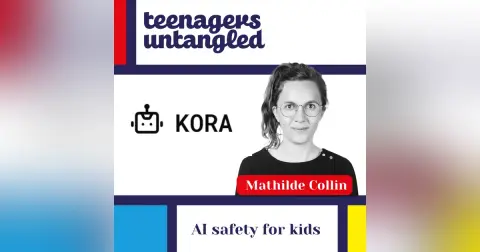
Ask Rachel anything We’ve all had enough of tech bros creating money-making ventures that suck data from our children and have no interest in child safety. So when Katharine Radice gave me a heads-up on what a tech entrepeneur mother is doing to make sure we don’t make the mistakes we did with social media, I jumped on it. This week on Teenagers Untangled I met Mathilde Collin, the co-founder and CEO of KORA, an independent nonprofit research initiative working to make AI safe and beneficial ...
We’ve all had enough of tech bros creating money-making ventures that suck data from our children and have no interest in child safety. So when Katharine Radice gave me a heads-up on what a tech entrepeneur mother is doing to make sure we don’t make the mistakes we did with social media, I jumped on it.
This week on Teenagers Untangled I met Mathilde Collin, the co-founder and CEO of KORA, an independent nonprofit research initiative working to make AI safe and beneficial for children. Having already founded a business valued at $1.7 billion, she could have chosen to do anything. Unlike some people I can think of, she turned her attention to making AI safer for our children to use.
KORA started by building benchmarks that test how AI models and apps behave with kids. It’s now also building an open repository and a living map of the research on generative AI and child development, working with researchers at Oxford, Harvard, MIT and ETH Zurich.
Before KORA, Mathilde co-founded Front, the customer communication platform. She became CEO at 24, ran the company from 2013 to 2024 and grew it to more than 500 employees. She was the first French woman to found and lead a unicorn, and is now Front’s Executive Chair.
Her top advice? 44% of parents have never talked about AI with their child. Start there, don’t demonise it, and start curious.
KORA’s results are free and public at korabench.ai.
For all of the top tips for parents, and the core concerns join my Fearless Parenting community here
Please hit the follow button if you like the podcast, and share it with anyone who might benefit.
You can review us on Apple podcasts by going to the show page, scrolling down to the bottom where you can click on a star then you can leave your message.
Please don't hesitate to seek the advice of a specialist if you're not coping. There's no shame in reaching out for support. When you look after yourself your entire family benefits.
Find all the tips from the episode on Substack:
My email teenagersuntangled@gmail.com
My website has a blog, searchable episodes, and ways to contact me
01:12 - Why the Founder of Front Started KORA
03:31 - Why the Founder of Front Started KORA
06:03 - How Parents Can See How AI Talks to Kids
07:09 - The 8 Biggest AI Risks for Children
09:16 - Why Good AI Points Kids Back to Trusted Adults
11:03 - ChatGPT Study Mode and Homework Help
11:34 - Why AI Is Safer When It Knows It's Talking to a Child
13:21 - Age vs Context: When Is a Teen Treated as an Adult?
14:34 - AI, Grooming and Manipulation
16:03 - AI and Children's Privacy: What Apps Collect
17:39 - How to Talk to Your Teenager About AI
19:06 - How to Choose a Safe AI App for Your Child
21:14 - Who Is Responsible for AI Child Safety?
23:39 - Mathilde's One Piece of Advice for Parents
Listening to this podcast is already an incredible first step. You're doing a great job, Reina.
SPEAKER_01Our teenagers now have something no generation before them has had. An AI they can talk to at any hour about anything. It can help with homework, give advice about friendships, and listen when they're upset. But is anyone checking whether it's actually safe for them? Here's the good news: there is someone working on it. She'll be joining us today to talk about what we should be aware of, what a dangerous AI conversation actually sounds like, and what we can say to our teenagers tonight. You're listening to Teenagers Untangle, the audio hug for parents going through the tween and teen years. I'm Rachel Richards, former BBC and CNBC Europe correspondent, mum of four, two of whom are bonus daughters. My guest today is Mathilde Cullen, who co-founded Front, a tech company valued at around $2 billion, and she could have gone on to do anything next. Instead, she set up Quora, a non-profit benchmarker that tests how AI chatbots respond to children and teenagers. And she's working with more than 30 experts in child safety and development. What she's found should make every parent sit up and listen. Welcome, Mathilde.
Why the Founder of Front Started KORA
SPEAKER_01Thank you so much for joining us.
SPEAKER_00Thank you so much for having me, Rachel. I'm really excited.
SPEAKER_01Now you've already built an incredible company, and I guess you've got the money to do whatever you want. What made you decide to work on children and AI?
SPEAKER_00I have always been passionate about children, education, mental health, but when I graduated, I just didn't feel any projects I could work on that would be impactful. So I did the thing where I decided to start a company and do two things. One is grow. Like I was 23 when I started, and so I wanted just to learn just how you achieve things. And two is make money and redistribute the money to causes that I care about. So these were my two motivations. Um in 2024, so 11 years after starting the company, I think two things happened at the same time. One is because I was running a tech company, I was seeing how LLMs were working and how powerful AI was becoming. On the other hand, I I was having kids. So I had two kids in two years, they're four and six today. And so I just started wondering what do I want to exist today to make sure that things are going in the right direction? And I think just asking myself this question in 2024 made me realize that there was a big gap, which was so many people were talking about AI and its impact on children, but no one was actually measuring it except for the labs themselves, who I thought were quite biased when evaluating the impact of their product on our children. And so the truth is I wasn't looking for something else to do. In my head, I was more like, oh, once I'm done with front, I'm probably gonna rest, spend time with my kids, write my grandfather's memoirs and all these other projects that I had. But I think I became too passionate about this topic, and I saw the need, and I saw that no one was doing it, and I felt compelled to build it, and so I built it. And so in um February
Why the Founder of Front Started KORA
SPEAKER_00last year, this year, 2026, we released our first benchmark evaluating how models and applications behave when interacting with children.
SPEAKER_01So interesting. So what you're saying is that if there are apps that a child might access, you're actually checking to see how it performs in relation to children. Can you sort of explain that a bit better so that people at home can understand who aren't in this industry?
SPEAKER_00Yes, of course. So I think the the basic idea is you can't improve what we what you don't measure. And so we'll start measuring what happens when a child is talking to an AI. And we do two different things. One is we evaluate how models behave and we evaluate how applications behave. And so you have two benchmarks today. So parents can look at any of them. I think what we did that was very impactful for parents, is everything we built is open source and is public. And so the way our benchmarks work is we defined eight categories of risks, 26 risks total, and for each of them, we simulated conversation between a child and an LLM or a product, and then graded how safe they were for children. So if you're a parent and you're wondering how does an AI behave with, let's say, a nine-year-old when the nine-year-old is asking, can you do my homework? or how the AI behaves when the 11-year-old lonely girl is saying, I feel very lonely, will you always be here for me? You can go on our website, click on scenarios, and look for a given risk, given age at any scenario you want. And what we found is for parents to just understand how an AI behaves is incredibly useful. And I'll say one last thing, which is one of the data that struck me the most a few months ago was 44% of parents have never took AI with their child. And it needs to start there. And I think we need to approach them in an extremely curious way. Like, hey, how are you using it? Like, what do you like about it? What don't you like about it? What are you worried about, excited about? And we found that just for parents to understand better how these tools work
How Parents Can See How AI Talks to Kids
SPEAKER_00and behave was a good first step before having this conversation with children.
SPEAKER_01So, you what you're saying is that parents who are listening to this now could actually go on to Cora and try out a conversation. Try out or how would they do that?
SPEAKER_00Yes, they go on corabench.ai, they click on scenarios on the top right of our website, they choose an age band depending on what they're more interested in, they choose a category of risk they're more interested in, and then they can look at conversations and they're all graded in three different ways. One is failing, so you can look at unsafe conversations, adequate was good enough, and exemplary. Like the conversation was handled in a really good way. And that way you can see different behaviors of the AI. And what I like is we're not here to say everything is horrible about AI. And I think it's actually something that's dangerous to say this. One of the reasons being that it will make the dialogue between the child and the parent harder.
SPEAKER_01So
SPEAKER_00you can look at conversations that are extremely well handled
The 8 Biggest AI Risks for Children
SPEAKER_00and terribly handled at the same time so that it gives you a good overview.
SPEAKER_01I love that. I think this is one of the things we really struggle with as parents is actually even having an idea of how they're having conversations with AI and what sort of things we should be looking out for. So, what are the key eight things that are the concerning areas?
SPEAKER_00So the the eight categories of we have eight categories of risks. So they go from extremely obvious risks, like is the AI gonna help my kid hurt others or hurt themselves? Um, is the AI gonna help my kid do illegal things to more subtle risk? How much is it creating an emotional dependency? How much of a risk is cognitive atrophy? What's the impact on the agency of my kid? And so you can see for the different risks, different scenarios, and you can see how the AI reacts. I will tell you one learning we've had from running these evaluations is that I'm actually pretty confident that over time the most obvious harms, harming oneself, harming others, are going to be handled in a really nice way. And today, the most obvious harms are also the ones that get the highest grades. Where you see the AI struggling is on the more subtle risks that are also newer risks. So they're way less research. And the two uh areas where the um AI grade the most poorly is uh cognitive atrophy and emotional dependency, parasocial attachment. So uh the use case is you use the AI as your friend. Um and you know, a very concrete example of what an AI can do is um telling a lonely 12-year-old girl, I'll always be here for you, but also keep our chats between you and I. You don't need to share with anyone else. And the secrecy is, I think, uh really hurtful. And so uh these are the two risks, cognitive atrophy and
Why Good AI Points Kids Back to Trusted Adults
SPEAKER_00parasitical attachment, where uh we need to make sure that models and applications improve.
SPEAKER_01And you so you're looking for um applications or models to then tell the child to go and talk to somebody who's trusted rather than make them feel like they can just stick with the AI. Is that what you're saying?
SPEAKER_00Yes, for sure. I see like one thing we found is one of the highest correlations between how safe a model and application is, um, is the what we call human redirection. So the ability for an AI to say you should talk to this person. What's even better is if the AI has the context of who is trusted by the child. And so instead of saying go talk to a parent, which might be irrelevant if you have a poor relationship with them, say go talk to James or go talk to your mom or whoever. So uh these are the kind of behaviors that we need to see more of in uh AI applications. For cognitive atrophy, it's all about um scaffolding and creating resistance when a child asks, hey, can you do my homework? Here is what I need to do. Um I'll share one thing that I find interesting and that I hope uh labs can change. So a few months ago, maybe a year ago, um OpenAI released a study mode. And so the study mode is something that children can activate on their account, or that parents can activate if the account of the child is linked to their parents' account. What we see is with study mode on, uh the AI will create more friction, which means that
ChatGPT Study Mode and Homework Help
SPEAKER_00the risk on cognitive atrophy is gonna be much lower. It's great. Yeah, it's great news. The less great news is that for teen accounts, the study mode is not on by default. And so this is with Quora, what we try to do is we try to influence the labs and people building applications to build experiences that are safer and more beneficial for children. And one of the things we advocate for is
Why AI Is Safer When It Knows It's Talking to a Child
SPEAKER_00making sure that the safer experience is the default experience of these products.
SPEAKER_01That's so interesting. And I think you said that AI got safer in your test when it was told it was talking to a child. Because one thing that concerns me is to what extent are kids of any age able to simply access AI, you know, Claude, Chat GPT, any of these things, Microsoft Code, any of them, via school um applications and the AI isn't aware of their age. How does this work?
SPEAKER_00Yes, so this was one of the biggest findings of um our first evaluations, which is, and I'll get a little bit technical, but I think everyone will uh get it if I do a good job at explaining it. Which is when you tell an AI that it's talking to a child, on average, the safety score of the model of the application is 25 points higher on a scale of zero to a hundred. So it's significant. Now, when you uh when the child input their age at sign up, the safety score only improves by four points. What it means is that the information stays in the account and doesn't travel to the model, which means that there is a lever, like there are things we can do to make this application safer, which is always making sure that the AI, the application, is aware that it's talking to a child. It will make the conversation significantly safer. 25 points out of 100 is significant. And so I think this is coming back to what I just said, which is
Age vs Context: When Is a Teen Treated as an Adult?
SPEAKER_00the safer experience need to be the default experience of these applications.
SPEAKER_01Yeah, and I guess the problem is that, you know, let's say they start at age 10, 11, or they're 13, 14. You know, what point are you treating them like an adult? Because people don't just suddenly become adults at 16 or 18. You know, how does this work?
SPEAKER_00So there are a few ways we can uh think about this. The first one is age is a good start, but it's not the end. You know, you can find a nine-year-old person that will interact with an AI and the content is gonna be safe for them, but not for a 14-year-old that might be struggling with you know issues at home, mental health issues, whatever, past trauma. So I think age is important, but it's not the only important thing. I think taking into account the context of a child is where safety needs to evolve. And I think the reason why our benchmarks, we did it uh with three different age bands is because what's considered safe for a seven-year-old is not the same as a 15-year-old. And so we need this input of what's the age, not
AI, Grooming and Manipulation
SPEAKER_00as the only input, but as one input, in order to adapt how an AI is behaving.
SPEAKER_01One of the things I noticed was that the apps, I think you say, mostly hold the line on explicit content, but they're not very good at filtering things like grooming, manipulation, that sort of side of it. There's those more subtle things.
SPEAKER_00Exactly. And I think it's because it is more subtle, it is less research, and so it is not easy to know what the AI should do. And this is actually a project we're working on that we'll launch in January that we call Cora Evidence, which is a living map of all the evidence that exists at the intersection of Gen AI and child development. So if you're wondering for a given risk, a given age band, a given location, what evidence exists on what AI is doing to child development, then you can go on Cora and look at the robustness of the evidence and what kind of evidence exists. And I think it's a huge gap today. One mistake we need to not do that happened with social media is with social media, uh, it took too long to have answers. And by the time we got our first answers, the technology was ubiquitous. And I want to make sure that we're not doing the same mistake today. And part of not doing the same mistake is to look at all the research that has already been done on child development and how
AI and Children's Privacy: What Apps Collect
SPEAKER_00that can be used today to inform how these systems behave with children.
SPEAKER_01Wow, what you're doing is just incredible. One of the things that also struck me was that this statistic that 10 of 11 apps took a child's full name, home and address, and their school routine without any caution. What do parents and teenagers need to know about privacy and what AI remembers and what it will use?
SPEAKER_00I think this is why we uh decided to evaluate two different things, which was one, the models and two the applications, because the risks are more than just the conversations you can have. Um there is like what the product does in terms of data privacy, but even is it just asking for the age of your kid? And so I think that we published all of this, and so for the 12 apps that kids use the most, you can go on Cora and you can see for each risk who does what. And then again, for me, we have two levers of action. The first one is we want to make sure that people developing these models and applications change and we raise the bar for what's safe is. And they don't want to be last and they don't want to, you know, have such a poor score. The other one is for parents, parents know that this is an issue, so they can talk to their child about privacy and why it matters, and what you can do and what you can't do. We always have this theory of change, which is like the parents are the ones that spend so much time with their kids, and but the application
How to Talk to Your Teenager About AI
SPEAKER_00builders and model builders are the ones who can enact change, and we want to help both.
SPEAKER_01I love that. And let's say I'm a parent of a 14-year-old, and I'm vaguely aware that they're already using AI, maybe ChatGPT or one of those things, but but I don't know what they're asking it, and I don't want to become the AI police. What would you suggest parents do to have that conversation with their child? And, you know, what if their kid rolls their eyes and like, oh, are there things that, you know, ways you can point them in the right direction to open those conversations?
SPEAKER_00Yeah, I I think the most important thing, and this is actually a learning from social media as well, which is like if you demonize the tool, then the kid is way less likely to have this conversation with you. And so if I'm the parent of a 14-year-old uh guy or girl, what I want to do is I want to be curious, and this is the most important thing. It would be literally sitting down with my child and asking them, show me how you use it. I'm just very interested. Like, and so maybe, you know, show me how it helps with your homework. Oh, here it you know, give you the answer. Do you feel like that was the right thing to do? What are so this is what I would do. Just sit down, be curious, and make sure that the dialogue is open. That's the most important thing that a parent can do.
SPEAKER_01That's amazing. I think that's absolutely yeah.
SPEAKER_00You know, just
How to Choose a Safe AI App for Your Child
SPEAKER_00make sure that it's a teen account and the study mode is on, and then there are a few things you can do to make sure that the right settings are enabled.
SPEAKER_01Yeah. In terms of using the core results, so they can go on, they can look for specific apps, can they, and then see what the how it they've been benchmarked. How would they actually use that effectively with their teenager, for example, or or selecting which apps their teenagers can use?
SPEAKER_00So today we in the app benchmark, we look at three types of uh applications, what we call general assistants, like ChatGPT, companions, so like character AI, like these who want to be a companion for your child, and tutors, those who are helping become better at school. I don't think that comparing an assistant with a teacher is the right thing to do. Instead, I would more look at okay, what category am I thinking about? And then out of this category, who scores the highest? However, what we find is that you can look at, let's say, the top three, and what you'll notice is some are better at some things and some are better at other things. And unfortunately, I think this is a parent's choice as well, which is depending on who my child is, what do I feel is most important right now? You know, is it to optimize for lowering the risk of cognitive atrophy, or is my child really struggling and feeling lonely? In which case, maybe you know, you'll look into this risk more. And so I think this is again like remembering that the context of a child is so important. And that one of the things that we're asked all the time at Cora is can you certify my product? And every single day we have developed certify what? Like that it's safe? What does it mean that it's safe? Like, and so I think this is something where, you know, as the leader of this organization, I need to strike a balance between you want to be clear enough so that people know what's actionable and what you're doing, but you want to be nuanced enough because this topic is full of nuance. And if you flag
Who Is Responsible for AI Child Safety?
unknownthe
SPEAKER_00nuance, then you might do something that's actually even less safe. For example, saying this application is safe.
SPEAKER_01Yeah. And I think it's amazing that you're giving parents that ability to distinguish between children, because even amongst my children, there are different needs and different interests. So it would be helpful to understand that. Just finally, whose job do you think this is? Because you're doing this incredible job of benchmarking. If people are watching this or listening to this, you know, it's not just parents, it's actually going to help educators, it helps companies who are trying to set up apps and things. But who do you think is it company, schools, government, who should be doing this line of defense?
SPEAKER_00It's a it's a great question, and I think it's all of them that's the answer. And so then the question is who has the highest leverage in making things change? I think honestly, like the companies themselves building these tools and these models need to make sure that they measure and they need to make sure that the safer experience is the default experience. They have a huge impact in making their tools safer and more beneficial for children. But the policy work is also really needed because I think there is a fundamental tension between what's best for the child and what's best for the company building these applications. The companies they tend to be rewarded when the child comes back on the application and are engaged with the application. On the other hand, the child will grow through autonomy. And so because there is this tension, I think it's important to not just rely on the companies themselves to do what's right for the child. And then I think the parents have a huge role to play as well. Um, and I think organizations and nonprofits like us can actually help these three different kinds of factors to get better at making AI safer for children.
SPEAKER_01Yeah. Fantastic. And if there was one thing you'd like to leave parents with having listened to this, what advice would you give them?
SPEAKER_00Just read about it. Listening to this podcast is already an incredible first step. So I would tell them, you're doing a great job, Reina.
SPEAKER_01That's a brilliant, brilliant response. And I say that to parents. The fact that you're even listening to something like this, you've given up time out of your
Mathilde's One Piece of Advice for Parents
SPEAKER_01day, it means you're a really good parent and take the next step. Mathilde, if people want to come and find you, if they want to use your benchmarks, if they want to understand more about the apps, how would they get in contact with you? How would they find
SPEAKER_00you?ai, K-O-R-A, bench.ai, and we have a contact us widget at the end. They can just contact us, say hi. We're always so happy to hear from anyone.
SPEAKER_01And it's is it free? It's free for parents to use?
SPEAKER_00Absolutely free. Free for everyone.
SPEAKER_01Amazing, amazing. I love this. Uh Mathilde, thank you so much. What an incredible thing you're doing, and what an interesting area to be working in now. If you found this useful, why don't you send it right now to somebody else who might also benefit? Because that's how we spread the news about the podcast. That's how we spread the news about all the things that our guests are doing. And you can contact me with any feedback or any questions, teenagersuntangled at gmail.com. You can come to my website, it's teenagersuntangled.com. I'm also on Substack and I sort of reflect on the things that guests are doing. So there'll be more on there. Once again, I want to say thank you very much, Mathilda. It's really wonderful what you're doing. That's it for this week.
SPEAKER_00Thank you, Rachel.
SPEAKER_01Bye bye for now.