


 Apple Podcasts
 Spotify
 Castro
 RSS Feed
 The Manosphere for Parents of Teens: Signs Your Son Is Being Influenced (and How to Respond)
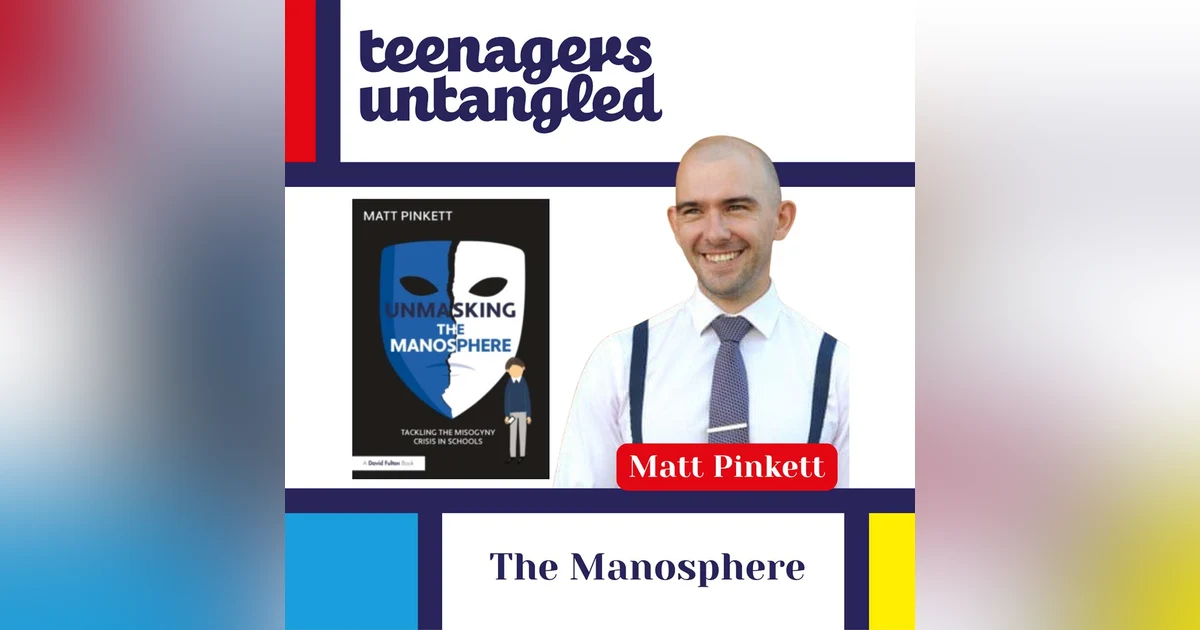

Ask Rachel anything “Is my son secretly being taught to hate women?” If you’ve ever heard your boy casually repeat a line from Andrew Tate… seen him disappear into his room with his phone… or wondered what on earth he’s absorbing on TikTok and YouTube, this episode is for you. The manosphere is grooming boys to believe women are the enemy—and most parents don’t even realise it’s happening. In this conversation, I’m joined by teacher and author of Unmasking the Manosphere, Matt Pin...
“Is my son secretly being taught to hate women?”
If you’ve ever heard your boy casually repeat a line from Andrew Tate… seen him disappear into his room with his phone… or wondered what on earth he’s absorbing on TikTok and YouTube, this episode is for you.
The manosphere is grooming boys to believe women are the enemy—and most parents don’t even realise it’s happening.
In this conversation, I’m joined by teacher and author of Unmasking the Manosphere, Matt Pinkett to unpack how these ideas hook our sons, how they show up at home and in school, and—most importantly—how you can respond without shutting your boy down or pushing him further into that world.
Toolkit: Checklist of How to Talk to Your Boys
Conflict resolution skills
Talking to your teen about pornography
The expert on talking about pornography
Please hit the follow button if you like the podcast, and share it with anyone who might benefit.
You can review us on Apple podcasts by going to the show page, scrolling down to the bottom where you can click on a star then you can leave your message.
Please don't hesitate to seek the advice of a specialist if you're not coping. There's no shame in reaching out for support. When you look after yourself your entire family benefits.
Find all the tips from the episdoe on Substack:
My email teenagersuntangled@gmail.com
My website has a blog, searchable episodes, and ways to contact me
00:00 - “Parenting Teens Through the Manosphere: Signs Your Son Is Being Influenced (and How to Respond)”
01:27 - What Is the Manosphere? A Teacher Explains
02:58 - Early Warning Signs Your Teen Son Is Being Influenced
03:55 - ‘Looksmaxing’ vs Healthy Self‑Improvement in Teen Boys
06:59 - Why the Manosphere Feels So Attractive to Teenage Boys
08:12 - Algorithms, TikTok, YouTube and How Fast Misogyny Reaches Teens
09:42 - Misogyny in Schools: What Teachers Are Seeing Now
12:48 - Porn, Violence and Teen Sex Expectations
16:56 - Banter or Radicalisation? Using Critical Thinking with Your Teen
22:31 - What Parents Should Avoid: Punishment, Panic and Shutting Boys Down
27:29 - Should We Talk to Girls About the Manosphere and Incels?
30:19 - Why Gender Equality Helps Boys’ Mental Health, Safety and Sex Lives
31:37 - How to Model Respectful Relationships at Home for Teens
32:52 - Final Reassurance: Most Teen Boys Are Capable of Nuance and Change
34:04 - How to Contact Matt and Rachel for School Talks and Parenting Support
Rachel, hello and welcome to teenagers. Untangled the audio hug for parents going through the tween and teen years. I'm Rachel Richards, former BBC journalist, mother of two teenagers and two older bonus daughters, and just the fact that you're listening to this makes you a parent who really cares, and that's a good parent. Now, you know, I like to keep an eye on what's going on in society, because we're all trying to raise good people. And a few years ago, I researched an episode looking at why Andrew Tate had become popular for the sons of one of my listeners. And that's when I became familiar with the term manosphere and its various thinkers. You can listen to my old episode by clicking the link in the podcast notes. More recently, Louis thew, a UK documentary maker created a Netflix film following a few of the other hustle culture brews that seem to be making money out of influencing, they would argue, inspiring young men. I think it's made more people aware of both who those people are, and frankly, it scared some parents. And when I hear your jungle drums, I answer, and this time I thought, you know who spends a lot of time with boys teachers. So today, we're lucky enough to be joined by Matt Pinkett. He's a teacher and author of the book unmasking the manosphere, tackling the misogyny crisis in schools. He's also written two other books, boys don't try and the author of boys do cry. Matt, thank you so much for joining us. Pleasure to be here now for parents who haven't listened to my past episode. What is the manosphere and why does it matter?
Matt Pinkett:So the manosphere is kind of the umbrella term for a collection of websites, chat rooms, gaming platforms, social media spaces in which users and contributors give voice to anti female, anti feminist sentiment. Originally, it was quite a positive space. It's kind of place where where men could go to get you know, style advice, relationship advice, fitness advice, but as I've already mentioned, it's now predominantly quite a toxic space. And when people who write and speak about gender talk about the manosphere, they're talking about this, this more toxic element of the internet. Does it matter? It matters because 1000s of vulnerable young men and boys are accessing this space, and they're being groomed, I guess, by this space, and they're being groomed to believe that women are the enemy, but society is rigged against men, and understandably, once you're groomed to believe these things, all it creates for you is anger and resentment, which which can be quite dangerous, you know, when it's projected onto those people who you think have wronged you, name me?
Rachel Richards:Women? Yeah, no. I mean, it's actually quite worrying. And I centered my original research around Andrew Tate pulling apart what he does to draw boys in for how can we identify if our sons are being influenced by that ecosystem or the manosphere? What are the signs and language, behavior, attitudes?
Matt Pinkett:Yeah, that's a good. That's a good. There are lots of signs to look for. I think any parent who notices that their son has become increasingly withdrawn probably spending more time on the internet alone. Of course, that doesn't automatically mean that your son is involved in the manosphere, but certainly I think it's worth checking in with your son, asking about the kind of things that they're accessing online in the evenings or whenever it may be, I think also open expressions of anti female sentiment. Are lots of the boys that I do work with who have been groomed by the manosphere. They it's almost like they're reading off a script. So they will say certain things. You know, 80% of women are only attracted to 20% of of the world's men, for example, and they'll pedal this stuff almost as if it's gospel. And when you actually question them on it, they're not very able to to answer the questions, because essentially, what they're doing is they're repeating the script so open expressions of disdain and resentment towards women, particularly if they start to sound a bit like they are just reading off a script and they're not really able to deal with any sort of interrogation of those belief systems. Lots of your listeners will have maybe read about looks maxing. Large parts of the manosphere talk about looks maxing, which is a process by which a man make, or a boy makes drastic changes to his physical self in order to be able to be attractive to women so that you can manipulate them and dominate them. So also look out for, you know, is your son become almost obsessive about his physical appearance. It's tricky, isn't it?
Rachel Richards:Because, I mean, you mentioned things, you know, something like look, looks maxing, for example. And you know, there's a is, there's a very clear need in teenage boys for millennia to attract girls. They want to look good for girls. So it's quite, it's quite a tricky one, isn't it? Because. Is, I can't help thinking that boys can start go out looking for like, how do I, you know, build up my physique? How do I look better? How do I and then stumble on this stuff quite quickly with the algorithms and find that they've they've gone down an area into a route that they're not they weren't intending to go into.
Matt Pinkett:Yeah, that's it. I mean, I don't think there's anything wrong with wanting to be more sexually or physically attractive to prospective mates or romantic partners. I think that's I'm almost obsessed, obsessive a bit about myself, but, but I think the thing with looks maxing. You know, the best way to looks Max is to have a healthy relationship with foods, and that includes healthy relationship with junk foods as well. You're allowed to have little treats, a healthy relationship with physical exercise, drink lots of water, get out and about, get that vitamin D. That's the proper way to looks Max, you know. But sadly, you know, these people are telling boys that they need to be smashing their jaw lines with hammers in order to give a more defined appearance. There's people advocating the use of crystal meth to achieve a more gaunt kind of streamlined look. Wow. You know, there's all sorts of drugs steroid abuse that people are that are advocating and and that's not a healthy way to improve your physical self. So wanting to appear sexually or physically attracted to other people, I don't think there's anything wrong with that, but looks maxing in the techniques it advocates, there are very definite problems with that. So I think the I think any parent that says to their son, you know, how you look doesn't matter. I think that's a hard argument to win, because the fact is, they exist in a world, an online world, where looks are everything. But certainly you know, talking about healthy ways to achieve a better physique, I think that's the way to go.
Rachel Richards:Yes. And why do you think this content is so effective with with the boys who get drawn in? What is it that it's offering boys that they're not getting elsewhere?
Matt Pinkett:I think it's offering boys acceptance. You know, because what it does is it provides a neat little narrative for their maybe their romantic or sexual or physical failings. So you know, the manosphere is telling boys or the reason your girlfriend dumped you, or the reason you can't get a girlfriend is because women are shallow and women are inferior, and inferior creatures that they're not sensible, they're irrational. They don't know what's attractive. Women are only attractive to certain traits. So they provide a nice little narrative where we can go, oh, all of a sudden, it's, it's not my fault. It's not my fault that, you know, maybe I'm a bit too controlling in my relationships. Maybe I'm not a very interesting person because I don't read often. Maybe I am a bit selfish in my relationship? No, it's the woman's fault, or it's women's fault. So not only does it provide a neat little narrative for our failings, but also it promises a way out of those failings, right? So not only do we just pay
Rachel Richards:us as much money and then we'll tell you the answers,
Matt Pinkett:yeah, exactly. You know, all you've got to do is accumulate wealth, dominate women, treat women as objects, and they'll find you more attractive as a result, and yet, and also will charge you lots of money for our secrets. Yeah, I think an explanation for a failings, and also a way out of them is, is, what, what? What many boys are drawn to that, and the fact that, also the algorithms are actually pushing these things towards boys. You know, yes, on average, it's just 23 minutes before YouTube and tick tock start to recommend misogynistic content to teenage boys accounts. Yeah, 23 minutes. Wow. A boy only has to be watching. I believe this was research from Dublin University. A boy only has to be on YouTube for about two hours before, I think it's 76% of his feed contains toxic masculine content, you know?
Rachel Richards:So, wow, yes, it's fascinating, isn't it? Because my daughter said she was out with a whole load of guys a while back, and she's at university now, and she said it was so interesting, because we all just sat there and said, Hey, let's look at each other's for you pages on Instagram. And she said, when she looked at their for you pages, she was shocked by how completely and utterly different they were to her for you and what her girls tend to see. And I think that's also one of the big things, isn't it, and how is it affecting schools and teachers.
Matt Pinkett:I think it's affecting schools and teachers, because I think there's more brazen kind of misogyny around so there's simply the fact that misogyny is more mainstream now boys are being exposed to misogynistic content. Which, you know, just because it's the source of the problem is the online world doesn't mean that it remains an online problem. It seeps into real life. So, you know, untangled levels of sexual harassment in schools, openly misogynistic language towards girls and to female teachers. So obviously there's a behavior problem there. Also, on a very pragmatic level, you know, teachers are now, you know, the recent draft of the new keeping children safe in education document, the government have listed misogyny as a harmful sexual behavior for the first time ever. So yes, we're having to deal with it because the problem is there, but we're also having to deal with it, because as of September and the new academic year, there's a legal obligation to to follow the government guidance. So so there's that very pragmatic need to better understand this, this problem. Do you think is a good thing that the
Rachel Richards:government has given that sort of guidance?
Matt Pinkett:Yes, yes, I do think it's good. I think it does show good intent. I think it displays a willingness to tackle a problem that I think for too long has been ignored. Does that mean it's going to instantly solve the problem? No, not necessarily, but certainly, it excites me that we're, we're going to exist in a world in which schools have, you know, a safeguarding kind of obligation to to not just tackle harmful sexual behaviors, but to actively address misogyny, because it's rife.
Rachel Richards:I know that the percentage of female teachers versus male teachers now in secondary school education has actually, you know, there's so many more female teachers and male teachers, but that's one thing. But also, to what extent, has it just got worse? Or is it just that we're more aware of it now because of what's happening?
Matt Pinkett:The similar answer is, is very difficult to tell. People often ask me, has it got worse? I think it's more open. I think it's more brazen, but I think misogyny and sexual harassment and objectification of women has always been there, so it's difficult to tell if it's got worse, or if we're just more aware of it, or if you know very slowly, this limping towards greater female equality means that women feel more empowered to talk openly about it. What we do know is that, you know, one in three girls in the UK will be the victim of sexual harassment. One in four girls in the UK will be the victim of physical sexual harassment. And of the girls who are the victims of sexual harassment at school, 86% of those don't report it to a teacher. So it's a very real problem. You know, whether it's whether it's got worse, is something different? It's hard, yeah, and
Rachel Richards:you're, you're quite clear that pornography is, isn't a side issue. It's actually shaping ideas about sex, consent and power. Can you sort of elaborate on why you think that? Yeah. I mean,
Matt Pinkett:funnily enough, I'm not anti pornography, which I think people are often surprised to to hear. I am anti female violence, or anti violence against women and girls, and I know that a recent meta analysis showed that 87% of the world's most watched porn films show an act of male on female violence. Okay, whether that's slapping, choking, strangling, and in those 96% of those cases, the woman who is having the violence inflicted upon her is either remaining, showing a neutral face, or showing enjoyment of that violence. Now, in actual fact, if people want to watch if people want to watch pornography, it doesn't bother me. I really believe that for millennia, human beings have found the acts of sex erotic, and watching other people have sex, people have found that erotic. So if people want to watch pornography in a way that is legal and ethical. That doesn't mean anybody's being exploited. That's fine, but what I do have a problem with is boys and girls absorbing the messages that male on female violence is a natural part of sex. And obviously, you know, there are girls who, who expect to be slapped during their first sexual experience? I've had boys come to me. I've had boys tell me how worried they are. They're scared to have sex because their girl is expecting the boy to be violent to her and she's, you know. So girls absorb these messages as well. I have boys saying to me, I don't want to hit her, but it's kind of expected of me. So I think
Rachel Richards:we've pulled I think that's a really important point. That's a really important point because there's always this idea that it's boys just wanting to do this. But, you know, some boys find this very uncomfortable.
Matt Pinkett:Yeah, of course, yeah. And for some boys, if they're not. Violent. It's almost like they're not they're not good at sex. So it's a it's a very, it's a very tough one. I think we need to get a lot better at talking about pornography. I think some of the, I think the way it's stigmatized, and the way that we talk about kids who have engaged with pornography as if they're somehow dirty or sexually deviant. I think that puts up a real barrier to children coming to us with questions that they might have about what they've seen online. You know, if we make our son feel as though watching pornography means he's a pervert, then when he does watch pornography, and inevitably, he will at some point, statistically speaking, you know, he can't go to mum and dad about his anxieties. If Mum and Dad or the teachers at school or whoever it is, are going to make him feel disgusting for having engaged with what he engaged with.
Rachel Richards:Yes, I heard the same thing from Mike Nicholson, where he said, you know, boys shut down because they feel judged, and as soon as they realize they're in a judgment free environment that you can't shut them up. And I think you're making a really good point there, that when we ignore areas, then what they're learning is they're learning from each other and learning from online none of which is necessarily very healthy. I mean, I remember my daughter when she turned 12, I just said to her, you know, I know that your friends are wonderful and they love you and they care about you, but they're 12, they have not got that breadth of experience. And it's so much better to ask an adult that you trust, who can give you context. But we need to be those people in the room, don't we? Yeah. And how can a parent tell the difference, perhaps, between a boy who might just be repeating things for a laugh that they've heard from other people, and it's part of sort of banter and one who's genuinely been genuinely being influenced? Where would we draw that line?
Matt Pinkett:Yeah, again, that's that's another difficult question. I think it comes from conversation. I think a lot of misogyny when it rears its ugly head. A lot of it is performative. A lot of boys doing it because they're trying to fit in, or they're playing for laughs, or they're doing it to feel part of an in group. Boys being genuinely radicalized to the point where they hate and resent women and want to inflict violence upon women, or sexual violence upon women. It's rare the actual answer is just critical thinking. You know, getting asking kids questions all of the time about the content that they're consuming, and it's only you know, it's not like there's there's a button that goes off that lets us know, oh no, this boy has been radicalized. We have to use a bit of our own knowledge of that individual kid, but simply asking questions and just gaging the responses from those questions. You know, I had a boy fairly recently tell me that one of the reasons he hated women was because he believed that all women are gold diggers. And so, you know, I was then able to say, Okay, well, what do you mean all women like, Have you got objective proof that every woman on the planet is and, of course, he said, No. And I said, Okay, so how many women have you come across that are gold diggers like, if I had to give you a figure now? And I think he said, 40. I said, Okay, so 40 women. Where have you seen these women? He said, Well, online. I said, Okay, so what you're being shown? And basically he told me that he's only fans girls and and women who are very attracted by Western standards, I guess that he follows on Instagram who are always jetting here, there and everywhere and dating rich men. So I said to him, do you ever curate your your algorithm, right? Do you ever follow? Do you ever actively try and search for women who do not value rich men? He said no, and very quickly he started to kind of laugh as I was asking him this question. He he could very quickly see that his initial statement, of all women are gold diggers, was, was quite easy, falling apart. So then I could obviously tell, look, this is, this is a smart kid. He's just, you know, he's, he's just like, almost like, an unthinking repeater of misogyny, rather than a boy who genuinely believes, you know, whereas, if I'd asked those questions and that boy was still adamant, like, you know, then obviously I realized, well, this is a problem now, because I'm as an adult, I'm quite good at deconstructing these arguments With this kid, even in the face of my deconstruction of his argument, is still sticking to it. He's almost sticking into it blindly. And in that hypothetical situation that is a student who certainly I'd be talking to other adults about about, you know, what do we need to do now, I think
Rachel Richards:that's a fantastic way of showing us how you would actually go. About doing that. Because I think often parents think, yeah, I know I should be doing something and asking questions, but I just don't know how to do it without upsetting and offending them. I love that. And I remember this one woman saying that her son had trotted out girls only go for this type of man. And she said, Well, we live in a quite poor area with a lot of men that aren't very successful. They're short. How did they get their women. It can really help, can't it?
Matt Pinkett:Yeah, it reminds me of I had a conversation with one boy who was telling me that 80% of it's quite a popular manosphere ideology or belief, the belief in the 8020 principle, which is basically this idea that 80% of the world's women are only attracted to 20% of the world's men, which means that 80% of men are at the bottom of the dating pool, and women are free to use us, settle for us, and leave us when someone better comes along. And obviously this is the source of lots of resentment. Anyway, this boy was he swore blind in this 8020 principle. So I just said, Look, I don't mind me asking, but is your dad? Well, fit? He said, What do
Rachel Richards:you mean for the international listeners? That just means he really
Matt Pinkett:good looking. Yeah, is your dad? Is your dad? Like, really sexy? Is your dad really good looking? He was like, Well, no, don't be ridiculous. And I said, Well, surely anybody, if 80% of the world's women are only procreating with 20% of the world's men. Surely, everybody that's ever had a father or been born must have had a really sexy dad, right? Correct? You know, think about all the dads that you've met. Are they all? David Gandhi, they're not. Are they? When we look at the facts consistently across cultures, women are drawn to intelligence, kindness, personality traits of financial means or wealth. In fact, the more gender equal a country is, the less men and women value money in a prospective partner. So it's also finding these little facts and these little sound bites, and kids don't do research, right? They'll watch a video on Tiktok where somebody's spouting out all these percentages, and sometimes they just need us to just show them what fact checking is like. Have you fact checked that? You know,
Rachel Richards:yes, yes, I'm gonna have an interview about critical thinking coming up. So here's the thing, let's have a think about some practical advice. Because I love these examples you're giving. It's very, very helpful. What? What would be the worst thing that parents could do, or that the parents should avoid
Matt Pinkett:when they're at home? I think just being punitive rather than actually discussing these things? Yes, remember people like Andrew Tate and another manosphere influencers are telling boys that masculinity is dead, right? Your teachers, your parents, society, they do not care what men think or what men feel or what men want. So when your son says, Actually, Mum, you know, I there's, there's some bits of Andrew Tate I quite like if all we do is say, right, get to your room now or right, you're not having your pocket money this week, or right, get out the classroom. Right, you're in detention. If that's all we do without any sort of discussion, then what we're doing is we're simply reinforcing the things that Tate and his ilk are telling these boys we're reinforcing that we're not open to discussion, however upsetting it might be for us and however inclined we are to react by wanting to punish or, you know, get out of my sight. I don't want to hear you when you speak like this. Actually, what we really do need to do is get used to showing curiosity. You know, that would be my number one piece of advice. And also, don't, don't, also make the assumption that just because a boy likes Andrew Tate, that he is a sexist pig, right? Like read a piece of research that looked at it was from YouGov, and it asked boys who had a positive view of Andrew Tate four questions and and I remember one of the questions was, do you agree with Tate's views on women? And only 11% of people who liked Andrew Tate agreed with his views on women, right? So boys are actually a lot better, and maybe to a fault, really, because, you know, but boys seem to be a lot better at distinguishing, or making the distinction between Andrew Tate, the athlete and Andrew Tate, the person who says horrific things about women. Yes, and again, just knowing that just because your son has watched pornography, or just because your son can see something positive in Andrew Tate doesn't mean your son is like Andrew Tate, you know. And I think just knowing that that can bring a lot in terms of even our body language and tone of voice. Once I read that research, it's never left me, and certainly in the early days when I was first talking to young lads about Andrew Tate, when a boy would advocate or champion for Tate, i. Would I think I brought quite a lot of hostility in my body language, my tone of voice, the look of scorn or disdain on my face, but actually now I'm a bit more open minded. I think I'm a lot more willing or to engage in conversations, but also my tone of voice, my body language, is more positive, which means, you know, I can have a more fruitful discussion with a boy. One other thing I would just quickly say on that is also, I think, you know, if you're a parent talking to your son about these influencers, it's always much better to attack the belief system or the value system rather than the individual. So rather than saying, well, Andrew Tate's horrible, you know, actually saying, Well, do you think it's okay to hit women, you know, what's the you know, and attacking the belief system, rather than the individual, however tempting it is, and I let myself down all the time here, we all do. We all do. Yeah, like, it's very, it can be very pleasing to attack idiots, you know. But you know,
Rachel Richards:no, no, absolutely. And it's so interesting, because when I researched deeply into what he was saying, I thought there was a very, a lot of very clever sleight of hand in the things, because he hits a lot of buttons. And, you know, if you're only looking over here at kind of the workout stuff, or the, you know, get strong, get rich, whatever stuff, and that's your interest, you're not going to be listening that closely to some of the much more toxic things he's saying. And so if you just say to the boys, that's a terrible thing, they're going to think, What do you mean? He's fine. And so yeah, I agree with you. I think it's really important to sort of drill down and be a bit more circumspect in our pushback,
Matt Pinkett:and also think about the messages that we are sending to us, like schools or many schools are places where kids are being told, you need to work hard. Why do I need to work hard so you can earn money, you can go to university and become a doctor or a lawyer. Schools put lots of emphasis on the accumulation of wealth as a measure of success and the accumulation of qualifications as a measure of success, which is the same thing Tate's doing. He's saying
Rachel Richards:such a great point. Yeah, Work hard.
Matt Pinkett:Work hard so you can accumulate wealth. Isn't that what schools are doing? Maybe we need to think about how we distance ourselves from his messages, rather than worrying about how his message aligns with ours. You know, yes, I love that.
Rachel Richards:I think it's a really important point. And what about girls? Do you think we should be having conversations about the manosphere with girls, and what should we be saying to them? Because I think scary. It is scary.
Matt Pinkett:I was a bit. I was a bit. I mean, the answer is yes, girls need to learn about these things, however. Well, girls need to learn about these things if we're going to talk to the boys about them, I think the big question is, do we need to talk to the boys about these things? And what I mean by that is, I was very skeptical when adolescence was released on Netflix. And I think even the Prime Minister perhaps, maybe, you know, was coming out talking about, you know, we've got to show this in schools. We got to talk about INCEL culture with students. I'm skeptical of that. And the reason I'm skeptical is, firstly, the research for my new book on the manosphere. And I did write a chapter which was a lot of it was about INCEL culture. It took me to some dark, dark places, right? You know, men talking about how they can rape. You know, rape should be legalized. Lots of talk about suicide and self harm. It's a really, you know, there were nights where I wouldn't sleep because of what I'd seen in my research during the day. And you know the idea that you would show a video about or give a lesson or show a Netflix drama about in sales to a group of young people, for me, is a bit problematic. I'm quite happy to talk about Andrew Tate because I think he's ubiquitous to the point where he's mainstream. But I don't think in cell culture is mainstream. I still think it's it's very dark, and I'd be worried about signposting kids towards these websites and these ideologies. However, I think 15 years old, 16 six formers, year elevens, perhaps you could talk about in cell culture with them. Perhaps you could show adolescence with them. But even so, you've got to think very carefully about how you do that, because if all we do is talk about in cells with mocking and disdain, and let's all laugh at these weird little guys on the internet, if there's a boy in that classroom is already being groomed by INCEL culture, for example, to have his teacher at the front kind of being openly disdainful of in cell culture, it could just further push that boy into the ideology. So, you know, simply just, well, let's all address it in schools. It will be okay. We I do think we have to be careful. We need to think carefully about about how we do it. I think as parents, you know, when, when a boy reaches 15. Mean, I think you could have a very frank discussion about it. But again, I would much prefer a world in which we attack the value system, rather than a group of people known as incels, or, you know, an individual known as Andrew Tate, whatever it is we've
Rachel Richards:been talking about misogyny and how problematic it is. But for a boy, why would he care? Like, what's what's in it for a male, if we're
Matt Pinkett:going to ask that question, what's in it for men, there's a lot in it for men in 2018 the World Health Organization did a did a study into the impact of of gender equality on men's lives and and what they found was that in countries where there is more gender equality, in countries where men and women are on an equal footing, or more of an equal footing, there's loads of benefits for men. We're less likely to die by suicide, we're 40% less likely to die a violent death. We're 50% less likely to have depression, we have better lower back pain, we have better sex lives. We have better sleep. We're less likely to die of heart disease. That's a good list better sex, you know, like, who doesn't want that? And also, would you believe it? Who would have thought it? But in more gender equal countries, women have better sex too. Yes, gender equality is good for everyone,
Rachel Richards:good for everyone. That's, I think that's the important message there. And you write that prevention is relational, like boys need respectful contact with girls and women. What does that look like at home? I mean, how can we foster that? I think modeling,
Matt Pinkett:you know, in families where mom and dad are present, or, you know, there's there's male on female dynamics. Maybe a sister, I think the man demonstrating respect for women, thinking about when Mum and Dad are having an argument. Just always remember that just because your kids aren't in the room doesn't mean they're not hearing what you're saying to each other. Be aware of your body language, you know, try and resolve conflict when I'm disagreeing with my partner. You know, I'd be sat down listening to her speak, not interrupting her, having my say, without swearing, without, you know, intimidating her by standing up. So, you know, modeling positive conflict resolution, but also just thinking about the way that we talk about men and women. Yes, when an attractive women woman walks past me on the street, you know, I think it makes me cringe in my early 20s, where, you know, not turning around ogling her and being all disgusting and creepy, whereas now, obviously you know you wouldn't do that. You know, just just modeling that respect
Rachel Richards:for women. Are there any other points you'd like to make for parents? Top tips before we go,
Matt Pinkett:my first thing I like to say to parents is, you know, boys aren't as bad as the media will have us believe. I want you to feel reassured when I go around schools. Boys are capable of emotional nuance. Boys are capable of nuanced thinking, and most boys when they're engaging in those more toxic elements of masculinity, nine times out of 10, it's performative. It's not it's not sincere. They're doing it because they've never been told otherwise and and actually, when you talk to boys and you educate them, just having those very direct conversations, really works for too long. A quite outdated, dominant brand of masculinity, has been the default. It's been the blueprint. And because it's the blueprint and it's the default, it's never been questioned. We still don't question it, but actually, just having these direct conversations with your boys is it empowers them, it doesn't disempower them? Yes, speak, speak, speak. Yeah.
Rachel Richards:Fantastic, Matt, if people want to get hold of you, what's the best way for them to contact? You? You can find me
Matt Pinkett:on Instagram, at official Matt Pinkett. I'm also on LinkedIn, or you can just google me, Matt Pinkett, and you'll find some way
Rachel Richards:of getting a hold of me. And you go into schools to do talks and things like that as well. Don't you?
Matt Pinkett:Yeah, yeah, yeah. I go Yeah. I go all over the country. I go into Europe as well. Recently, so yeah, I'll go anywhere, you know, fight the good fight. And talk to lads about misogyny. Speak to girls as well. Misogyny, sexual harassment, how to stand up to it, that sort of thing.
Rachel Richards:Fantastic, brilliant. Thank you so much, Matt. I really appreciate it. If you found this useful right now, send it to one other person you know who might also benefit. If you'd like to contact me, it's teenagersuntangled@gmail.com I have my own website that@teenagersuntangled.com's and I also have my own substack. I'm on Instagram, I'm on LinkedIn, I'm all those places. So just come and find me, ask me questions, give me feedback. I'm open for anything, even if it's negative. Be kind, and that's it for me. A big hug. Bye, bye.