


 Apple Podcasts
 Spotify
 Castro
 RSS Feed
 Parenting in High-Conflict Homes: Protecting Your Kids When Your Partner Won’t Change

Ask Rachel anything “My husband is highly critical of the teenagers, gets angry over little things and yells, so I’m having to make up for his behavior, and I often avoid involving him in parenting decisions." This message came into my Substack. It was a plaintiff request for support and a plea to know how others deal with the problem. When I posted it (with her permission), a flood of parents said, “This is my life too.” If you're dealing with high conflict in your home, whether with y...
“My husband is highly critical of the teenagers, gets angry over little things and yells, so I’m having to make up for his behavior, and I often avoid involving him in parenting decisions."
This message came into my Substack. It was a plaintiff request for support and a plea to know how others deal with the problem.
When I posted it (with her permission), a flood of parents said, “This is my life too.”
If you're dealing with high conflict in your home, whether with your teens or your partner, then this is the episode for you.
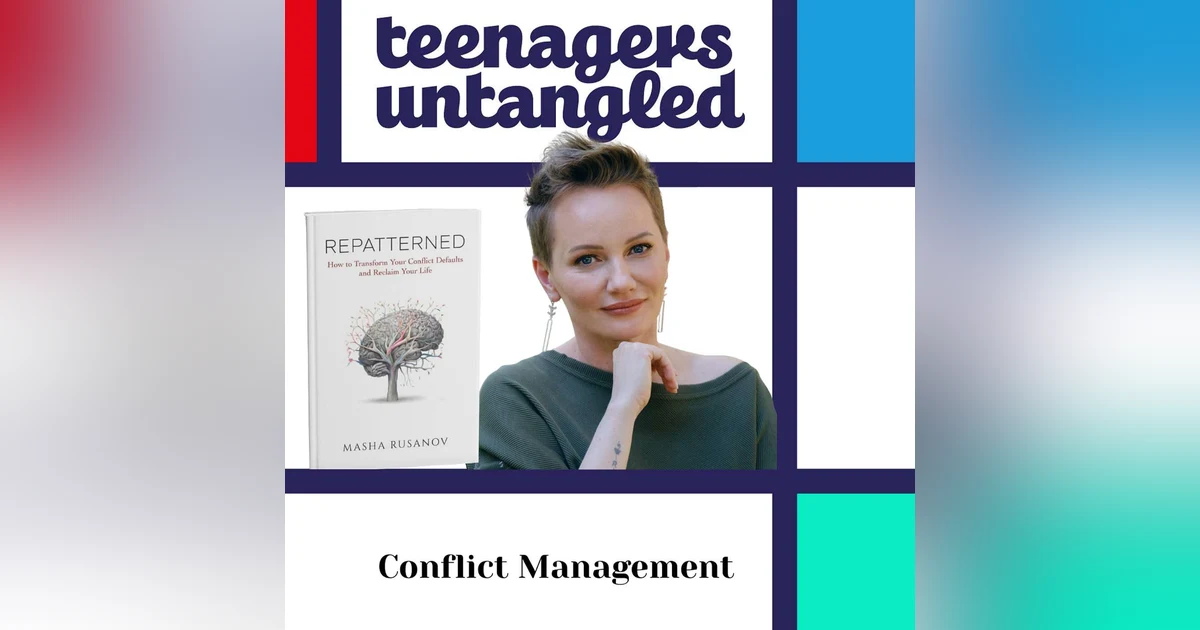
Conflict navigation specialist, mediator, and divorce coach Masha Rusanov helps us to unpack what really sits behind high‑conflict dynamics at home—especially when one parent is emotionally dysregulated, highly critical, or reactive.
She says:
'We don’t choose our conflicts.
We repeat them.
Until we change the pattern."
Link to my write-up on the topic
In our conversation we explore:
- Why we repeat the same painful conflict patterns (and how to start changing them)
- Masha’s simple but powerful Exhale–Explore–Engage framework you can use in the heat of the moment
- Practical scripts and tools (EAR and BIFF) for navigating a high‑conflict partner
- How to protect your children emotionally, set boundaries, and avoid parentifying them
- Ways to talk to your kids honestly about what’s happening—without overburdening them
If you’ve ever found yourself “making up” for a partner’s behaviour, or trying to keep things calm so your teens feel safe, this conversation is for you.
REMINDER: Please don't stay in a situation that is potentially dangerous. This is the national domestic abuse helpline for the UK, but you will likely have one in your country if you're listening somewhere else.
Spotting the signs
- Is your partner jealous and possessive?
- Is he charming one minute and abusive the next?
- Does he tell you what to wear, where to go, who to see?
- Does he constantly put you down?
- Does he play mind games and make you doubt your judgment?
- Does he control your money, or make sure you are dependent on him for everyday things?
- Does he pressure you to have sex when you don’t want to?
- Are you starting to walk on eggshells to avoid making him angry?
- Does he control your access to medicine, devices or care that you need?
- Does he monitor or track your movements or messages?
- Does he use anger and intimidation to frighten and control you?
Please hit the follow button if you like the podcast, and share it with anyone who might benefit.
You can review us on Apple podcasts by going to the show page, scrolling down to the bottom where you can click on a star then you can leave your message.
Please don't hesitate to seek the advice of a specialist if you're not coping. There's no shame in reaching out for support. When you look after yourself your entire family benefits.
Find all the tips from the episdoe on Substack:
My email teenagersuntangled@gmail.com
My website has a blog, searchable episodes, and ways to contact me
00:00 - Introduction: High-Conflict Parenting and Emotional Dysregulation
01:45 - Why We Repeat the Same Conflict Patterns in Families
03:30 - You’re Not Broken: Understanding Your Conflict “Defaults”
04:57 - The Exhale–Explore–Engage Framework Explained
07:49 - How a Long Exhale Calms the Nervous System in Conflict
08:49 - Scripts From Childhood: Why You React the Way You Do
10:23 - Choosing a New Response: Rewriting Your Conflict Script
10:54 - The Aggressor–Victim Cycle in High-Conflict Relationships
13:10 - Spotting High-Conflict Personality Traits in Your Partner
14:10 - Practical Tools: Choices, Future Focus, and EAR Statements
17:15 - Boundaries with High-Conflict People: What Actually Works
17:56 - When You Change, the Family System Shifts
19:38 - Staying but Still Protecting Your Kids in High-Conflict Homes
21:23 - Doing Your Own Work: Grounding, Grief, and Self-Regulation
23:05 - Exploring Your Patterns: Parts Work You Can Do Yourself
25:30 - Grounding Techniques: Breathing, Tapping, Movement & Shaking
27:17 - What to Say (and Not Say) to Your Kids About a Difficult Parent
29:06 - How Parental Conflict Shapes Your Child’s Identity
30:51 - Using High-Conflict Tools with Teenagers
Hello and welcome to teenagers untangled the audio hug for parents going through the teen and tween years. I'm Rachel Richards, former CNBC Europe and BBC correspondent, a mother of two teenagers and two bonus daughters. Just quickly, the fact that you're listening to this podcast makes you a parent who's curious and wants to learn, and that makes you a good parent, right? I recently received a message on my sub stack from a listener who said I would love to hear how to manage a dynamic in which one parent has issues with emotional dysregulation and is emotionally immature, and the other parent is trying to navigate this to create a stable environment at home. My husband is highly critical of the teenagers, gets angry over little things and yells, so look, I'm having to make up for his behavior, and I often avoid involving him in parenting decisions. It creates more stress for me to be honest, and I've taken on most of the parenting the children trust me and share with me, which is good. It would be a great support to know how others deal with this dynamic, especially when the partner has no insight into his issues. So with her permission, I put this on Instagram and received a flood of responses saying it describes their own situation perfectly. So you're going to love today's guest. Masha rusanov is a conflict navigation specialist, mediator and divorce coach. She's also the author of an excellent new book that's coming out in May, I believe, called we patterned how to transform your conflict defaults and we claim your life. Now in today's episode, we're going to discuss a framework we can all use to help ourselves navigate difficult situations, whether at work with friends or loved ones, how to apply the framework and create boundaries in hostile, reactive co parenting situations, protecting your children and also what success looks like when repair isn't actually possible. Marcia, thank you so much for joining us. Thank you. It's a pleasure to be here. Now. You say we don't choose our conflicts. We repeat them until we change the pattern. I'd love to begin with, what made you write we patterned? Was there a particular moment when you realize that this was the work you most wanted to put into the world.
Masha Rusanov:Yes, there was a moment. It was actually a dream that came to me. And I believe that dreams happen for a reason, and they carry helpful messages. And the reason it came was probably because we were dealing with teenagers who were quite high conflict, believe it or not, how interesting. Yeah, but in this dream, I had this aha moment of like, oh my gosh, we are repeating the same pattern. And the only thing that could help is really to look at what the opposite of that could look like. And when we are in the pattern, we don't see anything else outside of it, so it's really hard to get out of it when you're in it,
Rachel Richards:I love that. And you write really compassionately, that our default positions and reactions, they're not signs that we're broken, but they're signs that we have these patterns. So can you explain what you mean by that, and why that shift in perspective matters so much. Yeah, everybody has their own upbringing and history and experiences in life, and there are moments that define how we show up. And there are moments when we have to freeze or run or hide or get defensive or aggressive, and
Masha Rusanov:that reaction works in the moment, usually in childhood. And the reason that it works is because we cannot consciously choose in that moment how we will respond. So if you're a child and an adult is yelling at you, you cannot really yell back, because it will likely lead to much more difficult consequences for you. So instead, we choose to either freeze or hide or shut down, and that strategy keeps us safe, so we adopt it as a subconsciously, of course, as a long term strategy that works for us, and we carry it through life without realizing what's going on. Because especially if the pattern repeats, we reuse it. The neural pathway gets stronger. We adopt it, and we're like, oh, okay, this is how I'm going to show up now in this moment, although it's always a subconscious decision at that point, and it feels comfortable and familiar, right, right, exactly. It feels comfortable. And we go down the same track, and the more times we go down the track, the clearer the track becomes. And we don't even know that we're on this track until we start looking in and get curious about what's actually going on, and
Rachel Richards:now that this is the perfect moment to talk about. I mean, before we go on to the specifics of family dynamics, perhaps you can walk us through your framework, which is, exhale, explore, engage and like, how is it designed to help people?
Masha Rusanov:Yes, it's meant to give. Us enough space to become aware that something is going on deeper than what's on the surface, get curious about what it is, and then engage in a different way that would allow us to have a different outcome, that what we always do. But the framework, the way it works, first step is to exhale, and it's just a very long exhale. You can do it anywhere, even if you're in the work meeting and you're starting to get activated or feel triggered, if the discussion gets heated, you can always exhale. That's something that's available to you at any moment. The biggest, most difficult part of this is to remember that you can do that. So if you can, you take this long exhale, maybe one, maybe two, maybe 10, however many. You need to just create the space for yourself to pause. And then once you have that space, you get curious. You explore like, Oh, what is it that is going on right now? What do I actually want to do? What is the need underneath? And that's the Explore stage. Usually that comes up in more depth when I work with clients and coaching and we go deeper into what's behind it. But even in the moment, if you can just think, oh, right now I'm feeling activated, and I really want to hit someone with a pen. You know, that's a great that's great awareness when you're in the middle of conflict. And that's the second step. So once you understand what your urge is and what is it that you want to do, then you can think, okay, if this is what I want, what could the opposite look like instead of hitting someone with a pen? What if I made them some pancakes instead, or ran away or said something rather than becoming that physical? And once you think of a couple of options, you can try them on, see what it would feel like in the body. If you have the opportunity to do that, you just imagine like, okay, let's imagine that hit someone with a pen. How do I feel? And your body is very wise. It will know. It will give you a reaction. You become tense. You become what your jaw might get tight. Or if you think, okay, if, instead of that, I put the pen down and give them a hug. Maybe the body is going to relax, and you might notice different sensations. And then maybe you imagine couple of other reactions that you could do. And then you go with the one that feels most aligned in the body, where you feel the most relaxed when it's opening, rather closing, and it definitely will get you to a different outcome,
Rachel Richards:the breathing out. What's that doing in the body? Because you presumably, you're in threat mode. You're in your you've got your your fall for free, your fight. Fight, freeze, fall. How does this really re engineered? What's going on?
Masha Rusanov:It's meant to calm your nervous system down, because when we're activated, your amygdala kicks in and all kinds of circuits that start firing, and when you have the long exhale, it calms those systems down, and it kind of gets your brain into this more logical state so that you can make different decisions,
Rachel Richards:right? Yes, you're getting it, but to switch back on again, because you can't. Once you're flooded or you're upset, it's very difficult to think and with the Explore. Did you talk quite a bit in your book about how we have these scripts that we run from our childhood or from events that have happened in the past where we're not even aware that we're trying to protect ourselves from something. Can you talk a bit more about that?
Masha Rusanov:Yes, it's really hard to do this part in the moment, but it's good to focus on that when there is a moment to do so. And I am a big fan of internal family systems theory, which you probably have seen in the book. But I believe that we have different parts and the self, and these different parts have different roles. For example, the ones that respond first and have the strongest reactions are firefighter parts, and they protect something sensitive, or traumatized part that might be called an exile that doesn't want to face whatever it faced in the past. In a similar situation, so with firefighters and then manager parts, they carry those functions of protecting those more tender, most often child parts that carry the pain, that carry the wound. And when in explore, we get curious about that, and we realize that, oh, I'm actually freezing because there's a part of me that was really hurt when somebody yelled that, when we create the awareness that's necessary to them to be able to. Change the pattern altogether,
Rachel Richards:and we can't simply, when we've become aware of the pattern, that's a very important stage, isn't it? And you're saying you can choose a response, and you're you were just saying to sort of try and think through what could be a possibly, a possible different response, rather than the old script, and then go through a range of them, and then pick the thing that feels feels best for us, is that, is that right?
Masha Rusanov:Okay,
Rachel Richards:great. So once people understand this framework, the real question becomes, what, what does it look like in real relationships when we're really activated? And I mean, for many of that's family. And as you say, family conflict is is rarely just about what's happening? Well, we get upset about something, but often it's about something else. It's the meaning behind it. So what are the classic family some of the classic family roles you see people slipping into when conflict starts,
Masha Rusanov:it's often somebody attacks, somebody defends. These roles. Unfortunately, I see very often in divorcing couples, where one is the aggressor and one is the victim, and they enable each other too. When the aggressor attacks, the victim falls into, if they're, you know, repeating the pattern that they are used to. They fall into this state where they get defensive. They probably try to appease the aggressor. The aggressor escalates even more. The victim appeases even more, and so on, but doesn't seem to ever make them satisfied. Then it escalates and escalates and escalates to the point where the victim kind of breaks down and, you know, there's crying and worse things sometimes, then the aggressor feels bad and becomes really nice and loves them again, and that's what victim wanted. And they live for these moments. And I can speak to this because back in the day, I had a relationship like that, and before, I never knew that I could get stuck in such a dynamic, but then later I looking back, I was like, Oh my gosh, I was repeating that pattern there. Thankfully, I got out pretty quickly, but I understand how it works, and it just sucks you in, and it's really hard to get out when you're in it, because there are those moments where you get hopeful again. You know, he's so nice, maybe he can change, but reality is very unlikely. Well, they need
Rachel Richards:to be the person listening to this and making the changes, rather than you, because that's the problem. We can't change other people, can we? Unfortunately, yes,
Masha Rusanov:but they never will, because they don't have the introspection, curiosity.
Rachel Richards:Have you ever seen people think actually, I do need to try and make a difference.
Masha Rusanov:Yes, that's a great question. I wish I had many examples, but I might have one if I really scramble and fully most often people don't change. One example that I can think of, it was near death experience that triggered the change. So
Rachel Richards:when you heard the listeners plea in the introduction, what was your thought? Your immediate thought about that,
Masha Rusanov:I recognize the high conflict personality pattern, and that's basically what we're talking about when we talk about those aggressor victim dynamics that repeat, and the patterns and people who have high conflict personality have four traits. They are unable to take responsibility for their actions, hence blaming everybody. They have unprocessed or unmanaged emotions and extreme behaviors and all or nothing thinking and because they cannot look inside and they do not process emotions. Well, they get stuck in the denial and anger stage a lot. They are not able to get passed through it. So it's really hard to communicate to someone like that when you are not in the same framework, in the same mindset, but there are ways to actually be able to there are steps that you can take and tools that you can learn to move forward with a relationship like that. So can you give us some? Yes, of course. It would be funny if I just said, Well, yeah, but the idea is to bring them more into left brain, where they can tap More into the logical rather than the emotional thinking. And to do that, for example, you can give them choices instead of asking open ended questions. So let's say they're like, Oh, you did this again. You, you know they they're attacking you. They're saying how you never clean things then you never help me out with whatever, right? And here you can give them a choice you want to move them into the future. You're from the past, otherwise they might get stuck on all the things that you did wrong. So you can say, Yes, I can see how important this is to you. Would you prefer we did this together tonight, or I can do it myself in the morning? So you give them a choice about the future, and that's gonna bring them down eventually, if you keep insisting on this focus on the future rather than feeding into their reminiscing of the past. That's one way. Another way is using ear statements. And by the way, these are, I learned these from Bill Eddie, who's the founder of high conflict Institutes in San Diego. But another one is ear statement. It's empathy, attention and respect. And an example is, if someone is in a bar, they've been drinking, and they get into an argument, maybe it's about politics, because things like that happen, and there's a lot to argue about there, and they start coming at you, and you know they're big and they they're strong and they're scary, and you respond with an ear statement, empathy, attention and respect. I can see how important politics is to you, or how important this topic is to you. I respect your opinion very much. I would like to make sure I understand you correctly. Are you ready to talk? They may say, No, I'm not ready to drop like and then you respond with another ear statement. I can see that you feel very passionate about this topic. I don't like to argue with you. I'm going to walk away now and set a boundary. And then you kind of back off. And that's another thing that works in those situations. It's setting boundaries, but also the way you go about it needs to be very concise. Defensiveness doesn't really work. Explaining doesn't really work. Appealing to logic is not gonna work. It's you focus on yourself with this is my boundary, and this is the consequence that I'm going to implement. And you say it once, you say it twice, and the third time you actually have to implement the consequence. Otherwise they'll keep going with whatever it is. It is they've been doing.
Rachel Richards:It's interesting, isn't it, because from I've been writing quite a bit about family dynamic and how we all playing a role. And when one person changes, it's it shifts the dynamic, and people notice it, and they can feel uncomfortable, because they're like, Oh, hang on a second. What's happened here? And then, and then, you risk upsetting the entire apple cart. I'm sure a lot of parents are quite scared of, you know, putting those boundaries and then causing further problems. So you is that, is that something to be there genuinely you should worry about? Or do you think that this, putting these boundaries in place can genuinely make a difference? Presumably, it also helps the kids see that this is a good way to do it.
Masha Rusanov:Yes, that's a great way to think about it. What would you like your kids to learn about relationships that it's okay to stay and not have boundaries and continuously tolerate whatever is going on in front of you or with you with your significant other. Or would you like them to see what a healthier relationship could look like? And it is a choice and a risk. Once you understand how to do that and start setting boundary, it can and likely will lead to some sort of change, and the change could be separation, and that's a question that I hear quite a lot with my clients, especially the ones who are considering divorce, like, oh, maybe I should stay there for the kids. Maybe separation is the worst thing that can happen, and there's a lot of societal conditioning around divorce and how it's bad. But really, what would you like your kids to know about relationships? Would you like them to model after your relationship with your spouse the way it is right now, or would you like to give them a chance to see something different?
Rachel Richards:I think there are a lot of people who for whom that isn't really an option, perhaps right now. So for those people, what can we be saying to them to help them look at their family dynamic and think, Okay, this is the best way that I can help protect my kids or show them that this isn't actually the way we we expect people to live. Because, of course, your kids are just absorbing what you're doing, and if they're if the high conflict parent is letting off steam on the kids that, in itself, is really problematic.
Masha Rusanov:Yeah, so learning about them is getting curious about how to co exist with a person like that, and there are many other tools besides the ones I just mentioned. I think learning the way their brain is organized and the way they work allows us to be. Able to communicate them in more effective ways. For example, using shorter communication rather than longer. There are things like bif messages, where it's brief, informative, friendly and firm, instead of going into lengthy explanations about something and just learning the tools and knowing their traits, knowing that they tend to reminisce in the past, and we can bring them out of it by focusing on the future, knowing about giving them choices and options, knowing about how to actually support ourselves. How do we manage our emotions and self regulate when we are triggered, knowing when to walk away, where your higher boundaries are, like you mentioned, for example, if they get abusive towards the children, that's a hard boundary. That's not something I would say anyone should continue being a part of. And there are ways to stop that, you know, calling law enforcement in or 911, or, you know, whatever it is that you can call
Rachel Richards:what if it's not, you know, physical abuse, it's just that they discipline them harshly without really thinking through the consequences or the way that that child's going to receive that, and then the parent just ends up in a situation where they just having to manage a complex situation. It's exhausting, isn't it? Yeah,
Masha Rusanov:yeah, it's hard. I think the key to surviving in this situation is really to getting to work on yourself and your own patterns so that you stop enabling what's going on around you. And the more you get grounded, the more you can lean into yourself, the more you're able to hold those boundaries with the other parent around the children. You can show the children by example, what that looks like, so they learn it from you. But you cannot do it unless you are in a place where you can right, where you feel grounded and emotionally regulated.
Rachel Richards:I think that would give comfort to some parents, that if we do the work, even though we know that we're not, we have to go through this grief process of accepting that the other person isn't going to change.
Masha Rusanov:Yes,
Rachel Richards:and I think that, in itself, is quite a difficult thing to go through, isn't it, because you don't have children with somebody thinking they're going to stay that way and be difficult. I mean, because it could have developed over that time. So coming back to some of the techniques that they can be using just to develop that, you know, we've had this kind of pause in this breath and and the exploring. So can we just talk more about how you would go about exploring what this might be that is causing your response. So you're in a dynamic, you're behaving a certain way with that person. How would you go about exploring why you're behaving that way and how you what other options might be available? So you know, let's say that he's just got really angry because there's no dinner on the table, or the kids just irritated him. How would we go through that process?
Masha Rusanov:Ideally, in therapy. Ideally, if you don't have access to therapy, there are certain things that you can do on your own, and it's all about getting curious about what's going on with you, you can envision yourself sitting at a round table, and you start inviting different parts of yourself to the table and giving them voice to speak so thinking of a situation, a conflict at the dinner table, not in the moment, but afterwards, when things are calmer. You can think of all the voices in your head, so to speak, that are expressing certain emotions, feelings, thoughts, and you invite them to this table, and you ask, what's going on? What do you need? What are you afraid of? And see what they have to say, and that's how you get curious and really go deeper into exploring the patterns. And you may not hear every part that's present right away, because exile parts tend to be pretty well hidden and only show up once you've worked your way through with the managers and the firefighters, and you understood where this fear is coming from. But then once you do recognize them and see them, most likely, you will notice that this situation at the dinner table is a replica of something that happened in your childhood, and you're not actually reacting to the person who's present. You're reacting to a some kind of an authority figure from from back then, once you see it, then you have an opportunity to decide, like, oh, actually, I'm not a child anymore. I have other ways that I could be showing up. I'm an adult now. I have access to different things and tools. Tools and resources, and I can make a different choice now, but that's also not going to be easy, because the pattern is there, but once you notice it and you consciously start practicing it, then the new neural pathway is going to form eventually, so you will show up differently. So
Rachel Richards:I think the message is, don't expect it to change immediately. It's going to take quite a bit of thinking and work. Thinking and work. Are there ways we can ground ourselves with there's the long exhale, but are there other things that we can be doing really help?
Masha Rusanov:Yeah, there are different exercises, including breathing exercises. There's box breathing, where you take a breath in for four counts and then hold it for four and exhale for four, and then hold it at the bottom for four. And you can keep doing that there. There's tapping techniques where you tap yourself and kind of give yourself a hug and tap yourself on alternate shoulders. It bilaterally, stimulates your brain and also is meant to calm you down. You can do it if you're driving on the steering wheel with your fingers. Make sure not get into an accident. Yeah, don't focus too much on the fingers and the tapping. But there's that if you can, you can also go for a walk. Any kind of movement helps. Movement loosens the body. And of course, our mind and body are connected, and in those traumatic moments, some muscles stiffen and we carry that. So there's somatic experiencing, where you unravel the trauma through body, through the movement, noticing the sensations and so on. But in the moment, yes, I would say breathing is the most accessible, taking walks or making movements, exhaling and maybe Shaking. Shaking is great, although, again, it would be a little strange if you did it in a boardroom, in a meeting. Yeah, those are my favorites.
Rachel Richards:And let's say I'm a parent and I've got this very difficult partner. I'm not in a position where I can leave them yet, I had met parents. I know people who've been in this situation had to go through quite a while before they could lead them. What What can we be saying to our kids while that's happening? Do we acknowledge and say, Yes, I realize this is very difficult and this is unacceptable, and talk about it. Yes,
Masha Rusanov:it's a very fine balance. Because on one hand, I'm all for being honest with our kids and discussing things with them. On the other hand, we need to be aware of the hierarchy that exists that there are parents and there are kids. Parents set the boundaries. Parents are responsible for the kids. Kids are dependent, and they learn from the parents. If we start sharing too much with them, we bring them up right to the adult level of interaction, and that is too much for them to handle. So there's age appropriate ways of discussing everything. There are ways we can find the words to do that, like maybe the way that you would discuss the situation with a five year old is very different than 15 year old, who understands a lot more. But again, the important thing is to make sure that you're not putting it on them. So even if you say, this must be hard, you know, you can ask questions, especially if it's a teenager you're talking about, what are you noticing? How are you feeling? How are you dealing with this? What's most difficult for you about this? And then we say, Yes, I know this is difficult, and you acknowledge how it might be for them, and you share how it is for you. Make sure to say that, but I got it. I'm an adult. I got it. I'm going to figure it out. Because if you don't, they're gonna start trying to figure it out for you, and take on too much, and then they get angry and it becomes too much for them.
Rachel Richards:I love that. I think that's absolutely critical. And I guess thing, I can love a person and not like their behavior, and we can separate that behavior out, can't we, but I love your point, because it's so important that they're not parentified by this whole scene, Marcia,
Unknown:is
Rachel Richards:there anything else you'd like to say to parents before we finish this that you think might help them
Masha Rusanov:with regards to co parenting? The reason they even got into the field of conflict resolution beyond you know, conflict I was witnessing is the effect parental conflict has on the children. I wanted to help the children of parents who are going through divorce or went through divorce, and to help the children really the best thing that we can do is help their parents communicate in a peaceful or at least neutral way, because parental conflict is the biggest impact on the children and their future. And if parents understand just this part that their child is half mom and half dead, whenever we say something bad about Mom, it lands like it's about them. Whenever they hear something bad about dad, they think like, Oh, I must be really. Bad too, at least half of me and they cannot witness the conflict or the negativity, rather, not even the conflict. Witnessing conflict is fine, as long as they also witness the resolution of the conflict and learning,
Rachel Richards:right? Yes, yeah, but if the parents can remember one thing, it's that the child is half mom and half dad, and so the more peacefully the parents can communicate, the better outcomes it will be for their children. I love that so perfect. And just one last thing, you mentioned that you had sort of been in a situation with high conflict with teenagers. Obviously they're going to be some parents who've got teenagers where it just feels like there's quite, quite a lot of high conflict there. Are there any tips that you can give, finally, for them about how to manage
Masha Rusanov:Yes, and it's funny, because teenagers, when they go through hormones and their growth stages and their separation and all that, they actually exhibit quite a few of those high conflict traits we've been talking about earlier. So the tools that work with high conflict personality actually work quite well with teenagers, the ear statements, you know, empathy, attention and respect, the beef messages, brief, informative, friendly and firm, giving them options and choices. Yeah, all those things work great with teenagers.
Rachel Richards:I love that. Brilliant. Well, we've got some great tips there. I hope that's answered our listeners question in a way that is helpful, and she has some tools to move forward. Marcia, if people want to get hold of you, I'm going to put the link in the podcast notes. Is there anything you'd like to let people know for a best way to contact you.
Masha Rusanov:I'm on Instagram at Masha rusanov, I have a website which has all my social media accounts there as well. Mashausanov.com, my book has a website. It's repattern book.com and it's coming out in May. But those are the best channels for me,
Rachel Richards:yeah. And I will say, I mean, I've read the whole book, I will say, what I really loved about it was you had these sections which would just say, think about this. What about this? So it gives you time to just stop and reflect and think about the patterns. Because a lot of this is unwinding stuff that's taken a long time to build so it doesn't just happen instantly. And I love that about your books. If you want to get in contact with me, I'm at teenagersuntangled@gmail.com send over your questions. I love to hear from you, because you're all on the lookout for things, and then it helps the rest of the community. My website's www.teenagersuntangled.com I'm on all the socials, and I have a substack which I love, and it's teenagersuntangled.substack.com Marsha is on substack too, aren't you? That's it for me. Bye, bye for now. Big hug.