


 Apple Podcasts
 Spotify
 Castro
 RSS Feed
 My Teen Has No Friends: Loneliness, Friendship and How Parents Can Explain & Model the Skill
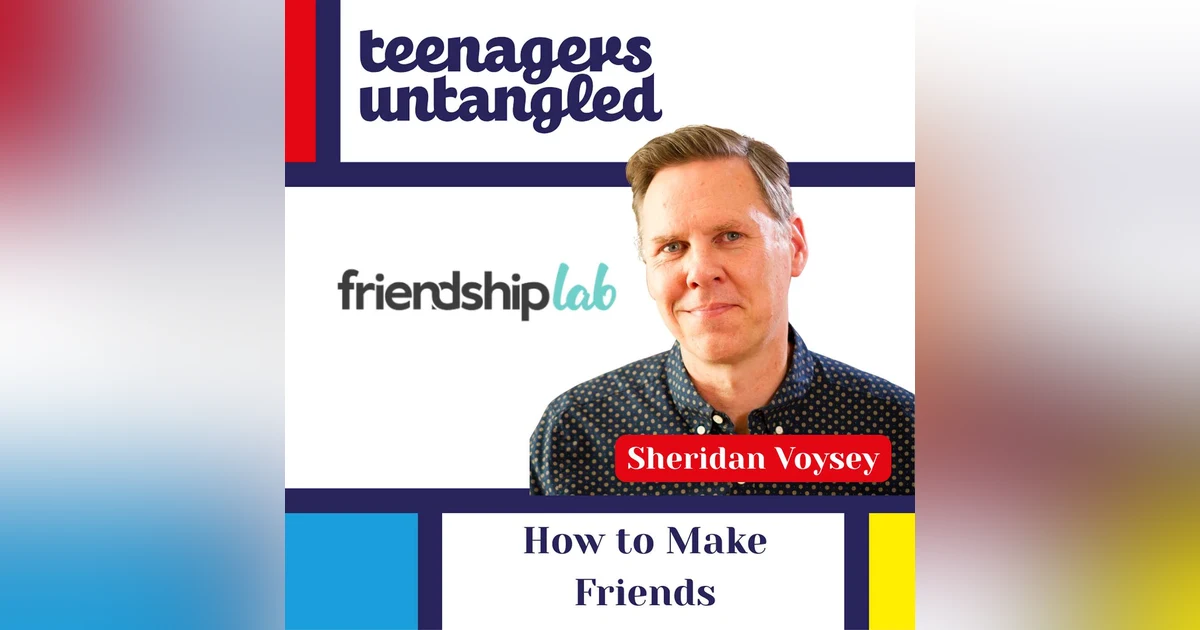
Ask Rachel anything So many parents come to me saying 'My teen has no friends. What should I do?' and I can't help wondering if we are missing one of the most important ways to help them. Being good at friendships ourselves. Think about it. If we're not good at making and maintaining friends ourselves, who will our babies learn their friendship skills from? In this episode of Teenagers Untangled, I’m joined by author, broadcaster, and founder of The Friendship Lab, Sheridan Voysey, to unpack ...
So many parents come to me saying 'My teen has no friends. What should I do?' and I can't help wondering if we are missing one of the most important ways to help them. Being good at friendships ourselves.
Think about it. If we're not good at making and maintaining friends ourselves, who will our babies learn their friendship skills from?
In this episode of Teenagers Untangled, I’m joined by author, broadcaster, and founder of The Friendship Lab, Sheridan Voysey, to unpack why 20–25% of adults now say they have no close friends, how that impacts our teens’ mental health, and what we can actually do about it.
We explore the five stages of friendship, why busyness, smartphones, and constant mobility are eroding our connections, and the simple, intentional steps parents can take to help their tweens and teens build deep, lasting relationships.
Whether your child is struggling to find “their people,” stuck on the surface with classmates, or hiding behind screens, this conversation will give you practical language, science-backed insight, and real-life ideas for modelling healthy friendships at home. If you care about your teen’s confidence, wellbeing, resilience, and sense of belonging, this is an episode you won’t want to miss.
I create notes on every episode which you'll find on my Substack page
Please hit the follow button if you like the podcast, and share it with anyone who might benefit.
You can review us on Apple podcasts by going to the show page, scrolling down to the bottom where you can click on a star then you can leave your message.
Please don't hesitate to seek the advice of a specialist if you're not coping. There's no shame in reaching out for support. When you look after yourself your entire family benefits.
Find all the tips from the episdoe on Substack:
My email teenagersuntangled@gmail.com
My website has a blog, searchable episodes, and ways to contact me
00:00 - Why Teens and Parents Struggle with Friendships
01:28 - Sheridan Voysey’s Story and the Birth of Friendship Lab
04:17 - How Parents Model Friendship Skills for Their Children
05:23 - The Mental and Physical Health Benefits of Close Friends
07:38 - What Truly Predicts Happiness: Harvard Study on Relationships
08:09 - What Is a Real Friend? Sheridan’s Four-Part Definition
11:07 - Why Modern Life Makes Friendships Hard: Busyness, Moving, Shyness
12:46 - Smartphones, Social Media and the 2015 Loneliness Spike
14:34 - Pandemic Isolation, Self-Optimization Culture and Teen Wellbeing
17:20 - AI Chatbots, Companionship, and the Rise of Narcissistic Friendship Models
19:15 - The 5 Stages of Friendship: From Acquaintance to 2 a.m. Friend
22:54 - Teaching Teens How to Make Friends with ‘Enlightened Small Talk’
28:09 - Why It’s Lonely at the Top: Leadership and Workplace Friendships
31:12 - How to Build Local Community: Rachel’s Monthly Village Gathering
Is making and keeping friends just something that should come naturally to us, or are we missing something? I'm posing the question because I've had so many parents asking me how they can help their kids who are struggling with friendships. But then it got me thinking: how are we supposed to help our children when there are so many adults admitting to having few or no friends? So today we'll be looking at how friends are made, how we can keep them, and why it's so important. You're listening to Teenagers Untangled, the audio hug for parents going through the tween and teen years. I'm Rachel Richards, journalist, mother of two teenagers and two bonus daughters. And if you're new to the podcast, the aim is not to tell parents what to do; it's to help us think differently, to be a fearless parent, so we fear less and wonder more. Now, today's special topic is friendships, and who better than Sheridan Voicey to help us? He's an Oxford-based author, speaker, and broadcaster, and founder of the Friendship Lab. is the UK's first non-profit dedicated to helping adults build and keep meaningful friendships. He's the author of nine books and a regular presenter on BBC Radio Two's Breakfast Show. Sheridan, thank you so much for joining us. I really love what you're doing.
Sheridan Voysey:Thank you, Rachel. Thank you for the invitation. I'm looking forward to our conversation.
Rachel Richards:Now, before we go on, just a reminder to like, follow, share, or review the podcast. It makes such a difference. Now, Sheridan, let's get back to the Friendship Lab, and I'd love to know what prompted you to focus on friendship.
Unknown:Well, there's a two-part answer to your question. So, late 2019, I was a few years away from a big birthday. I know I only look at a couple of days over 30, but anyway, I was approaching a big, a big birthday, and so I started thinking and reflecting about what the next season of life, you know, might look like. The last kind of 12 years or so, I had been writing, speaking, broadcasting predominantly in a solo capacity, and that had been very good, very fruitful. So I went away on a one-day prayer retreat. Faith is very essential to my personal life, and I came away from that retreat with a real sense that I needed to focus on this area of loneliness and friendship. And I left that retreat hopping and skipping and jumping with joy because I thought, Rachel, that I had my next book project. I spent the next year, kind of exploring all of the secondary research that had been done on friendships, really learning what a challenge that we actually had. 20 to 25% of adults have no close friends. In many cases, every second person you pass in the street is regularly lonely, so the the need was huge. A couple of things happened during that that year. I read a little article for the times that got picked up and got a lot of traction, I got made the creative lead on Radio Two's Friendship Season. Both of those were just kind of, kind of pointers that I'm I'm on the right direction. I'm going in the right direction. I'm on the right right topic. A year later, though, I had a an outline for a book. I had a publisher interested, and I felt like there was a handbrake on the project. It was a very strange experience, so I went back on another prayer retreat. And on that retreat, I really felt voice say to me, "Sheridon, you are thinking too small. You've been thinking about how to write a book and get it out there. What if instead you were to focus on that 20 to 25% of people who have got no close friends, and what would it take to bring that number down? And I realized that you know, even if a book did well, it would have to do incredibly well. We would still not see that percentage budge one iota. Now you're right. Yeah, that got me thinking. Well, what would? And that's where I realized, okay, we need media collaborations and arts collaborations and educators collaborations, and we need conversations with parents. We would need documentaries. We would need podcasts. We would need evidence-based courses. Long story short, I left that retreat shaking in my boots because I realized that this was a a calling much bigger than I could do, and that was ultimately the beginning of what we now know as Friendship Lab. So that's how it began, and then since then we put four years into an evidence-based course, which we're now rolling out through non-profits and through businesses, and for individuals and indeed for families to do together as a family unit, and seeing some absolutely wonderful results.
Rachel Richards:Amazing! It's funny, isn't it? Because I saw you on LinkedIn, and I thought, wow, that looks so fantastic. And I asked you on the program, and you said, "But my work isn't about teenagers; it's about adults. And I thought, "Fair enough. And and then I thought more about it, and I realized that our babies are learning their friendship skills from us, and we model friendship. So if we're not okay, and we don't have friends, and we don't know how to make them, and they never see us socializing. They're not going to know how to do this, and we can't help them.
Unknown:Absolutely correct. You are modeling it, and the fact is that we have never been taught this, Rachel. We've never been taught these skills. It hardly gets any emphasis in the school curriculum. There has been this myth around. That friendship should just be something that kind of grows organically. That we should just somehow imbibe and just discover somehow. Well, actually, well, where are the first places, the first environment we're going to pick up those skills if we're not officially taught them? It's going to be in the household. It's going to be with it from our parents. And yet, the majority of parents are lacking those friendships too. So this is why our conversation is so important.
Rachel Richards:Yeah, and and if you talk to any parents of children when they go up to senior school, that's when the big crunch is. They call it the the friendship meat grinder. You know, it's really hard, and we think they're going to school to learn, and the kids are going to school thinking, how do I make friends and how do I survive this? It's a very very different experience at that stage, how important actually is friendship? Because presumably you've got some research on that.
Unknown:My goodness, I mean, there is no silver bullet to the human condition, but friendship would have to come fairly close to it. People who have got close friends have lower rates of anxiety, lower rates of depression, higher rates of meaning, higher rates of happiness, better cardiovascular health, greater buttresses against some of the other major diseases that we have, against dementia, things like that. Ultimately, there is something very powerful. I mean, there's even been studies that have been done likening friendship to the power of morphine when it comes to pain relief. If you've got somebody you can hold your hand when you're in hospital, and you think about that, last time that you maybe you were in hospital, you visited somebody else. There is something very powerful about having somebody else by your side coming to visit you, whereby you can cope with pain much better than when you don't have those people around you, so this is it's it's both a great gift. It's both a great challenge when we then correlate that with the loneliness figures that we have around the place. When we talk about loneliness epidemics and you know friendship recessions and things like that, because we have neglected our whole culture is built around romance. We focus on it. We celebrate it. Everybody knows the date of Valentine's Day. How many of us know the date of International Friendship Day? And I long for the day when we celebrate IFD as much as we do VD, because I want to see friendship, you know, celebrated because it's just so essential. What is the basis of a great marriage? It's friendship. What is the great, great, wonderful goal that you want to get to with your with your kids? Is you want to then have not just a parent child relationship, which will all you'll always have, but you want to have a friendship ultimately when you're both adults.
Rachel Richards:Oh, you've absolutely convinced me, and it's interesting, isn't it? Because I read that Harvard study, which I think it spent 85 years showing people going through their their lives, and they concluded that the quality of close relationships we have is the single strongest predictor of our health, happiness, and longevity. It's not whether you got into the best university, whether you you know studied hard when you were at school, or all these things that parents tend to focus on, so focusing on their ability to have good relationships is such a great thing. So, what is a friend?
Unknown:Good, yeah. Let's define that because that's half the problem. And interestingly, Rachel, it's actually half the problem with some of the research around as well. What actually is a friend? How do we define it? And so, if we have a very loose, soft definition, well, then all of those figures actually fall out of the air, and it turns out that we've all got friends. There was one definition that I read recently where somebody said a friend is somebody with whom I have regular, repeated, positive interactions, and I thought, my goodness, that would that would be my checkout lady. That's the checkout. People who don't even know my name, even though I've tried to strike conversations, we have nice little conversations, but they don't know me at all. Here's what we define a friend as at Friendship Lab. We define a friend as someone I can talk to, depend on, grow with, and enjoy. And the more of those factors you have, and the stronger and the tighter those factors, the the richer they are, the the richer the kind of friendship you have. So, talk to about the little things and the large, from hot ball football scores and holiday plans to our deepest regrets and our deepest hopes and silly dreams-those kinds of things that you're only going to share with somebody that you feel you can trust-depend on. They're the people that we can call at two a.m. when everything has gone wrong. That's a big kind of marker that we use. Who could you call at two a.m. in your moment of greatest vulnerability and their moment of greatest inconvenience when you really need somebody. It's not a family member. Who could you call? Grow with Aristotle said that ultimately friendship is a school for virtue. King Solomon said, "As as iron sharpens iron, one friend sharpens another. One of the great benefits of friendship.
Rachel Richards:Oh, I love that!
Unknown:Isn't it? It's it's that we. To shape you, you get to shape me in a positive way-not just for your sake, not just for my sake, but for our spouses' sake, for our children's sake, for our community's sake. So there is a growth aspect, and then enjoy. There is no friendship without enjoyment, whether it's because we enjoy playing tennis together or because we enjoy the same kinds of laughter, comedy, jokes, sense of humor, or maybe because you, like me, Rachel, enjoy moody European films with subtitles. I know it's rare. I know it's it's a bit niche, the kind of where everybody dies in the end, but they die so meaningfully. My wife doesn't join me with this particular thing, but I've got a few friends who do. I'm
Rachel Richards:not sure why. That's so funny. I'm going to write these. You've got some brilliant points. I'm going to write them up in a Substack article after this. If anybody is listening to this, thinking,"Oh, because I get people scribbling notes, just click on my Substack, and you'll be able to read some of the notes from this. Now, you've defined what is a friend. What is it about the structure of modern life, do you think, that conspires against us having these great friends?
Unknown:Yeah. Oh, there's a whole bunch. Some of the basic ones. Firstly, the number one barrier to friendship today. Funnily enough, it's not so much a lack of personal skills. You might think, oh, there's a big stigma attached to loneliness because we somehow think that other people are going to perceive us as being no hopers, socially awkward, those kinds of things. Now we do need to get some skills. We can talk more about that. The biggest barrier is is is spirit busyness. The biggest barrier is the fact that we are just so busy. This is talking about adults. The second barrier is mobility. Now, you and I, off air, we were talking about the fact that you and myself included have had a number of moves around, geographical moves. In when you were younger, I think I'm up to 15 or 16 house moves and three countries, five major cities. Each time we make that kind of move, we uproot our friendships and try to take them with us. And only a certain amount of those will actually take root in the new place. So mobility is a big one. Shyness is then, according to the research, the third one. But we can work with shyness. Shy people make great friends. They just need to get over their their fear initially, but there are other things. The focus on romance to the detriment of friendship has been a big one culturally. Our growing individualism, which has just been completely growing crazy. Well, researchers would would say it's really escalated since the 60s, and then since the 90s, and then 2015, interestingly, was another big bump in loneliness.
Rachel Richards:Why then?
Unknown:Here's the interesting thing: 2015 in the U.S. was when market penetration of smartphones broke 50%
Rachel Richards:Whoa, really?
Unknown:So since then, the time spent alone has gone up. Time spent with friends has been going down rapidly. So we are just spending so much time, you know, glued to these things and just scrolling and scrolling and scrolling. And it really is so addictive. I mean, there's so much psychological power in the algorithms that are there, keeping us kind of locked there when we would be so much more benefit benefited if we then put that down or used it to call somebody and develop real human relationships. There are so many other factors, but those are probably the big ones.
Rachel Richards:I love that. I wrote a Substack about how my kids were railing against texting. So when they weren't at school. They were just saying,"I just, I know I'm supposed to message my friends, but I hate it. I hate this this thing that I'm having to do. And I said,"That's because it doesn't feel real, and you really want to be with the person, and they do. And it's almost like we've created, you know, 24/7 ease of use, ease of access, but it stripped out all the you know you can't have deep emotional conversations on a text, and we need much more of this sort of phoning, being together in order to grow that. And it's interesting because Noby Way, who I interviewed, who's done nearly 40 years of studies of kids laterally, she said that the kids are telling her that they are being taught to be selfish, this kind of self-optimization, and they don't like it. They don't want to be like this, but it's almost like where they're swimming in this soup. And what do you think about the the pandemic? Did that have much of an impact? The
Unknown:pandemic exacerbated what was already growing, so it wasn't the cause, but it certainly was the amplifier. And because then we had all of these new new habits shaped in us, didn't we? Where we had lockdown after lockdown, last lasting weeks after weeks, and what is the old thing? It takes three months to develop a new habit. Well, we had months on end. In fact, what a good 18 months where we had you know rolling roll. Moments where we just weren't connecting with other people that has shaped us, and we know that that has that has shaped younger generations when they were going through their schooling. So definitely, that's a that's an issue. Let's just touch a little bit more on that selfishness that you were just talking about there, Rachel. It really is a key thing, and it's very very concerning. It's come through some of the popular books also on friendship. I was reading a popular level book on friendship, and it was all about. I think it was written for the person who felt that they were being taken advantage of by quote toxic friendships. The problem is that whenever we talk about toxic friendships in the popular sense, most of it it all comes down to this person doesn't affirm me for what I say, believe, think, choose. Let's go back to our definition. A good friend helps us to grow, to grow beyond ourselves. So it's not just all about us; it's actually about others. But here's another really concerning thing, which your your listeners will be particularly interested to explore. Some studies have just come out from the government last few months saying that 33% of the British and Australian populations have used a chatbot for companionship, emotional support, or just somebody to talk to. 33% in the UK, four 4% of those people are doing it every day, 8% per week. Now that's a real concern because we know that it becomes particularly attractive for those who are already lonely and already isolated, but we're also getting some lot more kind of longitudinal studies that are coming out and showing that it doesn't help with loneliness and isolation. It makes it worse. But worse than that, why are we turning to chatbots when we are literally in this country, UK, for our Australian listeners, 26 million people. For our American listeners, 335 million, or whatever. We're literally surrounded by millions of potential friends. Why are we turning to a chatbot? Yeah, people will say three reasons. Number one, it's available 24-seven. My regular friends aren't available 24-seven. Second reason, it always affirms me and never quote judges me. Third reason, it's friendship on my terms. I can I can simply be the focus of that friendship. I do not have to give anything back. Now you and I both probably know where I'm going with this. Those turn out to be three of the classic markers of narcissism.
Rachel Richards:Narcissism. So the more
Unknown:we go in that, the the problem we're going to have, and here's the great heartbreak, is that the more then we turn to this, the more isolated and lonely, and completely bereft of relational abilities we are going to be, and our children are going to be. So we need to have conversations now with our kids, with those in our in our classrooms, about the the powerful tool that AI is, the wonderful tools that chatbots can be. I fixed my dishwasher the other day with the help of a chatbot. I do this all the time. Me through, yes, wonderful. Let's use chatbots as tools. Let's use them as consultants, but never as confidants. They are not supposed to be a replacement for friendships.
Rachel Richards:Yes, that's exactly how I use it. I'm not interested in what it has to say about any of my friendships or anything like that. But definitely for fixing things, there is brilliant. I think that's a really, really important point you're making. It's something that we should all be engaging with because it's very worrying, and I think with parents because I don't think that anything that's happening that you're talking about is just children. I think that one of the things they're talking about is a lot of adults are doing this stuff too. Yes, and I think the teenage years can be quite a shock for parents because they lose that schoolgate network. Teens pull away. Family life becomes more private. They're sort of back to work, coping alone. And one year, I think it was a couple of New Years ago, I thought I want to focus on my friendships, and I sat down and really sort of thought through now how am I going to ensure that my friendships blossom this year? But I didn't really know how to structure it. So I would love you to walk us through what you know about the stages of friendship and how how we can work this.
Unknown:Yeah. So in our course, we work on five stages, and interestingly enough, a good friendship, like a very close what we were talking about before, a two a.m. friendship, will have to go through all the stages. But each of the stages actually has value in and of themselves. So stage one is the acquaintance. No friendship starts without first being an acquaintance. Now these are people that we we know from work from the neighborhood, from indeed the school gate might be a church if you're a part of that gym, football club. They're the people that we probably have just started to get to know. We know their names, we know where they live, some of the basic things about them, but not much more than that. These people wouldn't come to our birthday parties, and they certainly would. Be at our funerals. If you keep on nurturing that relationship, though, you can then move into the second stage, and that's the casual friend. Now, the casual friend is actually a really valuable friendship. This is where it's primarily about enjoyment. We might discover that we enjoy that shared game of tennis. We enjoy the same sense of humor. We enjoy moody European films with subtitles, and so we go and catch a moody European film with subtitle. We go and see that, so we find something to do. Now, actually, casual friendships are good in and of themselves, but if we do continue to nurture them, some of them will then move into what we call friendship proper. These are people who we would then be ready and available, and they would be available to us. Maybe it might be walking the dog while we're away for a week. A little bit more commitment is required. We can then maybe knock on their door and say,"Hey, I need a lift to the train station. The car's just broken down. So there's there's a little bit more commitment going in there. These people would be the people that we would invite to our birthday parties, and they'd probably be there at our funerals. Now, if we keep on nurturing, keeping put the time and the effort and the conversation, looking for new things to do, looking for ways to have regular conversations, regular meetups, regular engagement in each other's lives, then we can move to the fourth stage, and that is close friendship. These are people that we would trust our children with, and we are emotionally engaged with these people, and they with us, and there is mutual commitment and mutual support. These people would definitely be at the birthday party. In fact, they would have come early, early to help us set up, and they would be there late at night cleaning up after everybody else has left. And then, if we continue to nurture that relationship, it may well become then the fifth stage, which is the two a.m. friend. And these are people that we really could call when everything has gone wrong. They know the deepest, darkest depths of this, not just the the nice bright and shiny elements that we put up on social media. They know the secrets. They know what's really going on in our lives. These people would be at our funerals, and in fact, they're not just at our funerals. They're carrying our coffins. Those are the five stages we work on. Now, if you only get to stage two with somebody, that's actually okay. Those are really enjoyable friendships. They can just be low commitment, but they're still there's there's a basic level of commitment there. There has to be for any friendship, but they're they're valuable. But we have to, we have to have some close friendships in the mix. And I say that you can just work on three to five. If you've got one, you're doing better than most people. Just three to five of people that are in that stage four, stage five, then you will both have what you need, but also you will be giving what they need as well.
Rachel Richards:So you talked about the stages there, and I'm going to want you to unpick some of this because you know, if a parent is just saying, "Oh, just go and make friends, which is what we tend to do, and we try and say, "Well, just go and find a group, you know, here is another sports group you can join. Maybe you'll just find your tribe there. Helping, I think, teenagers understand the the stages of friendships is vital. What are the skills that are involved in making friends because I remember my girls going, "Mummy, I don't know how to talk to them. I
Unknown:don't
Rachel Richards:know.
Unknown:Yeah. Oh yes. I mean, this is the thing. Just say, you know, go and make friends is just. It's like kind of go and sail the ocean when you haven't given them the
Rachel Richards:vote. It's a great way to describe it.
Unknown:We often speak negatively about small talk, particularly as adults, and we say, "Oh, you know, I want to get beyond small talk. Small talk is a great gift. There is no big talk without small talk. Small talk is what we need to be training our young people, in particular, to learn how to do, and us as well. But what I would call enlightened small talk. Ultimately, what is small talk there to do? Is to number one find out about the person, find out about them, and secondly, to find out those points of contact that we have between our lives. So enlightened small talk will be not just you know how was your weekend and what would we say good. No, it was actually what what was the highlight of your weekend? The highlight of what highlight of my weekend was oh, I had this great game of football with my with my my little boy, and it was just really lovely. The sun was shining, and the birds were were singing, and we were just in a really good place together. I just had a really good time. Now, if somebody says, actually, it wasn't that great a weekend. It was really difficult. Well, what's happened either way? You've gone beyond some sort of surface level general chit chat. You've actually gone straight away into emotional connection. But what might happen out of that is you. Well, you you play football, do you? Oh, you play football. You actually, my my child likes football as well. So you're starting to find those points of connection. Other
question might be:This is one that I love. And in fact, there are some downloadable questions that we have on our website that that your listener can go and get, which you can use. They're broken up into three stages. The first stage is what we're talking about here, which is that small talk, that enlightened small talk. Question that I love is, what three things would your perfect weekend have? Because straight away then it tells me what you really really really love. So Rachel, tell me we're getting to know each other. What would what three things would your perfect weekend have? You could have anything you want. What would have
Rachel Richards:it would have something like physical, like hiking and being outdoors, it would have some kind of entertainment like theater or meals, and it would have friends or family.
Unknown:Brilliant, great. So I've just in the space of what did that take 10 seconds or whatever for you to tell me? I've just gotten to know a little bit more about who you are, and some of our listeners, we've just heard more about who you are. No doubt you've shared even more in this podcast over the months and years that you've been running it. But we've learnt a little bit more about you. So, like, oh, I might go. Oh, I love going out for walks. Love it. And and and where do I most love to go? I love walking along cliff tops where there's lots of water, and I love natural beauty. So you find those points of connection. For me, it would be natural beauty outside there, amongst natural beauty in some kind of way, normally by the sea. Also incorporating some sort of art galleries, museums, things like that. Time with my wife, time with my little my little dog Rupert Reginald McScruffy. Oh,
Rachel Richards:love it!
Unknown:Those the things. So that's the kind of thing that we need to be teaching folks to do. So, if you go to friendshiplab.org, you can download a whole bunch of free questions there that will start you off. You want to get to know the other person, and what we're looking for is to have a genuine interest in that person. You give that other person a genuine interest in who they are; they will want to be friends because, boy, quality listening is just so rare these days.
Rachel Richards:It's such a great point, and it's interesting because the points that you made, like the questions you asked, I gave three things, and you've given something, and actually, out of all of those, you can drill down and and open them up. So you you've always just by doing that, you've got a whole load more things that you can ask that will help you sort of really drill down into who you're dealing with. I remember I was interviewing the head of a telecom company, and I was waiting for my cameraman to set up. And I'd said to him, "What's the best thing you've seen recently? And he said, "Oh, I went and saw mud and butterfly. And I said, "I saw that too. And suddenly we were best friends. He said, "Oh, did you cry? I went, "I cried. And it's just one of those moments where I've never forgotten him because what a special moment that was. So yes, I think that's amazing. I mean, talking about, for example, his situation because some of our listeners will be in companies, they'll be managing things. How hard is it for leaders or managers, when it comes to friendships, because I think that can really make life a bit more difficult.
Unknown:Ah, it really, really does. I'm so glad you're asking this. Actually, so one of the kind of three groups that we serve with Friendship Lab is actually businesses and business leaders, because if you're in a position of leadership, then all the loneliness rates kind of multiply by a factor of one and a half to two. So you know, if 25% of the population are wrestling, it's about 3032 to 45% of senior leaders that are wrestling with loneliness. It really is lonely at the top, and the reason. No, what do you
Rachel Richards:think? It's is it? I mean, when you think about it, you-it's not what you think. Anyway, carry on.
Unknown:No, and the reason why is because the very qualities that leadership requires are the very qualities that work against what friendship requires. I'll give you. There's actually four main barriers that we do when we're working with business leaders or other leaders in charities, churches, and various other places. The first one, and they all correlate basically to our definition. The first one is friendship requires openness, but leadership requires confidentiality. So you come up to me, and you can just tell, just say we're friends, been friends for a while. You can tell that there is something wrong with me. I'm not. I'm just not. I'm not fully myself today. So you say, Sheridan, how are you doing? What's are you okay? I just say we're working at the same company, and actually, the reason why I'm not okay is because of another employee who you know very well, and by me sharing and answering the question honestly to you, I would then be breaking confidentiality. I wouldn't be professional, so right in that moment, I can't be fully open with you. You sense that I can't be fully open, and in fact, you might go, "Well, why isn't he sharing with me? I thought we were friends. That's just one of the four barriers. Another one is when you are spending time with somebody. Particularly, the challenge with all of this is, particularly with people in direct reporting lines, it's a little bit easier if you then go across departments. If you go particularly, you know, beyond into other industries, and you, you know, you connect with other leaders in other areas where you're outside of those reporting lines. But with workplace friendship being workplaces now being one of the number one places that we make friends, we've got to got to address it. But if you're then, as I say, a leader, spending quite a bit of time with one or two of your colleagues, one or two of your employees, having lunches with them, you're going out and you're doing the tennis, you're doing the you know moody European films. There can then be that perception. Hang on! Is there favoritism going on here? Yes. So you've got that wanting to to to invest time in those people, and yet that could be interpreted as favoritism, and therefore that that preferentiality that can become a problem. So there really are quite a few barriers there, and all of these can be overcome. You've just got to be intentional about it. So, just as you realized a few years ago, I wanted to be more intentional about my friendship making and deepening. Then we have to explore those kind of factors with leaders as well.
Rachel Richards:I don't want to let you go without mentioning a project that I have started here in my local village area, where I just thought I've got to start something because I don't know my neighbors properly. I sort of see them around, and so I invited everyone that I could get hold of to come for tea and cake or drinks, and we do it once a month, couple of hours. We just get together. I don't tidy up. I just make it very easy, very repeatable. I say I'm not. Don't expect anything. There'll be some snacks, nothing special, and it's had the most incredible impact on the network that we have here. Because I've found out things about these people that I had absolutely no idea about. We've started having people connecting up, putting barn owl boxes around on the different houses. We've got someone bringing honey to sell. We've got one of the teenage boys is really good with woodwork, and now he's been commissioned to make woodwork for people. And just generally, it's kind of ballooning. And every every month, I make sure that I put it straight in the diary as soon as it's finished. I say, right, next month, can we all make this date? And every month, there's some people who can't make it, but it just means that there's this community thing going on, and I I was just wondering if you have any other suggestions because what we've lost that used to be around if people were living in housing estates or you know these long streets with lots of houses they would just be able to sort of put their kids out and people would be meeting up with people of all different ages and there would be some form of community as a result, and I'm trying to start that again.
Unknown:Yes.
Rachel Richards:What are your thoughts? Oh,
Unknown:I love what you've just shared for a number of reasons. It's almost like you've, you know, you've directly applied session two of the Friendship Lab course because you've been intentional. You've started something. You've you've taken the lead and and made the initiative, and that's that's the key thing. Many of us kind of want to have friends, more friends, but we actually don't take the initiative, partly because we're afraid of rejection. Here's what you
discovered:you actually rent, you put the invitation out there. If one person turned up, okay, great. If two people turned up, wonderful. Actually, it turns out a whole bunch of people were also very keen to get together, so you you were intentional about some kind of meetup. The second thing you do is you made it a regular event. This is key for moving through the stages, particularly you know when you get to the kind of casual to friend and friend to close friend stage. Is you want to then come up with something that you can do regularly. It might be let's do a fortnightly tennis game. Let's do a monthly get together. So come up with something which you can't do until you've done the small talk. You found the things that you have in common, and you've tried doing some of those things together. Some of them may not have been as enjoyable. Others were more enjoyable. You find what that is. The other thing I think you you just mentioned in passing that you don't really tidy up. You probably even don't recognize the significance of that. We tend to tidy up for the people that we want to impress, and the people we want to impress are the people we. I spoke to a social worker who spent years going into it was like a traveling community, and he realized that the day he had been made a friend was when he went, and two things happened. Number one, they hadn't tidied up their caravan before he arrived that day, and secondly, he no longer got the great seat of honor. He just sat anywhere, and finally he said, "I'm accepted.
Rachel Richards:Made it. I've
Unknown:made it. Isn't interesting? It's exactly the opposite of what we would think. So it's kind of bringing that down. Now, obviously, this is within. You still want to have a generally clean house, okay? Yeah, I mean, it's not. It's not. It's not a bomb site. Of course not. Of course not. You know, we don't want to be. But I also wanted to make it a low
Rachel Richards:barrier. I think one of the. Problems we've got is that we've created a society where, when you see everything on social media, it's pristine. I I keep seeing pictures of houses that look absolutely immaculate, and that's not how most of us live. Particularly if you have children, dogs, you name it, and I think it's just really important to show to to make it really easy to repeat. And if it's too perfect when you first start, you've got all you know. I mean, a friend of mine did this. Like she had beautiful food out, beautiful drinks and things. And my mother-in-law has done this, and then she said nobody invites me back, and they don't want to come. And I'm like, that's because it's too nice. And I know that sounds strange, but it's too. It feels too big, and it's much easier if it's something where everybody gets to come in and make their own tea, or they make. You know, it's much more like we're all at home here.
Unknown:Yeah, you know, the the self service is a lovely idea too, because again, there's that sense in which this isn't a event that I'm being catered for. I'm actually part of this, so I think there's some inherent qualities in what you've just shared. Come up with something, make it an open house, have something to do, that can be really helpful as well. So that the thing to do may well be afternoon tea, but it's not just a case of okay, just come round and we'll just kind of hang out. You can only really hang out once you've worked out what to do when you hang out. So come around, but also do your homework. Just think about the people that are coming round, and just think, okay, where is she up to now? Oh, that's right, she was going for that job interview, wasn't she? Where is he up to? Oh, yeah, he was. He was kind of you know wrestling with the kids, and just think about where each one of those people are at, and just be intentional about checking in with them. So a little bit of preparation, a little bit of homework, and again taking a genuine interest in them. And yes, in most cases, many cases, you won't be invited back. It's not actually to do with you; it's to do with the fact that you're much better at organizing and you've taken the initiative. Again, check out our blog. We've just released a very important article on this, which is that kind of difference of you're not necessarily in a one-sided friendship when you're the one doing all the initiating. You just might be a very, very good at organizing and initiating, and they may fear initiating because they don't know whether you're going to reciprocate, and they're the ones who then don't do it. You take the lead; they'll follow.
Rachel Richards:Yes, yes. I'm going to set up rounders next. We've got a field near us. I'm just going to call the community and say, anybody wants to play rounders? Let's all turn up one day a week in the summer holidays, and let's just all ages. Anybody, it doesn't matter. Let's see.
Unknown:So good. Going to
Rachel Richards:try. I'm going to try. I'm going to try. Anyway, show it. We've talked about the the friendship lab. It sounds absolutely amazing. I urge everybody to click on the link and go to it. Can you just tell us how they get to you.
Unknown:Yes, friendshiplab.org. You'll see a little opportunity there to pop in your email address and get those those free questions. There's 36 specially curated questions. Get those. That's free. Wow. And then the friendship lab course. Just consider doing that as a family. We've had whole families do it. Six sessions to be done in no less than six weeks, and that's very intentional because the research shows it takes 50 hours to move from acquaintance to casual friend alone. So we want to give a week between each session where every member of the family goes and actually tries the activities, comes back, talks them through, learns. We call it a friendship lab because it's not about success or failure. It's about trying something, tweaking, trying it again. Eureka! We've just found the discovery. Amazing! That's all amazing. I'm
Rachel Richards:such a fan of that. Yes, yes. Taking time to just process what you're going on, thinking about it, having conversations together. Love that. Brilliant. It's a workbook that
Unknown:each each of you do. You do a workbook. There are things to do, and then you talk it through. It'll bring your family together, but again, it'll be spiraling back to where we started this conversation, Rachel. It'll be you putting it into practice yourself as a parent, as an adult, so that others can follow your example. They can see it modeled, and you can learn together. You might have a, you might have the rounders, and it doesn't just doesn't fly. But you can talk it through and say, "We tried. We we did an experiment in the lab. Now let's see if we can tweak it, or whether we just go and try a different experiment entirely. That's the thing with friendship. Let's just learn and grow.
Rachel Richards:And I love the learn and grow. And I think the important thing we we do all the time, whenever we do anything social, is we always say what works, what didn't, and we make it a really low bar to you know of expectations. And I think that just keeps things keeps the freshness going and the ability to grow. So yeah, Cherrydon, this is such a wonderful thing you're doing. I'm so grateful for you. Coming on the podcast, thank you so much. If you like this, please share it with other people who you think may find it useful. Because that's the way my podcast grows. That's the way our guests really get heard and understood, and we help other people and we grow our community that way. It's brilliant. You could review it. You can follow me. I'm at teenagersuntangled. com. My substack is teenagersuntangled.substack. com, and you can contact me me by teenagersuntangled@gmail.com. It's all teenagers untangled. That's it for this week. Many thanks again. Big hug. Bye bye.