


 Apple Podcasts

 Spotify

 Castro

 RSS Feed
Is university worth it?
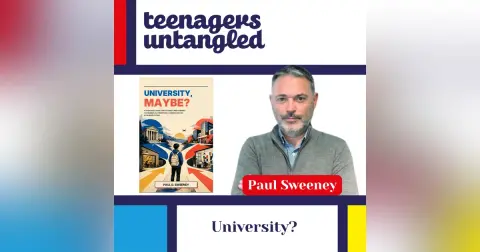

Ask Rachel anything Every autumn, families start the university conversation with the same question: which one? Paul Sweeney thinks most of us skip the question that should come first: should my child go at all, and if so, why? Paul dropped out of an engineering degree he hated and ran away to a job in an airline’s lost baggage department. He later became chief strategy officer at Unite, the UK’s largest listed student accommodation provider, and now advises universities on strategy and AI. H...
Every autumn, families start the university conversation with the same question: which one? Paul Sweeney thinks most of us skip the question that should come first: should my child go at all, and if so, why?
Paul dropped out of an engineering degree he hated and ran away to a job in an airline’s lost baggage department. He later became chief strategy officer at Unite, the UK’s largest listed student accommodation provider, and now advises universities on strategy and AI. His new book, University, Maybe?, draws on all of that background and his experience of going through this decision twice as a parent.
We talked about what you’re really paying for, what universities would rather you didn’t ask, and why the alternatives aren’t consolation prizes.
Click here for Paul Sweney'’s website
Click here to get my personal thoughts, the top tips from the episode and join the Fearless Parenting community so you get the episodes early and don't miss a thing!
Please hit the follow button if you like the podcast, and share it with anyone who might benefit.
You can review us on Apple podcasts by going to the show page, scrolling down to the bottom where you can click on a star then you can leave your message.
Please don't hesitate to seek the advice of a specialist if you're not coping. There's no shame in reaching out for support. When you look after yourself your entire family benefits.
Find all the tips from the episode on Substack:
My email teenagersuntangled@gmail.com
My website has a blog, searchable episodes, and ways to contact me
00:00 - Should my child go to university? Introducing Paul Sweeney
01:03 - Why Paul dropped out of university
03:10 - How to help your teen decide without taking over
05:30 - Is university worth it? Why it’s the wrong question
06:17 - Alternatives to university and when a gap year makes sense
07:32 - What parents think they’re paying for: employability, independence, status
07:59 - Choose the course before the university
10:32 - Questions universities don’t want asked at open days
12:03 - AI and jobs: does a degree prepare students for the future?
14:18 - Do you need a specific degree for your career?
15:52 - Borrowed certainty, passive drift and productive uncertainty
17:26 - “Can’t I just be an influencer?”
19:35 - Why top grades don’t guarantee coping at university
21:45 - Are mental health warnings making students expect to struggle?
22:52 - Tracking phones and letting go: parenting at university
24:30 - Apprenticeships and starting a business: real alternatives to university
27:18 - Private schools and the university conveyor belt
28:14 - It’s not now or never: going to university later
29:13 - Staying at home after school: why you need a plan
31:06 - The one question to ask your teen at dinner
32:06 - Do university rankings matter?
Should my child go to university? Introducing Paul Sweeney
Rachel RichardsEvery autumn, thousands of families start the university conversation with the same question. Which one? My guest today thinks most of us skip the question that should come first. Should my child go at all? And if so, why? You're listening to Teenagers Untangle, the audio hug for parents going through the tween and teen years. I'm Rachel Richards, journalist, mother of one teenager now, one at university and two bonus daughters. We're joined by Paul Sweeney, who is an author and was Chief Strategy Officer at Unite, the UK's largest listed student accommodation provider, and now advises universities and other organisations on strategy and AI. So he sees the sector from inside. The money, the pressures, the changes most families never hear about. He's navigated the university decision twice as a parent and has used all of his skills and knowledge to write his new book, University Maybe. It's a practical guide about university apprenticeships, gap years, and other routes and what AI could mean for the jobs our children are training for. Paul, welcome to Teenagers Untangled.
Paul SweeneyThanks, Rachel. Lovely to be here. Thanks for the invitation.
Why Paul dropped out of university
Rachel RichardsPaul, you dropped out of university. Can you just give us an idea of what led to that?
Paul SweeneyYeah, so I finished school quite early in the Irish education system. I was only 17 when I when I did my uh equivalent of A levels there, and I had really no idea what I wanted to do, but because I'd been reasonably good at uh things like maths and physics and applied maths, my career counsellors and parents all pushed me towards an engineering degree, which at the time, you know, I I was consumed minds about and didn't really have much of an alternative in my head. But I ended up just going along with the kind of roller coaster uh and uh and went to university uh near my hometown, and I hated it. I hated every second of of of engineering. I find it to be uh no no offense to engineers, but for me personally I found it to be incredibly dull uh and uninspiring. Yeah, I just hated every minute of it. I I spent most of my time then avoiding lectures, kayaking and socializing, but ultimately came to the conclusion that this, you know, this really wasn't for me and it had been all a terrible mistake. I left I effectively ran away to take a job in the lost baggage department of an airline instead. Which which turned out to be fun.
Speaker 1But you say that that's the first time you actually took control yourself.
SpeakerYeah, until then I felt very much like I was on this conveyor belt where the choices were being largely made for me and I was expected to conform. And then it was only when the the harsh reality hit me sort of a few months into the course that I was never going to enjoy it. Uh and that was that was a very really difficult time, hard time for my parents who didn't agree with my choice to leave. I had invested quite a lot of money in in the whole situation, um, and a hard time for me because I I felt very uncertain about the future then. But uh yeah, I think in looking back, it was a great decision, but not an easy one at the time.
Speaker 1It's a really important story because there will be so many parents who can relate to this and who also worry about this, because of course when you put that much investment in their future, that's a terrifying thing that a child drops out. And I've spoken to so many parents who say, I'm just trying to get my kid to carry on. Um
How to help your teen decide without taking over
Speaker 1You say that by sixth form, parents have become researcher, driver, funder, project manager. How do we help our teenagers make this decision without quietly taking over, which is what a lot of us tend to do.
SpeakerYeah, this is a really hard balance between um advising and coaching and encouraging your child to be independent and then not being terrified when they are. This is really this is a quite difficult balance. And this is why I think uh part of the book um just lays out uh several question frameworks that you can either work jointly together on or separately, and I think that helps to take some of the emotion out of it because it's always emotional, right? So by the time your kids get to be teenagers, there's always a bit of rebellion in there, there's always a bit of pushback against authority and a desire to make their own decisions. But uh the frameworks in the book sort of help or almost force students, if they go along with it, to really think through those decisions and be able to defend them and articulate them. And it does the same for parents. So, you know, what are your assumptions as a parent? If you were being really honest, you know, do you want them to go to to Oxford because of the status it gives your family? Or would they be better off doing something else? You know, so there's lots of um hidden assumptions underneath all these frameworks. And the job of the book is to try to surface some of the assumptions so you can at least be clear and then hopefully be able to defend and challenge in a sort of constructive way that doesn't fall into the trap of stop telling me what to do, it's my life, etc. etc. The you know, the arguments that you can get into.
Speaker 1Yes, I love this because again, it fits perfectly into my framework, which is fearless parenting, fearing less and doing more wondering. Wondering what's going on. Because I think so often we're we feel anxious, we're not entirely sure why, or we're status driven and we're not aware of those things. So actually stepping back and being able to think through logically what's going on is important. And telling a child it's entirely up to you is no more honest than we know best, is it?
SpeakerNo, it's totally it's totally not, because parents have a a role to play in any decision, really. If you go to university, you end up being the part advisor, part funder, part support mechanism, and part emergency backstop. Those are the kind of four roles you end up playing. So you know the there is context for parents and they do deserve an input into the conversation, if not necessarily to make the decision for their children.
Is university worth it? Why it’s the wrong question
Speaker 1Now the question parents type into Google most is is university worth it? Do you do you think that's the right question?
SpeakerNo, I don't think that it's the right question. I think before you can answer that question, you have to establish what you think you're buying from university. Yeah, and that could be a whole range of things. It could be an entry into a particular uh into a particular career that requires a university degree. It could be that you're buying the experience of living independently away from home. It could be you're buying the network, it could be you're buying development, you know, that transition from from being a teenager into adulthood. And it could be that you're buying options for future careers. So I think what's really important to do before you ask the question, is is university worth it? Worth it compared to what is the is is the next question, right? So um
Alternatives to university and when a gap year makes sense
Speakeryou have you don't have to go to university, you have many choices. So it may be that your child is more suited to an apprenticeship, it may be they're really entrepreneurial, and actually starting a business might be the best the best thing for them. It may be that they should take a gap year, but actually I think you've got to be careful with gap years because a gap year really should be answering a gap. So it should be not just a year where you get to chill out and uh push the decision out by a year. It should be you take a gap year. If you haven't said no to university, you take a gap year because there is a gap to be closed. You either need finance or you know you you need work experience in a chosen field to decide what you want to do, or another pressing reason that made you want to defer your decision. I'm I'm not in favour of the uh you know, take a gap year and find yourself kind of hippie thing, which you know it may have some advantages, but actually I think in many cases you're just pushing the decision out by a year, and you're no wiser at the end of the year potentially.
Speaker 1Yes, I did an entire episode on gap years because I did have a parent contacting me saying, How does this work? What are we supposed to do? And that is actually I could totally agree with you. I think my gap year was transformative, but there were reasons why that happened, and it was to do with work as well as um the
What parents think they’re paying for: employability, independence, status
Speaker 1experiences that I picked. And I mean you say university is eight purchases in one wrapper. Yeah. Which one do you think parents think they're buying and which ones are they actually paying for?
SpeakerI think parents, I mean, I can't answer for all parents, but I I think they think they're buying employability. I think they're they think they're buying independence. So those are probably the two most in their mind. I think they're but employability is probably uh and then I think if they were to be honest, a status is in there somewhere, right? I think they're they're also buying status.
Choose the course before the university
SpeakerYes.
Speaker 1We'll we'll come on to the other options, but I'd like to talk specifically about universities and choosing them. Now you're not a fan of picking the university and then the course.
SpeakerNo.
Speaker 1And it's interesting because one of my daughters did this. Okay. She really, really wanted to go to a specific university. She didn't quite get the grades for that course and then ended up doing a course that was a combined degree that she could get into, but she's complained all the way through it about how one of the modules, you know, the one module was really, really not good, and she wasn't enjoying it, and she thought it wasn't really productive, and the other one that she'd originally applied for was. And and I think there were all sorts of issues with it. So I'd love you to talk a bit more about it.
SpeakerYeah, I I think the specifics of the actual course and the actual teachers on that course will have much more of an influence on your experience than choosing the institution by its overall ranking. So my advice would be to get very detailed about if you want to, you know, if you've chosen a specific subject, go and look at the detail on the courses. So how are they constructed? What are the modules? What will you be taught? How many hours of face-to-face teaching do you get? Are there seminar-based? You know, do you get access to tutors? How are you graded? You know, what happened to the students who did that course in the last few years, where did they go? I think you need to get really into the detail of this. And certainly look at the rankings, but look at the rankings for the course level detail as opposed to the institutional level. And I think it's funny, having just gone through this experience with my daughter, there is a lot of you know, peer pressure as well. So um she has a very close friend group that have been close for a number of years, and it it did factor into her thinking is like, well, I think I want to go to here because you know three of my friends are going to go here. So you you you kind of have to watch out for that as well. And um and and yeah, as I say, my advice is different courses with different labels, or sorry, with the same label. So so a a course in say economics in one university is very, very different, even though it has the same label to another university. Completely different teaching methods, completely different module lists. One might be have a heavy focus on mathematics, one might be much more focused on other theories. So it's really important, I think, to get beyond the headline and really get into the detail of what you get in that course.
Speaker 1I love your suggestion to cover the university name and then compare the two course files.
SpeakerYeah, yeah.
Speaker 1Because that really helps separate yourself from you know what the the university itself. Of course, we have to accept that there is more to being at a university than just the course. There will be the environment and
Questions universities don’t want asked at open days
Speaker 1well, what are the questions that universities would rather families didn't ask at open days?
SpeakerI think that they are slightly nervous of people asking too much about what's not in the brochure. Yeah. So what changes did they make to that course in the last year because they either, you know, lost a staff member or ran out of facilities? You know, if they if things are options in the course, how likely are they actually to be in reality delivered as opposed to just laid out as options? Are there any upcoming changes? So I I know from my work in the sector that lots of universities are now looking at their portfolio of courses, trying to figure out what the effect of AI might be. And, you know, I think the portfolio of courses are going to there's going to be some dramatic changes in the next couple of years. So if I was a student, I would want to be asking, what's in your strategy for this particular discipline? Do you think there's any changes going to happen in the next year or so? And what will that mean for for students going through the course? Um The other questions are being really specific about the stats that universities will tell you about how many people enjoyed this course, how many said it was great, um, where did the students go? And and there you often see you often see um very small sample sizes, which any student of statistics will tell you you've got to worry about that, right? So if only 10 or 12 people have responded to the to the uh survey, one or two answers that go in a different direction really swing in the survey data. So I think it's it's asking how many people responded and ask for some specifics on where the students went after the course finished.
Speaker 1I love that.
AI and jobs: does a degree prepare students for the future?
Speaker 1And how can a family tell whether a course really prepares students for an AI-shaped workplace? I've spoken to one girl who was at a prestigious university who said it was they were just told, just don't use AI. And she said that just was not helpful. How are we supposed to navigate all of this?
SpeakerSo And this is probably the biggest minefield at the moment. The internet is full of spurious lists about which jobs are safe and which jobs are not safe. I think the only thing that we can really conclude is that there's not much data available about the future. And therefore in the book, there's a couple of chapters on how to take a more structured approach to thinking through the impact of AI. AI is often also confused with automation, which is actually a different thing. But the so there's been waves of automation that have affected mainly lower-paid, blue-collar type uh occupations. Perhaps the difference with AI is that it's it's probably making inroads into more cognitive, you know, into more cognitive occupations that previously were a little immune to automation. So certain elements of law, for example, is a is a great one. So dealing with contracts, dealing with fairly basic legal issues that are templated and easy to read. That that stuff is really good for AI. Does that mean you shouldn't consider a degree in law? Well, I don't think so, because lots of the elements of a legal profession are regulated. They require human judgment in more complex cases. They are heavily dependent on human relationships and client relationships and on the wealth of experience that you've built up over a number of years that makes your judgment more reliable. So AI will affect some of the work of lawyers, but it's not going to replace lawyers anytime soon. And in fact, it arguably it may lead to more lawyers doing the complex work and less doing the simple work. But that that does have some implications for entry-level jobs, which is I think the thing you have to watch because entry-level jobs are the route to knowledge as well as employment. So and I think law firms are increasingly becoming aware of the risks of letting AI do too much, meaning if they do that, the more junior lawyers are not building up the experience that they'll need later. So I think you'll see um some law firms moving to counter some of that in the interest of learning.
Speaker 1I love that you brought up law. My husband read law at university and he hated it. He said it was the most boring
Do you need a specific degree for your career?
Speaker 1degree. And I I guess one of the questions is how can we tell whether we should be going down a specific route like because he thought he wanted to be a barrister.
SpeakerYeah.
Speaker 1Or that it's just as good to do something else at university.
SpeakerYeah, so this very much depends, I guess, on whether you are very wedded to doing something that um a specific degree is effectively the barrier to entry to. So if you wanted to be a a veterinarian, for example, or or or a doctor, you really don't have that much choice in terms of going to university for that specific qualification. If you wanted to be if you wanted to do something in law or something in accounting or something in consulting, you have many entry routes into those. So, you know, if for example, if you wanted to if you wanted to do a career in management consulting where some of my background is, you could pretty much do any degree. It it what matters more is whether you're interesting and curious and actually can demonstrate critical thinking, can uh can get along with people more than any specific technical qualification. So even a fairly specific degree, you know, in a language or in arts or in any kind of science doesn't limit you afterwards. There are many careers that are still open to you. Like in your husband's case, if you do a law degree, um, you know, there's no reason why you can't go into many other occupations afterwards. But if you if you did a if you do want to be a vet, there aren't many entry options available to you other than to go and do a veterinary degree.
Speaker 1Good point. I think I'm mentioning it just because I've spoken to so many parents who say, why on earth would you do a geography degree? What can you do with that? And I think there's there's you know,
Borrowed certainty, passive drift and productive uncertainty
Speaker 1there's a difference between borrowed certainty, productive uncertainty, and passive drift. Yeah. And do you have any tips for how we can tell the difference?
SpeakerPassive drift is the most dangerous one, um, and and borrowed certainty being number two. So borrowed certainty is probably uh how I would describe my own experience of just when I before I started my degree, I was asked by a number of relatives and friends and you know was able to tell them that I was you know headed to be an engineer, that's what I wanted to do, and I'd you know enrolled in an engineering degree. So that that allowed me to create the illusion of certainty of some kind of future career in engineering. So the borrowed certainty is where you're kind of taking other people's opinions and uh and and and pretending that they're your own. But the passive drift thing is really where people don't have any idea what they want to do, but are also not doing much to to kind of get some evidence on what the options are and what they should be considering. And that often, you know, you hear people say, Well, I think I might just get a job. But you know, it's what job would be my my my question. You know, what job in what in what industry, with what experience and and what what vacancies are available in that job role? You know, so it's kind of the uncertainty is unhelpful if you don't if you're not taking any steps to resolve it. So as a parent, you can be saying, Okay, I get that you're uncertain, but what are the what are the scenarios that we should examine? So, you know, if you're not sure you want to go to university, and what what are your options? Have you thought about an apprenticeship? Do you want to start a business? I even cover in the book the the quite amusing question of can't I just be an influencer? Because that is probably
“Can’t I just be an influencer?”
SpeakerLet's tackle that now.
Speaker 1What what would you say as a parent if your child said, Can't I just do this?
SpeakerYeah, so it's um it's a bit like the uh before influencers arrived, a similar question might have been, Can't I just be a professional footballer? Yeah and and actually so the reality about being an influencer or a content creator is that a bit like being a footballer or an actor, most of the money goes to a tiny percentage of people that are successful, and uh most uh most other content creators or influencers um will never earn enough to earn a living doing it. Having said that, you know, I don't think you should dismiss it outright. I think the best thing to do is to encourage your child to to test it. You know, so perhaps in the year before university, if you want to create content and seek income, go and do it. You know, set up a YouTube account if you don't have one. Be you know, put stuff on your Instagram, talk about what you want to talk about and share with the world, but but bear in mind that followers does not equal income. Even if you end up with thousands of followers, that's great. But the question is, how could you reasonably now turn that into any income? And that's that's a difficult one to resolve. If if during that experiment your child can show that that that income is is steadily increasing and becoming significant, then I think there's a conversation to be had, and that might form the basis for a gap year in itself, potentially, right?
Speaker 1Interesting.
SpeakerYes, but if the experiment just garners a few a few hundred followers, most of whom are your relatives or school friends. No, I think I think that that's a good learning experience for everybody.
Speaker 1Yes, and that entire landscape is constantly shifting. And when I see influencers, I see so many of them crying on social media about how, you know, their their income has suddenly changed and because they're at the mercy of the platforms. So um it's a difficult one.
SpeakerThe other thing I would say about being an influencer is is people don't understand that behind that and I'm sure you you feel the same about this, but behind that successful 30-minute um video or podcast is probably you know 30 hours of hard work, you know, researching, no, everything else you need to do. So what can appear on the surface to be easy is actually not easy at all.
Speaker 1No. Yeah, I I can attest to that. There's so much that goes on behind the
Why top grades don’t guarantee coping at university
Speaker 1scenes. Thinking about teenagers who are doing well at school. Yeah. You know, maybe they're top getting top grades. Why isn't that necessarily proof that they'll manage well at university?
SpeakerYeah, this one is really interesting because I think some of it has to do with the fact that school life is very structured. You know, you have to get up at a certain time of the day, you have to go to your classes, you have to do your homework, or you're gonna get get in trouble for that. And so certainly as you as you head towards your sixth form years, there's a lot of structure around that effort. You know, you get mock exams, you get feedback on those, you get you have access to to um tutors at school that you can access. So there's an awful lot of structure placed around that. And certainly for me, that was one of the reasons I think apart from hating the degree, I may have struggled anyway, because if you take away all that structure from me and just leave me on my own, I had a tendency to be quite disorganized. So so I think one of the reasons is that because there's just that lack of structure, and people have to be much more, much more self-motivated now to attend lectures, to study, etc. So when you're looking at university, part of the question you should be asking is, you know, what what is that level of structure on that course and is that something that's going to work for me? So my daughter was back for the weekend and she mentioned that she'd slept in the other day and missed one of her lectures and got an email about it almost straight away saying, is there a problem that we should know about because you did you missed this lecture? Um and I thought so that so that I thought that's really interesting because there's quite that tells me there's a bit of structure there in that degree, and people do notice if you don't show up for lectures and stuff like that.
Speaker 1So that's a really good question to ask. If you've got a child who struggles a bit with self-management, to find out whether the university or how they approach it when kids are looking like they're not really coping with the workload or they're not turning up for things.
SpeakerExactly.
Speaker 1That's an interesting one, isn't it? Because my daughter's at Oxford and she's they she said that they're amazingly supportive, but they just expect you to learn for yourself.
SpeakerYeah, exactly.
Speaker 1And that would not suit a lot of people.
SpeakerEspecially the transition, I think, is just going almost from total structured to totally unstructured in a way. It's kind of it's and also being away from home and your friends at the same time. Uh it can be difficult. Um
Are mental health warnings making students expect to struggle?
SpeakerI do have this sneaking suspicion, though, that we're not helping our kids with some of this because if you look at the communication that goes out to kids that are going to university, they're probably told twenty times about mental health issues at university and and all the support that's available and it's almost like we're subliminally signalling to our children that they're not going to have a good time and they're going to struggle mentally. And this matches with some research from the work side of things where in a big study at Oxford looking at wellbeing interventions at work, only one of them had any effect actually. And that was if you put people through stress and resilience training, they become more stressed and less resilient. Which I thought was interesting. Wow.
Speaker 1Yeah. That is so interesting.
SpeakerAnd it's probably because we're signalling to them that they should should feel stressed. Yeah.
Speaker 1Yes. Yes. I agree with you. I mean this is a very difficult area. And Dr. Lucy Fuchs, who I've had on this podcast, talks about that she's doing a lot of research into the messaging that we're giving our kids to try and support them. And at what point do we actually kind of teach them to feel fun more vulnerable and less capable, which is not what we're trying to achieve. And I think there's also
Tracking phones and letting go: parenting at university
Speaker 1a lot to be talked about where it comes to parents supporting kids at university. And there was a Times article just recently with a mother explaining how she monitors her son's phone and she will message him in the morning if he doesn't get up and go to his lecture. And it it's a curious thing because for a lot of us we went to university and that was the last we saw of our parents for quite some time.
SpeakerOh totally totally and um it is it is funny like that I see that one of Is one of my daughter Isabella, one of her friends, her mother still tracks her location on her phone all the time and rings her up saying you should be in bed. It's one o'clock in the morning what what are you doing? And um so it is there is a bit of having to let go. And actually we you know generally speaking our kids are far more capable and resilient than we think they are. I'd encourage anyone with kids particularly kids around 13 or 14 to watch a documentary which I I think it's still on Netflix called Maiden Voyage. And it's this it's the story of a 14 year old Dutch girl who sets out and sails around the world single handedly by herself for two years. And it's astonishing it's just astonishing to see how capable that girl was and and it really it really changed my perspective actually with my kids on what they're capable of and and and whether you should give them some more freedom to to be sensible. You have to trust your kids and realize that they are more capable and more resilient than you probably think they are.
Speaker 1Yes that that chimes with Ned Johnson who wrote the self-driven child and he talks a lot about how we really really have to step back and stop pushing and allow them to find their way and it's it's not the it's not the milieu at the moment is it it's not the it's not the zeitgeist.
Apprenticeships and starting a business: real alternatives to university
Speaker 1But when you look through history and you look at what people were doing at actually really young ages, we do have to start understanding that kids actually benefit from being made to feel like they're capable because then they step up to it. What do you think are the real alternatives to university? And and you say they're not consolation prizes. I mean how can you think about this?
SpeakerSo I think um apprenticeships in particular I think are a very strong a very strong alternative university for the right for the right student if they are well run. So not not all apprenticeships are the same. So again it's very important to understand the specifics of any apprenticeship. So how will you release for academic work? How will you be assessed? What's the support there? What time off will you have to attend seminars, etc. And what happens after the apprenticeship finishes? What are you expecting to see? But in the right circumstance with the right employer, I think apprenticeships are a pretty strong candidate. And there are apprenticeship routes into accounting, into law, into some really good careers now. And if you have a technical bent, I think it's a very strong alternative. You know you can you can earn money from day one, you can learn skills from day one. So yes I think that's really worth that is really worth investigating. I think one of the advantages of AI is that in the right level of curiosity and creativity, AI can make starting a business easier than it used to be and less labor intensive and less less funding intensive. So I think for the right students, you know, setting up their own business is something that's easier than it used to be. It's still difficult for s for someone at that age because much against the kind of perceived wisdom of entrepreneurs most successful businesses are started by people past their mid-40s because they have experience, they have network, they have connections, often they can fund things themselves. But it is an option and it is certainly an option to test and again if there was a strong bent towards that I think a gap year again perhaps presents a really interesting opportunity to to do that and try that and see what happens.
Speaker 1I like that I think it's pretty interesting.
SpeakerYeah and then again a gap year I think is a good alternative if the answer is not yet because it may be that for example you think you might want to have a career in social care or or one of the caring vocations but actually it would be really sensible to spend some time actually experiencing what that might be like in reality. So so finding a way to get real job experience for a period of time to be really illustrative of what your life would be like if you went into that career. I think that's a valuable investment for certain career paths.
Speaker 1I absolutely agree that's a that's a fantastic suggestion. It's interesting isn't it because these opportunities are so much harder in some ways than just applying to university and I mean that in the kindest way but I think there's a whole system around applying to university and this sense that you won something when you get offers.
Private schools and the university conveyor belt
SpeakerI think it's particularly prevalent in private schools. If you go to a private school it's almost the expectation that you will go to university. It's almost like wow what wouldn't what would make you not go to university would be would kind of be the question. And there's very little attention paid actually to alternatives because the whole private school system is geared up to making you get ready for your university application. I'm actually going to the Independent Head Teachers Association conference in a couple of weeks to talk about this because I think we need a lot more focus on alternatives, a proper consideration of alternatives and asking that question should I go to university before you are just pushed on that conveyor belt. And you know before you know it you're doing open days and arguing about which accommodation block you want to live in. And it happens really quickly. It happens really really quickly. Almost the opposite end of the spectrum which is I think some people perhaps in the state school sector in particular are are not encouraged enough to think about going to university.
Speaker 1So there's there's almost two sides of it to be to be thinking about
It’s not now or never: going to university later
Speaker 1yeah and I've had hands-on experience with that with my youngest who it's just not obvious that she should go to university she's looking at university courses which is one of the reasons why I wanted you on the programme but she's also keen to look at other things and I absolutely can see that there's a range of opportunities and also in my mind you can still go to university later. It's not like that is off the table if you don't go now. One of the good things about actually not getting your university funded which is what we used to have in the UK and now don't and a lot of other places don't means that you can buy it when you're ready. Exactly it's not it's not do it now.
SpeakerAnd I I went back to university when I was 36 to do an MBA and it was great. I had a thoroughly enjoyable experience and was very glad that I'd had all those years of work experience before I went back.
Speaker 1Yes, because you can really value it and my father in law did the same thing. He ran an entire business and made a lot of money and then went study music in at Dublin. Because you know there
Staying at home after school: why you need a plan
Speaker 1there are other ways of going cutting this one of the things I think parents are worried about is our child staying at home and I know I've spoken to parents who you know their child left school all the friends moved on and they were still at home and they felt like they'd dropped off a cliff. Suddenly their entire group had disappeared and there's a question about staying at home both in terms of staying at home to save money on university and just going into university but there's also that kind of staying at home to work or to you know pla take a year out and figure things out. What are your thoughts about that? And what do comings get wrong?
SpeakerYeah I I think it can be very difficult. So I think if if you were to not go to university I think you need to have a good plan as to what you're going to do when all your friends have left. I you know I don't think this idea of just taking a year off to figure something out is a great idea unless you know what you want to figure out and how you're going to figure it out. So as I said you know in that vocational case if you had a plan to go and get some real work experience that will keep you pretty busy. If you are investigating starting a business or doing something else or an apprenticeship you're busy applying or starting. So I think it's probably it's about having a plan and some confidence that you you know you can defend the plan. I think just the idea of I'm not going to university so I'm just going to you know hang around at home and try to figure out what I'm going to do that's going to be tough for everybody, your parents included I think. Because now your friend group has all gone to you or primarily gone to university, probably at least half of them or more. So you haven't got that support network. And and I'm sure it's difficult because people will feel a bit like they're missing on missing out on something perhaps or or left behind. In that situation I think if that was one of my kids I'd be working really hard to have a plan for the year after they left school so that they they feel they're working towards something and you feel you've got something you can help them
The one question to ask your teen at dinner
Speakerto work towards.
Speaker 1If parents do just one thing this week what's the question that they should ask their teenager over dinner?
SpeakerI think it might depend on what stage of school the teenager is at. So I guess if you are entering sixth form, you have the opportunity to ask, you know, how are you going to think about whether you should go to university or not? If you've already decided then I think the questions are about hey you know what what is the best way to find the right course in the right um institution and and how do we help you with that. And I think if you have an alternative in mind, what's the plan to flesh that out? How do we work out whether that's the right alternative for you and what practical steps can we take to help you to help you figure that out? So I think those are all probably quite broad open questions. I I think we should try to avoid where possible close questions like you are going to go to university aren't you? Or or things like well of course you'll apply to Oxford because your brother and your sister went there. Yes. You know which which can often be the topic of dinner or table conversation.
Do university rankings matter?
Speaker 1Yeah. And it's interesting isn't it because so many people worry about getting into what are considered the top universities we have rankings and i you know people sort of aiming for oh if you don't go to one of the most prestigious universities you're wasting your time. What are your thoughts about that?
SpeakerWell firstly I would say that the the UK market for higher education is bizarre in that going to Oxford which is I think still ranked as the best university in the world is the same price as going to an institution smuggling institution somewhere that was a polytechnic a couple of years ago. So that in a start is odd. So and there is there is some research showing that on average you know your your earnings might be higher if you go to a higher ranked institution and that certain employers might interpret that as a signal but that would give you an advantage. So there's there's no doubt that you can discount it. It is a real thing. So it you know it does help you can get into a higher ranked institution. Having said that, if you choose the wrong course in a higher ranked institution and you're thoroughly miserable and bomb out of that course after a year, that wasn't such a good decision. So I would say rankings yes they should be a factor but they shouldn't be the overriding factor in it's much more important to understand what you're going to university for, what will suit you, how good the actual course is and what options you might have afterwards. I think rankings are in there somewhere, but I think we pay far much far too much attention to them. And bear in mind that um below the very elite institutions like Oxford and Cambridge who you know are generally quite special cases, rankings vary quite a lot from year to year. So an institution that you choose based on the rankings now in ten years time may be you know three hundred places below that.
Speaker 1You don't you don't know and they'll they're not even comparing the same things because there are different ranking tables.
SpeakerAll the ranking tables are completely different and the yeah the methodologies it is worth looking into the methodologies of the rankings if you have, you know, three or four institutions that you're trying to compare the courses but go go to the rankings for the courses first would be my advice. Start there. Don't start at the overall institution ranking that would be that would be a mistake.
Speaker 1Perfect. I love the fact that your book breaks down so many of the questions that we either are scared to ask or we're not even aware that they're in the background. You pull them to the surface and give us a structure for working through them separately. So as parents we can answer the questions and then as children they can answer the question then you can come together and have an unemotional conversation about them. And I I think that's a really really as much as you can because it's it's really hard. It's really hard. But there's a lot involved in this and I think for many of us it can feel very emotional. Paul thank you so much for really spending the time to go through that with us. If people want to get in contact with you, buy your book, investigate more about what you do, how do they find you?
SpeakerUniversitimaby.com is the website that has um a link to the book and some downloadable resources based on the frameworks we chatted about. So that's uh that's probably the best starting point.
Speaker 1Fantastic thank you. So if you found this useful please right now send it to somebody else who would also benefit. This show I don't spend anything on marketing it's basically people sharing amongst themselves. So you ping it to somebody else right now. You can also review like follow it's all very helpful. If you want to get in contact with me or you have some suggestions or you'd like to just comment it's teenagersuntangled at gmail.com my website is teenagersuntangled.com and I have a substack as well where I write more extensively about my own personal experiences and my take on what our guests have said. So come and find me there I'm very friendly come and see me. Have a great week bye bye for now