


 Apple Podcasts
 Spotify
 Castro
 RSS Feed
 Is "Good Enough" Parenting Best for Teens? with Dr. Tara Porter
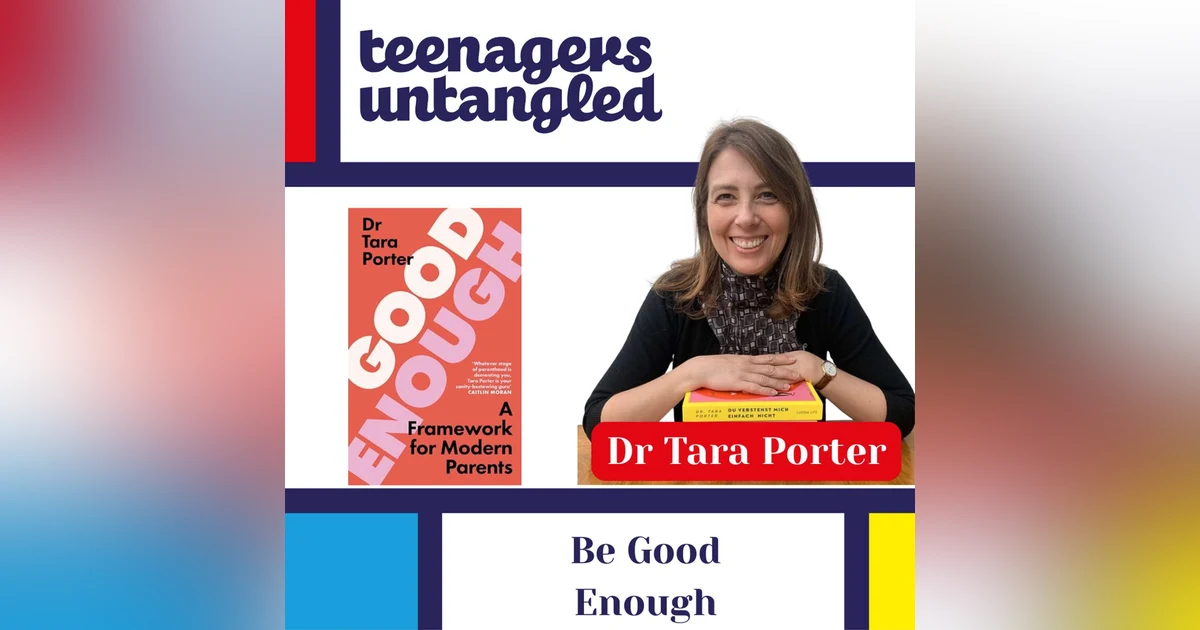
Ask Rachel anything Are you trying so hard to be a good parent that you might be doing too much for your tween or teen, and accidentally making life harder for both of you? In this episode of Parenting Teenagers Untangled, Rachel Richards talks with clinical psychologist and author Dr. Tara Porter about her new book "Good Enough" and why good enough parenting is actually the best kind of parenting. Drawing on more than 25 years working in adolescent mental health, Tara explains how so many te...
Are you trying so hard to be a good parent that you might be doing too much for your tween or teen, and accidentally making life harder for both of you?
In this episode of Parenting Teenagers Untangled, Rachel Richards talks with clinical psychologist and author Dr. Tara Porter about her new book "Good Enough" and why good enough parenting is actually the best kind of parenting.
Drawing on more than 25 years working in adolescent mental health, Tara explains how so many teens—whatever their diagnosis—secretly feel they are not “enough”: not clever enough, organized enough, pretty enough, or successful enough. She links this to a wider achievement-obsessed culture, fueled by:
- An education system caught in a “grade arms race”
- Social media’s like-and-kudos economy
- The professionalization of parenting and the tsunami of advice aimed at parents
Against this backdrop, Tara shares her three core principles of good enough parenting:
- A good enough attitude – Letting go of perfection, resisting the urge to optimize every aspect of your child’s life, and accepting that zigzags and setbacks are normal.
- Relationship-based parenting – Prioritizing connection over outcomes, being “like wallpaper” in the background: present, warm, and available without crowding them or trying to control everything.
- Firm and kind boundaries – Finding the balance between warmth and firmness (authoritative parenting), gradually letting go of authority through the teen years so that by adulthood, your child is guided by their own internal compass, not your rules.
Rachel and Tara explore:
- Rescuing vs building resilience
- Two common struggle patterns in teens
- The perfectionist achiever
- The rebellious non-complier
- How to set boundaries that still protect the relationship
- Better conversations with teens
Tara’s two key listening tools: - Empathy – stepping into your teen’s perspective, so they feel genuinely understood.
- Curiosity – asking open questions rather than jumping in with solutions.
- Rachel adds the idea of “LUFU – Listen Until they Feel Understood”, and both discuss why advice rarely lands until a teen first feels deeply heard.
- Mental health labels vs hope and growth
Rachel's personal blog on getting the balance right
Please hit the follow button if you like the podcast, and share it with anyone who might benefit.
You can review us on Apple podcasts by going to the show page, scrolling down to the bottom where you can click on a star then you can leave your message.
Please don't hesitate to seek the advice of a specialist if you're not coping. There's no shame in reaching out for support. When you look after yourself your entire family benefits.
Find all the tips from the episode on Substack:
My email teenagersuntangled@gmail.com
My website has a blog, searchable episodes, and ways to contact me
00:00 - Are We Doing Too Much For Our Teens?
01:07 - Why Tara Wrote Good Enough
02:40 - The Roots of ‘Not Feeling Good Enough’
03:30 - Achievement Culture And The Grade Arms Race
04:30 - What ‘Good Enough Parenting’ Really Means
07:30 - Rescuing, Over-Doing And Life Skills
12:00 - Perfectionist Achievers vs. Rebellious Non-Compliers
15:26 - Firm And Kind: Finding The Right Boundaries
15:26 - Firm And Kind: Finding The Right Boundaries
18:37 - Messy Rooms, Big Fights And What To Let Go Of
20:06 - Relationship-Based Parenting: Empathy And Curiosity
23:13 - LUFU: Listen Until They Feel Understood
24:00 - Are We Over-Talking About Mental Health?
28:20 - Zigzag Paths, Timelines And Holding Onto Hope
29:29 - When Your Teen’s Idea Of Success Isn’t Yours
30:20 - What Parents Worry About That Matters Less
31:30 - The Takeaway: Why Good Enough Is Best
Am I trying too hard to be a good parent and inadvertently doing too much for my teenager? That's the question I ask myself on a regular basis, and from your feedback, I know you worry about it too. Here's the thing: we've never had more parenting advice, but we've never felt less sure we're doing it right. So we're going to talk about it on today's episode. You're listening to Parenting Teenagers Untangled, the audio hug for everyone supporting anyone going through the tween and teen years. I'm Rachel Richards, journalist, mother of two teenagers and two bonus daughters, and I keep coming back to this struggle to balance things. I've written my own thoughts about it, called "Can anybody fly this thing? I'll put the link to it in my notes today in our studio is the brilliant Dr. Tara Porter, clinical psychologist and author with more than 25 years' experience specializing in adolescence. She's read *The Room* and written *Good Enough* a framework for modern parenting, and that framework takes us through every stage of parenting with three principles to guide us. Tara, thank you so much for being with
Unknown:us. Oh, it's such a pleasure.
Rachel Richards:Thank you. What have you been seeing that prompted you to write this book?
Unknown:I wrote a book called"You Don't Understand Me, which is was for teenage girls directly to teenage girls, almost like a sort of warm letter from everything I'd learned, you know, in all my years sitting in the NHS in CAMs, child and adolescent mental health, talking to teenage girls and listening to them, and it was a sort of surprise bestseller. Not just in the UK, it sold all around the world. And then people came and asked me, "Well, you've well articulated the problems that teenage girls are struggling with. What's the solution? What should we be doing as parents, and so I I tasked myself to answer that question, and good enough became out of that. It's a modern malaise, isn't it, to constantly optimize everything, and I think modern parenting has become this project, and we aim to optimize children too. What are you seeing as the impact it's having on us and our children. Well, I guess what I saw in in all the years I was working in CAMS was that all the children who came to see me, whatever their sort of official diagnosis, whether it be eating disorders or anxiety or obsessive compulsive disorder, when I untangled that and I was mainly seeing teenagers at the root of it, they didn't feel good enough, so they didn't feel smart enough, or clever enough, or organized enough, or pretty enough, or something enough, and so that got me really interested in the concept of good enough, which I'm sure you are aware comes from a psychotherapist and pediatrician called Donald Wwwwwwcot, who was working in the 1950s, and he sort of railed against what he saw as the professionalization of parenting at that point. Parenting parents getting too much advice. But you know, when we go fast forward of 5070, years, as when I started working, I think poor Donald must be you know turning in his grave because it's just reached fever pitch, and we can't open any newspaper or magazine or go online without there being almost a tsunami of parenting advice. And the parents I see, well, beating themselves up, what they see is giving their child every opportunity. But I guess what I saw in clinic is the tipping point when those opportunities that parents are killing themselves to give their kids turn into expectations in their kids' head, expectations of doing well, of reaching a standard, of meeting their parents'
Rachel Richards:expectations, meeting society's relentless striving culture, and and I guess I saw that as the root of a lot of the problems that I saw in in mental health services, I think it's one of the most important things for us to be talking about on this podcast, because as you said, you started out looking at what was going on with these poor girls, and then realizing that actually it's coming from us, us parents who, and we don't feel enough. And actually, I think Jennifer Brennie Wallace's book "Never Enough" is a brilliant explanation of how this this is panning out in America. This extreme achievement culture, where kids are now suffering the same kind of disorders, coming from a very very wealthy background, that kids from super deprived backgrounds are experiencing too. What do you think "good enough parenting actually means. Can I go back to something you've just said before I answer that question? Is that okay? I'm not avoiding it. I want to answer that question, but I would say I think
Unknown:it is down to us as parents in part. And I know as a parent myself, I struggle to step outside of it a bit. But I don't think it's just us. I think the expectations come from everywhere. I think you know the education system has changed fundamentally over a generation, and kids are under much much more pressure over the last generation. So I talk about that a little bit in the book, the grade arms race that we've been under really, and. Also, from social media and from the media, the visual culture we see everywhere, the like culture, the Cudos culture that we see online. So, the sort of expectations and standards are a part of our parenting. You know, we as parents are also impacted by education and social media. They're part of our parenting, but they're part of a culture, I think, which has impacted on kids is the water we swim in. Is the the water we swim in is a very good way of putting it. We all swim in it, parents and kids, and how we sort of sort of step up onto the side and say,"Hang on, what's going on here? is the question, and and still give our kids enough opportunities to succeed because we, of course, we want our kids to succeed. So I think good enough parenting is about finding that balance. You know, finding the sanity within all of that, and it's not about not having any expectations or standards in your parenting. Of course, kids need that, and that can be reassuring and beneficial to kids. But it's just watching ourselves that we don't get carried away by it, and we keep other things as important too. So, in my book, I have three tenets. One is the sort of having the good enough attitude, and the second one is being a relationship-based parent. And
so, what I see often:lovely parents who come and see me, but they've unwittingly got pulled along by the outcome culture, the achievement culture, and forgotten to connect the child in front of them with the rush to get the best grades or to engage them in lots of different activities and giving them all those opportunities. So, good enough parenting is about finding that balance. And in the book, I you know start with babies and go through toddlers and children, and then there's a whole section on teenagers as well, but just trying to think about how you catch yourself in the different stages to be to be good enough to have that attitude, which I think gives kids, you know, many more advantages than a sort of outcome-focused culture or an achievement culture that you were talking about.
Rachel Richards:Yes, I love that. It's about sort of stopping ourselves from being on autopilot and just pausing every now and then, going, "Where am I on this this balance that is is a really tricky balance? Because I'm hearing also people saying that parents are doing too much for their kids, and that's then stripping them of ambition, making them feel disenfranchised and uninterested in in what what's out there in the world. Do you think that that's something you're seeing as well, or is it more that you're seeing a lot of pressure for kids to meet expectations set by the world around them and their parents?
Unknown:I think it's both, and I don't think they're mutually exclusive. I think they're both almost two sides of the same coin. I think we often step in to rescue our kids, and because we are trying to optimize our kids, and we're kind of over involved in a way, it's all part of the same thing, isn't it? And I'm very sympathetic to parents. Most of the parents I meet in my clinic, I just think are such lovely people, and you know, just doing absolutely their best. And and I recognize the same tendencies in myself, but I guess what I would say is that in this world, we're always hearing about this global economy where our children are competing from children all around the world. We hear about untangled situations around the world, and we really get anxious about trying to smooth their path into that, and so then we step in to do lots of different tasks. This morning, I caught myself doing it. You know that one of my children had a problem, and I just wanted to rescue it. I just wanted to sort it. It was a problem I could just sort with money. You know, and we have to try and hold ourselves back from doing that, but because actually, what we do when we do that is we teach them self-reliance, you know, and we teach them organization, and we teach them flexibility, and we teach them a whole bunch of things. And so, and of course, this isn't a black and white thing. Sometimes we we step in because we're being kind. That's the third of my three
principles:being firm and kind, and being kind is important, right? It's the most important thing. It's how we show our love to our kids, but we do tend to step in to rescue them and prioritize often their academic path, their success at the expense of all the other life skills that they could be learning. So we don't give them so many chores as we used to because they have to do their homework or they've got their tutoring, for example, or we drive them places because they've got multi-level activities. You know, rather than expecting them to go on the bus, they might phone us from school that they've forgotten their games kit, which wouldn't have happened a generation ago because we didn't have access to phones, and and then we drive there. We're we're rescuing them in that way because we think, oh well, you know, their games is really important. We can think it's important for their mental health, which of course it is. We can think of it's important because we want them to succeed at it. You know, so there's just many different examples where we're kind of optimizing their childhood. To help them achieve at the top level, but actually not giving them some of those core skills that you need to get on in life.
Rachel Richards:I love your examples, and I often have to
stop myself and think:Am I being a concierge here? And that's the best word I can think for it. You know, is that is that sort of wait? Am I just that person on the front desk who's picking up the the the pieces and fixing things I do it I I easily slip into it it's becoming conscious that that's actually what I'm doing and then being able to step back and and then I'll just say this is this is this a you problem it's not a me problem so how would you like to go about fixing that but it's so easily done right and I think rather than when we do it wrong and beating ourselves up about it is noticing it and go, oh, I slipped into that again. And I actually make it clear to my kids. I go, oh, I'm sorry, that's your problem. You, you, you go and fix it. And I think it's not kind because I've got bonus daughters, and one of them, well, one of them served in her 30s, one of them's in her late 20s now. And when I talk to them about their friends, the ones who were rescued a lot, who had parents who just did everything for them, eased their way, gave them taxis to things, you name it. They are the unhappiest of their cohort because they are annoyed and frustrated by the fact that a they don't have the skills to manage well in life, and b that life isn't turning out the way that they expected. They thought it was going to be much easier, and everything was going to come to them, and that's not the way it works. So it is kinder. It's just reminding ourselves, isn't it? So how do we know? How can we tell? Okay, my teen or my tween actually needs help here, or I need to start backing off. I mean, that's a difficult question, and I think you know problems show themselves in so many different ways, and I've worked a lot with young women who have got some degree of perfectionism. I've worked a long time in with young women with eating disorders, primarily, and often their problems were absolutely hidden to their parents. You know,
Unknown:they were achieving, yeah. They were achieving at the highest level. They were getting all the A stars. They were doing the violin or the sports or whatever they were doing. They were on track to go to the top universities, and it was all sort of a facade of them meeting the young person meeting everybody's expectations. And I think you have to be really careful with particularly young women. That can happen with young men, of course, as well. But it's more of a female phenomena where where they are just achieving at the highest levels because often it's linked to a sort of emptiness inside. They haven't really discovered their own autonomy, what they're interested in, what they want to do, they're doing something because it's the best that's been sold to the best. Yeah, we see problems arising at the other end of the sort of spectrum of the perfectionism, but can also be a result of this kind of outcome-based society. Is is the rebellious ones, but they're really easy to spot because they're telling you they're rebellious. I've got one in each. Yeah, lots of people do. So you know, and it's more commonly a male pattern, and that they tend to you know not comply. They have a strong sense of their own autonomy, and they've they've. I think sometimes they've looked round, perhaps at their older sister. Or I thought, right, I'm not going to compete. I'm never going to get nine nines at GCSE. So I am going my own way, and I am going to mark my. I'm not consciously. They're not saying this consciously, but they're putting their flag in the sand somewhere different, which is no, not going to do that. So it's you. You notice it more with those ones, yeah. So that I think that's when you see the problems. I see most of the problems. I see whatever the diagnosis fall in one of those two patterns, and you know, and there's related patterns around it. You know, with the with the boys who are rebelling, they're often very meshed in the kind of computer gaming, and which allows them to have that sort of sense of autonomy and competence of something in the comfort of their own bedroom. You know, the more perfectionist girls they tend to, it shows up in their their striving for an appearance based culture, that sort of thing. So, those are two places I really see it.
Rachel Richards:I love that you've made those distinctions because when I interviewed Dr. Rebecca Winthrop about the disengaged teen, they have four different learning modes, and one of them is achiever mode, and it is exactly what you're talking about-that sort of perfectionist constantly trying to meet the grades. I have one of those. She's brilliant, but I've had to spend so much time trying to pull her away from from focusing just on that and actually just tuning into what it is that makes her feel good, all about her own needs rather than just focusing on meeting other people's. And I have the other the other one who's you know it's so funny. Like, have you met my children? Who's like, well, I can't be that, so I'll be something completely different. And they're all looking for status and respect in some ways. Like, how do I get that? So it is a difficult one, isn't it? Let's look at boundaries because it's one of the things my listeners struggle with most. How do parents work out whether they're being too strict or whether they are giving too strong a boundaries on their kids,
Unknown:the third principle is the sort of firm and kind principle, and I think you have to try and think about where you are along that. I sometimes, when I'm with parents, what I do is I write firm and kind on a on a line, and I say firm and kind, and and then I say warm and cold on the other axis, and I get them to plot where they are on that. And the research in child psychology would be saying that it's firm and warm, is which they call authoritative parenting, or which I call firm and kind parenting in my book, and most parents, when they I do that exercise with them, they know where they are and they know where they should be. That's really interesting. Yes, especially if you do it with a couple, you know, he'll put put himself. Well, yeah, it could be a bit warmer, and maybe she could be a bit firmer. That I think is really interesting, but I think the the thing to remember, particularly in the teenage years, they are going to separate and individuate from you. That is the task, right? And all along those years, you need to be letting go of your authority, which is why relationship based parenting is so important. Because at the end of when they're 20, you shouldn't have any firm left. They shouldn't be doing things because their parents tell them to. They should be doing things because they've internalized that clean socks are better than dirty socks, or that if you work hard, you get to reach your goals, or those sorts of things. Because when you see problems, it falls in two areas. It's parents who let go too quickly and and give too much freedom for their kids, where kids to end up pushing the boundaries, drink and drugs and stuff like that, and then the ones who hold on too tight, and often when the ones hold on too tight, they hold on too tight because of their own anxiety, their own wish to control the outcome, which we were talking about earlier. So I'm often having those sorts of conversations about whether they should be just a little bit more firm, which kids often find really helpful. And kids can often scare themselves when their parents aren't firm and get into all sorts of trouble and not like it. And it can feel like not caring, but also the sort of letting go of things, and you know, often parents come to me and they'll say something like,"Oh my goodness, I'm so worried about them. They're been so depressed, and they're really struggling at school, and I've noticed they've been self harming, and they're not getting up, and and their room's a mess. And nearly everybody I come and see thinks their child's room is more messy than any other child's room. All right, guys. So we take the last one off the list. I've never seen any intervention, anything, any parents done in 30 years of work which has helped a messy child be a tidy child. So take that one off the minute. Thank you, Tara. Thank you. I tell you what does help when they have a partner, girlfriend or boyfriend come into that room, and suddenly, then yeah, that's the only thing that helps. Then they tidy. So true. Them tidying their room when they're 16 or 17 is a sign that they're fancying somebody who they want to invite in their room. I would, yeah, okay, genius
Rachel Richards:advice. Love
Unknown:it. So I think you have to let go of a lot of things, and you know, the priority of having a relationship with them. Don't stress that small stuff that you're going to really put a lot of angst into, and you're not going to get any and any what's the word I'm looking for? Any
Rachel Richards:tangible benefit. It's any
Unknown:tangible benefit. Actually, that's right. You know, you might get them if you have an enormous fight. You might get them to tie to them in one day, but the next day it'll just be as bad. For example, so let go of the whole stuff to maintain your relationship, but don't let go of the important stuff that's going to stop them getting into real trouble. But you can't control their grades. That's one thing you can't control. Their success
Rachel Richards:and interesting, isn't it? Because so much I think of what happens is to do with our own background. I've spoken to so many parents who are panicking about their children. Oh, my child's like this. My child's like that. And if you keep them going, you go and and eventually, what comes out is they've got a relation who has those traits, and they're scared. They've inherited those traits, and that their child is going to turn out like that.
Unknown:Yeah.
Rachel Richards:And they project onto the child all of this stuff. And and and once we as parents can notice that fear, oh, we can relax a bit and go, okay, it's that's just one option of many. Yeah. So can you explain how a parent who is is making some of these mistakes? And getting tied up in the weeds, how can we shift more into to building that relationship based parenting?
Unknown:Well, I think in teenage years, particularly, you need to be like the wallpaper on their life. You need to be there in the. I
Rachel Richards:like that.
Unknown:Yeah, you need to be there in the background around them, but not intruding and opening up opportunities for conversations, and then listening-really listening-and the two tips to listening I always give empathy and curiosity. So, what I do in therapy often isn't very clever. It's understanding that young person, and I do that by empathy. I'm trying to understand their point of view. I'm trying for them to get to halfway through a sentence, and me being able to sort of see what the end of the sentence is because I'm so in their own head. I'm experiencing their their way of looking at things. And when we're parents, our teenagers want to pull away from us. They they're separating and individuating. They want to be different, so they are trying to make the the gap between us different, and we we need to try and understand that. And we have a pre existing picture of them because we've known them as 3456789, 10. So that's what I do. Is what I what I recommend is empathy and curiosity. Sitting with them when they come to us when we have an opportunity in the car late at night when they're making toast and you're around the kitchen trying to understand, trying to really know them and the adult that they're becoming, rather than projecting on them our idea of what they were as a child. The other thing I would say is, as soon as they open up, don't offer advice.
Rachel Richards:Yes. Oh, I say that all the time. Oh, yeah.
Unknown:Yeah, we immediately go into trying to offer them advice. This is what we would do, and what no adult has ever said to me in therapy. Wish my parent gave me more advice. That's what I really need.
Rachel Richards:But it's hard, isn't it? As parents, and I talk, I talk to parents all the time about this, and they go,"Yeah, yeah, and then they still do. And it's, I think, it's because a, we don't like a pause. We don't like. We want to fill the pause, but also in our heads, we're going, "Oh, I know this one. Oh no, no, no, I, I, I know the answer. And we're desperate to tell them, and it just doesn't land, does it?
Unknown:It doesn't land. It doesn't, and and and it's a mistake I make as well. But you know, when I have a 50-minute session with a young person, sometimes in the first few minutes, I I kind of know what my advice would be, you know. But there's there's no telling them, and you, I have to listen, understand. Sometimes they'll tolerate a little bit of advice, or you know, sometimes they'll ask you. You have to get to know them, and this person isn't going to be the same at 12 before they were teenagers. They are going to be at 20. They're going to be different, and they're going to have different ideas and different ambitions, motivations, friends, styles, everything. If we want to maintain the relationship with them, we have to try and get to know them, rather than maintaining. You know, in some ways, what parenting is is a power hierarchy, isn't it? You know, so
Rachel Richards:100%
Unknown:Yeah.
Rachel Richards:Yes, and I I love the acronym LUFU, L U F U. Listen until they feel understood. Exactly. Because once they feel understood, then they might be remotely interested in what you have to say. Probably not, but at least they feel there's a connection there. If you jump in before then, there's real disconnection. I found in my own experience anyway. We've got an increased emphasis on mental health and emotions. There's a lot of terminology being used in social media. A lot of it, you know, emphasis on education in mental health because we care, and we want people to better understand what might be happening. Can we focus too much on that and cause problems as a result of talking too much about mental health? That's a really difficult question,
Unknown:Rachel, and I think we're struggling to answer it as as a society, you know, as as a profession, the sort of mental health profession. I think, I mean, and I'm torn because I think at an individual level, it's important that we talk to our kids about it. But I do also see young people come to me and say, "Oh, I can't do that because of my anxiety, where anxiety is becoming like part of their identity, and it happens with other things. You know, ADHD, for example, that's another classic area where it happens. I can't do that because I've got ADHD. Rather than the sort of curiosity of I've been diagnosed with ADHD, and I really want to think about how I can improve my attention, you know, I really struggle with feelings of anxiety, but I want to work on that. So I think it's really tricky about how we talk about it. I'm not entirely comfortable with when mental health becomes an identity. So how can
Rachel Richards:we help our kids if they say something? That where it has become an identity, and they say, "Well, I can't do it because of that. What would you suggest to parents would be a helpful thing to do with our kids?
Unknown:Yeah, I think one of the things that's really important is to keep hope alive. I guess keep your idea as a parent. I'm looking a year, two years in advance when this is going to be different, and what are the steps we have to get there? And that can go back to sometimes to the rescuing that we talked about earlier, isn't it? So the idea about if a child is struggling in school, what we do about that, and how we talk about it, and we want to talk about it in a way which is kind and relationship based, and really understanding what they're struggling with, but also that there is some firmness there. There's a whole different debate about homeschooling, and that might be a way you decide. And I'm respectful of that, but have the idea that that they're just not going to be in education as one of the options isn't a good idea. And to be thinking about those small steps where you can return to whatever it is they they they feel that they can't do because of their problems. So you have an idea about growth. This not being a permanent condition. This not being their identity in in this. It was interesting actually because once, as part of an annual review in the in the NHS, I had to get out thank you cards and letters that young people had written to me, and to sort of you know prove that I was making a difference. And when I got them out, the there was a theme of hope in them, which I hadn't realized I was doing that. Yeah, so you know, because I had seen lots of young people through journeys of getting better with their mental health, of overcoming their eating disorder, feeling less anxious. But when I met a new person with that problem, I was always hopeful that we would get through it, and that things would improve slightly, if not completely. And so then I was sort of giving them a sense of hope without really realizing it-that the you know listening till they felt understood, but also having an idea that okay, so this is how they are now. So where do we want to be in a year? Kind of idea. I
Rachel Richards:love that because I went the wrong way. So originally, I think I was doing too much rescuing. I think she was struggling with learnt dependence, and it was that realizing that I had to give her opportunities to build skills, holding up a north star, going, you know, you can do this. I believe in you. I believe you can do it because I think the faith that we have for our children is one of the best things we can do, and it's definitely made a difference. And I think this whole thing about being a good enough parent is letting go of the timeline that we're given by social media, by schools, by everything of saying by this age, because it starts really, really young, doesn't it? By this age, your child should be, and then your child isn't, and you're looking around you saying, "Wait a second! My child must be broken. No, it's it's just a different timeline, and letting go of that, and just saying that's fine. You need to just figure out what how you're going to progress along your own timeline, and that has made a massive difference to me and my family. That continued belief that's really hard to hold onto sometimes, right?
Unknown:You're absolutely right. I mean, I think it starts what to expect when you're expecting. You know, your child will look like this at six weeks in your womb. You know, you have this kind of idea that they're going to meet all these these milestones, and I guess that is, you know, part of having seen 1000s of young people is that lots of people's paths are zigzags. They go up, they go down. Maybe they're mentally unwell when they take their GCSEs and they don't do so well. And then by A levels, they're really doing brilliantly. Or other people who've absolutely aced it all the way through, and somehow something happens in the A levels, and they don't get their grades, and they have to go through clearing. And you know what? It all works out.
Rachel Richards:I'm so with you. And I have a friend whose daughter was so ill with an eating disorder. She was hospitalized. She missed so much school. The girl has done so so well. She got the treatment, thankfully, because I know it's very hard to get treatment. But it's just holding that faith and that hope that they will improve and that they can do these things and not panicking. But what if our child's idea of success is completely different to ours because you talked about the kids coming to you and they they feel this weight of pressure. It's their life. I mean, you
Unknown:encourage them to keep their options open because we because of the zigzag because we know there's ups and downs along the way. But it is their life. We don't get to decide what they do, and if you do, you're giving them a recipe for fun, happiness. Really, you know, people. I mean, we've all met them, haven't we? Oh, saying that, oh yes, I'm a doctor because my mum wanted me to be a doctor. My parents wanted me to be a doctor. I wish I'd been a something else. If you're practicing good enough parenting, your child's outcome is not your. It's not your gift. How much? Damage can one bad parenting moment really do? When we lose our temper or get it wrong in the context of generally showing up and being good enough, and give you know creating warmth, having fun, trying to help them be them, I don't think we should beat ourselves up about it.
Rachel Richards:And what do you think that parents are worrying about that actually really doesn't matter?
Unknown:Well, getting them into a good school, maybe. I mean, I think we we get stuck on this idea that if we get our kids into a good school, then our kids will be set for life, you know, and they will achieve those good grades. So we get really caught up in a where the selective schools involved, either in the state or private schools, we get caught up with the pre-tutoring to get them into the highest, best achieving school that we can get them into, with the idea that then they'll be on this sort of trajectory. I've seen quite a lot of miserable young people who are in the bottom set at a high achieving school who are really brilliant, but they think they're thick because they're in this sort of selective cohort where actually everybody's in the top 10% or 20% or whatever it is, and so they think they're in the bottom set. They're not doing very well, so I think that's one of the things. I think there's lots more things that are important than getting them into a good school. And
Rachel Richards:when you're talking to the teenagers who come into you, what can we be doing differently? Because I don't. I want to stop telling parents to be better. What can we be better by
Unknown:being good enough? By taking like holding onto your own life, not making your children absolute focus of your life, having something bigger than your children going on for you, being involved in other things. Most kids who come in really love their parents and really can have have quite a lot of empathy for their parents' position. They're not coming in saying, "Oh, my parents are dreadful. Fascinating. Is there one last message that you would like parents to take away from this conversation that will help us be good enough parents. I mean, I think good enough parenting is best parenting. It prepares kids for the slings and hours of life. It helps them find their own autonomy to do what they want to do, so they don't end up on the wrong path, which is just a high achieving path. So, you know, I would give them the idea that good enough is best. It's showing a sort of compassion to yourself. I've lost my temper. I'm sorry, kids. I've made I've messed up today, and it's teaching them how to do that. It's all of those important things. Good enough is the is the best way.
Rachel Richards:Brilliant, Dr. Porter. Thank you so much for spending the time with us. I'll put the link to your other book in the podcast notes too. If you found this useful, please right now send it to another parent. We know how important it is to build a community to have other like-minded parents who understand the pressures we're under, who feel the same way as us. So this is how we do it. I don't really advertise this podcast. This is literally word of mouth. So send it right now to anybody who would find it useful. Let's just be good enough, right? Let's just do that. It's the best kind of parenting. I agree with Tora completely on this point. If you want to message me, it's teenagersuntangled@gmail.com. My website is teenagersuntangled.com, and my Substack is teenagersuntangled.substack.com. And that's where a lot of my articles, when I'm writing things, and I sort of flesh out all the things that we've been talking about. They're all on there. So I think that's it for this week. Thank you so much again, Tara, and bye bye for now.
Unknown:Thank you. Bye bye.